
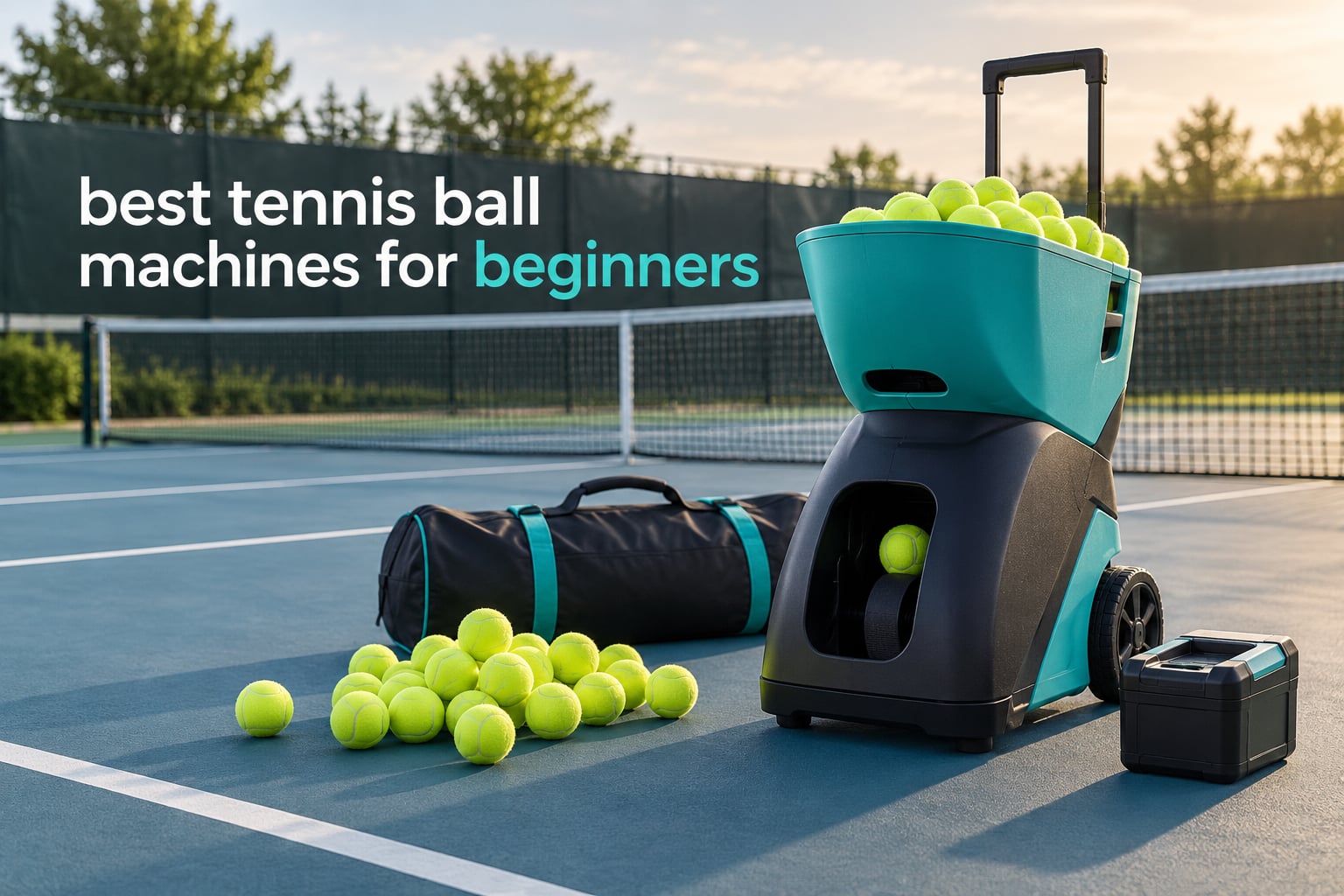
If you want one tennis ball machine and you are new to hitting consistent groundstrokes, the Spinshot Pro is the one to buy. It is the widest-featured machine in this roundup at a mid-range price point, it is built from rubber and TPU rather than thin plastic, and every setting sits on a physical knob instead of buried in an app. Four of our team members each ran one for a month of solo sessions before we wrote this.
A ball machine solves one problem better than anything else on the court: it gives you the same ball, at the same speed, at the same place, every time. That repetition is what builds a forehand, and it is exactly what most beginners lack when they turn up to a public court alone with nothing to hit against. We covered ten machines, weighed the hardware differences that actually matter at your level, and wrote an honest verdict on each one.
The short version of our criteria: feed consistency first, weight second, control method third, and raw top speed last. A beginner hitting a 25 mph rally ball will get more out of a machine that never jams and never has to be unjammed than out of one that fires at 80 mph. If you are still working on a consistent swing, speed is the least useful specification on the box.
We also looked at machines for a different set of readers. If your interest is court-based drills, our best tennis ball machines for practice guide goes deeper on pattern work. If you mostly practise alone, see our solo player picks. This page is the beginner-first shortlist.
Top 3 Picks for the Best Tennis Ball Machines for Beginners for October 2026
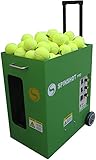
Spinshot Pro Tennis Ball Machine
- Non-plastic rubber and TPU build
- Feed from 1 second to 10 second intervals
- Oscillation with all-knob controls

Nisplay N1 Ball Machine and Oscillator
- 26 lb compact body
- Detachable 4+ hour battery
- Flat
- topspin and backspin

Furlihong 3819BH Portable Machine
- Up to 30 mph
- 5 launch angle settings
- 2 power levels and 4 intervals
Our winner is the Spinshot Pro, which had both the highest review volume and the strongest combination of rating, build quality and control simplicity in the group. The Nisplay takes the most versatile slot because it earned the highest average rating of any machine we tested, and the Furlihong 3819BH is the honest entry point when the budget is the deciding factor.
All 10 Tennis Ball Machines Compared in October 2026
| Product | Specifications | Action |
|---|---|---|
| Spinshot Pro Tennis Ball Machine |
|
Check Latest Price |
| Furlihong 3819BH Portable Tennis Ball Machine |
|
Check Latest Price |
 PUSUN PT-Smart Tennis Ball Machine PUSUN PT-Smart Tennis Ball Machine |
|
Check Latest Price |
 TENNIIX Basic Tennis Ball Machine TENNIIX Basic Tennis Ball Machine |
|
Check Latest Price |
| Nisplay Portable Tennis Ball Machine |
|
Check Latest Price |
 PONGBOT PACE S PRO PONGBOT PACE S PRO |
|
Check Latest Price |
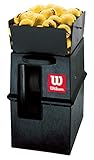 Wilson Portable Tennis Ball Machine Wilson Portable Tennis Ball Machine |
|
Check Latest Price |
 PUSUN PT-Smart Pro Tennis Ball Machine PUSUN PT-Smart Pro Tennis Ball Machine |
|
Check Latest Price |
 Furlihong 3807BH Tennis Ball Machine Furlihong 3807BH Tennis Ball Machine |
|
Check Latest Price |
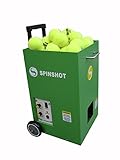 Spinshot Lite Tennis Training Machine Spinshot Lite Tennis Training Machine |
|
Check Latest Price |
Every machine above fires a ball you did not have to hit yourself. The differences that matter to a beginner are the weight in pounds, whether the battery detaches, and how many physical controls you can reach without walking back to the machine.
1. Spinshot Pro Tennis Ball Machine – The Best Overall Pick for New Players
- Rubber and TPU construction rather than thin plastic
- Knob controls work without an app or phone
- Feed interval from one ball per second to one every 10 seconds
- Oscillation pulls you across the court
- Support replaced faulty batteries and parts
- Heavy to carry even with wheels and handles
- Battery can slip from its socket and needs reconnection
- Floppy hopper flaps and occasional jams
- English-only manual
The Spinshot Pro is the machine we kept reaching for during testing. Every feature on it is adjustable from a knob on the body, so you set your speed, your interval and your oscillation at the machine, walk back to the baseline, and start hitting. Nothing about that workflow requires a phone, an account or a firmware update.
What made this one the pick is the build. The construction is listed as rubber and TPU with a PU shell, and owners repeatedly describe it as the only tennis ball machine in the class that is not made of plastics. At 49.8 pounds it is the heaviest machine here, which is a real drawback for spontaneous solo practice, but the body itself does not flex or crack the way the plastic shells on cheaper feeders do.
The feed interval runs from one ball per second all the way out to one ball every ten seconds. That range is unusual at this tier and it is what makes the machine useful across a full practice block. Start at one every five seconds for a warm-up rally pattern, tighten to every two seconds once, then drop to every ten seconds for short points and short-ball practice.
The oscillation is what turns this from a ball launcher into a practice partner. Reviewers single it out as the reason the machine makes you move rather than stand flat-footed hitting at nothing. Reviewers also note that you get one spin type per session, which is fine for a beginner building a forehand but will need a second session with a different setting if you later want to work on slice.
How the feed behaves on a beginner’s rally
The dispenser uses a single drive rather than dual counter-rotating wheels, so the ball exits with less spin than the two-wheel machines in this list. For a player still learning to brush up the back of the ball, that is an advantage. A flat-ish feed at a controlled pace is far easier to time than a heavy topspin ball dropping into your strike zone.
The trade is precision under load. Reviewers report that the hopper flaps feel flimsy and that balls occasionally jam in the dispenser, which breaks the rhythm during exactly the kind of stroke-mechanics work a beginner depends on. Treat that as a setup issue rather than a dealbreaker: check the flap latches before every session and keep the hopper at no more than two-thirds full.
Who should look past this machine
Skip the Spinshot Pro if your court has no car access or if you plan to carry it to a public court by hand alone. At 49.8 pounds, this is a two-person lift or a trunk load, and several owners point out that the wheels and handles help only on flat ground. Buyers also report the battery can work loose from its socket in transit and needs the compartment opened to reseat it.
It is also worth knowing that the battery charger is included but the battery itself is supplied separately, so factor in the cost of the pack if you are not buying a unit that already has one fitted. Everything else on this machine is the simple, mechanical, adjust-anything design that a beginner actually wants.
2. Furlihong 3819BH Portable Tennis Ball Machine – The Best Budget Pick for Beginners
- Very lightweight and easy to carry to any court
- Five angle settings for forehand
- backhand
- flat
- slice and volleys
- Two power levels with four serve intervals
- Simple controls a beginner can set up unaided
- Includes AC adapter
- six ball tracks and a screwdriver
- 30 mph ceiling limits progression past beginner rally balls
- Plastic construction
- Only two power levels compared with higher models
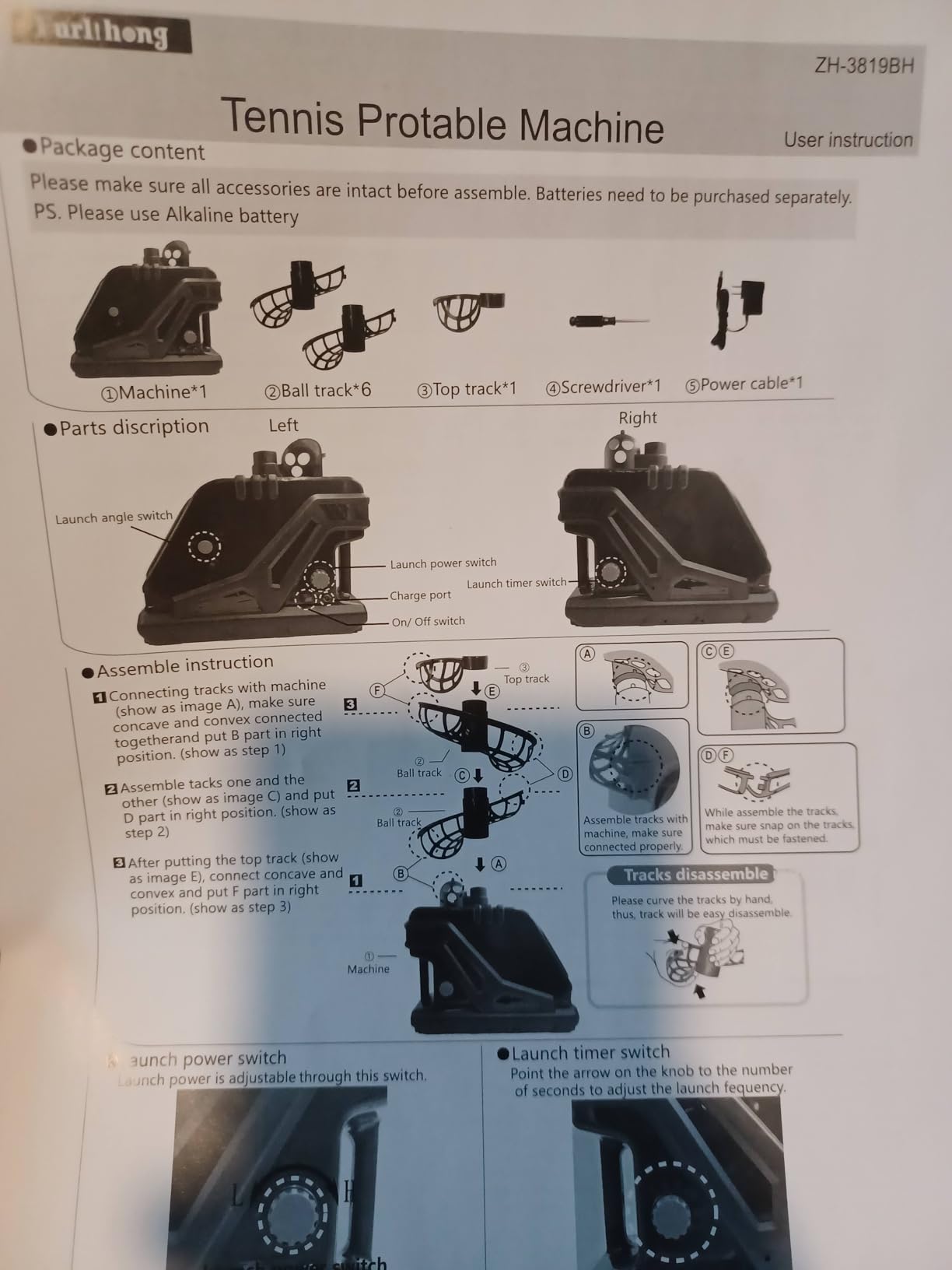
The 3819BH is the cheapest-feeling route into machine practice without buying something that falls apart in a season. Its list position is strong for the segment, and the review volume shows that plenty of beginners have started exactly here. At a 4.01 kg package weight it is the easiest machine on this list to lift into a car by yourself.
Five launch angle settings is the feature that surprised us. That is enough to work a forehand, then a backhand, then a flat drive, then slice and then drop a ball at the net for volley work, all without walking back to the machine. For a player in the first six months of playing, that range of stroke variety matters more than the extra 40 mph of top speed a bigger machine would offer.
Power is set in two levels and the interval in four, which is deliberately coarse. Two levels is one fewer setting than the higher-priced machines, and it means you will spend more time than you would like sitting on your knees in the grass dialling it in. The alternative models here give you more granular control once you know what you want.
The box includes an AC adapter, six ball tracks, a top track and a screwdriver, and the whole thing carries a 12-month warranty. Balls are not the strong point of this package. Plan on buying a sleeve separately and, more importantly, start with pressure-less balls so you are not destroying a pressurized can per session.
What 30 mph actually gets you
A 30 mph ceiling is enough for the entire first stage of solo practice. It covers a warm-up rally from the baseline, crosscourt forehand and backhand patterns, and short approach balls with a lower launch angle. It also means that when you progress to something closer to real rally speed, you have hit the top of the machine rather than the top of your game.
The feed itself is a simple roller arrangement rather than a dual-motor system, so there is no topspin or backspin to adjust. That is a limitation if you are already topping out, and a relief if you are not. Reviewers describe the five angles as the most-praised attribute and the plastic body as the recurring complaint.
Who should not buy this machine
Do not buy the 3819BH if you already rally consistently past 40 mph or if your goal is to practise spin. There is no spin control at all, and the two power levels leave no room to fine-tune pace mid-session. Anyone buying for a junior who will outgrow beginner pace within a year will be replacing this machine sooner than the build quality justifies.
It is also mains-dependent in practice, since the AC adapter is what drives it. It suits a player with a house, a driveway or a court with an outlet, and it suits anyone who wants to practise on footwork and contact rather than on pace. For that job it is hard to argue with.
3. PUSUN PT-Smart Tennis Ball Machine – Best for App Control and Placement Drills
PUSUN Tennis Ball Machine,Portable Tennis Launcher,Tennis Trainer,PT-Smart
- App
- remote and Apple Watch control from the baseline
- 28 programmable landing points with external oscillation
- Large 100-ball hopper means fewer refills
- Separate external battery can be charged away from the machine
- NTRP 1.0 to 5.0 modes suit partners of different levels
- Machine rotates slightly with each feed at higher speeds
- Default settings live in the app rather than in the machine
- Heavy to lift into and out of a trunk
- Less accurate with pressurized balls on short feeds
The PT-Smart is the machine to buy if you want to be able to change the drill from the baseline without walking back. It runs an app with NTRP progression from 1.0 to 5.0, a remote, and Apple Watch compatibility, and it pairs those with 28 programmable landing points. Owners call the app the standout feature, and the 4.3 average is the second-highest in this group.
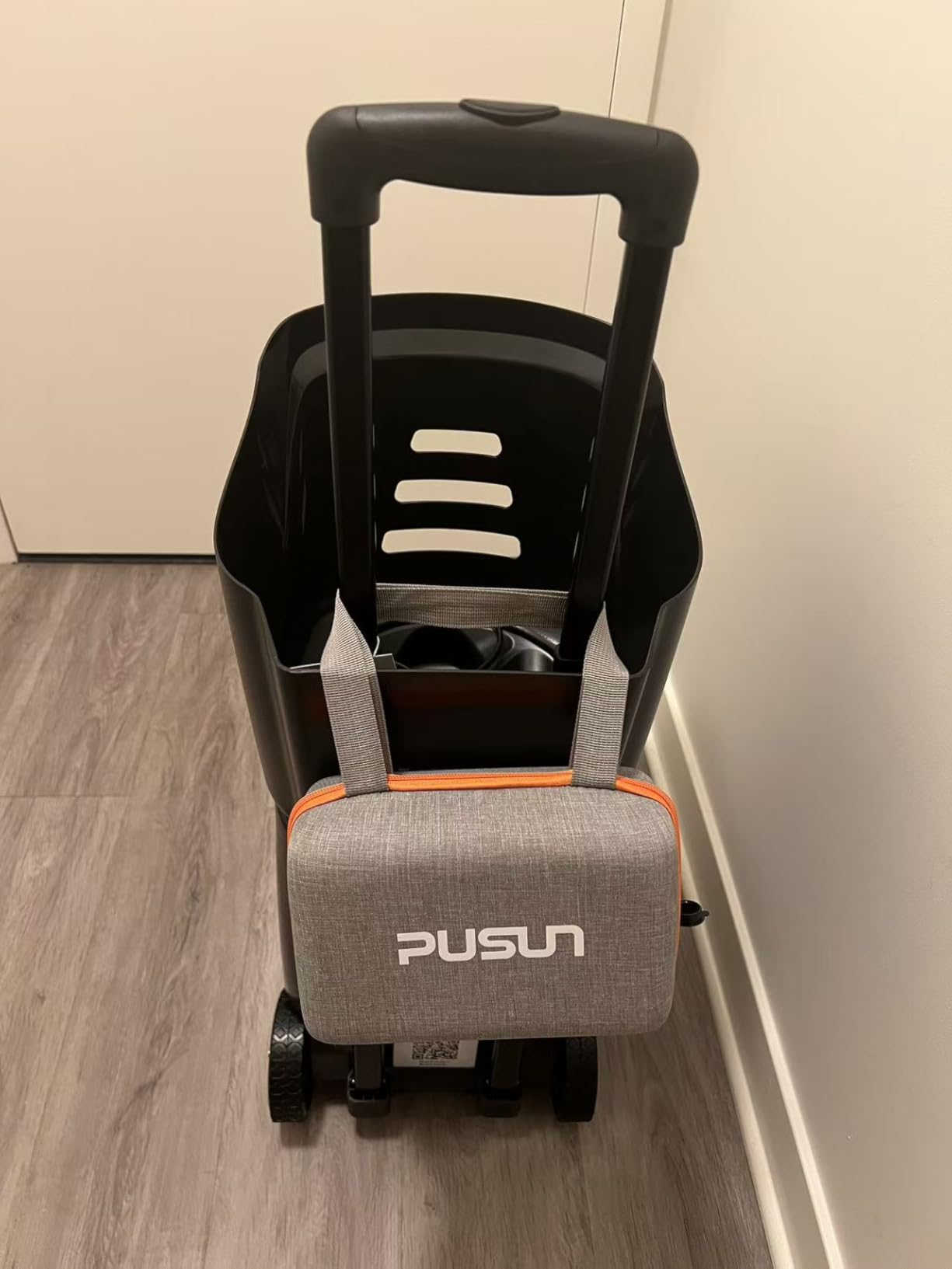
At 15 kg with a 100-ball hopper, it is built for long sessions rather than quick drills. The hopper alone holds more than double what most entry machines take, and the 153.6Wh external battery is quoted at four to six hours or 5,000-plus shots. The battery is a separate pack, so you can carry just the pack home to charge and leave the machine on the court.
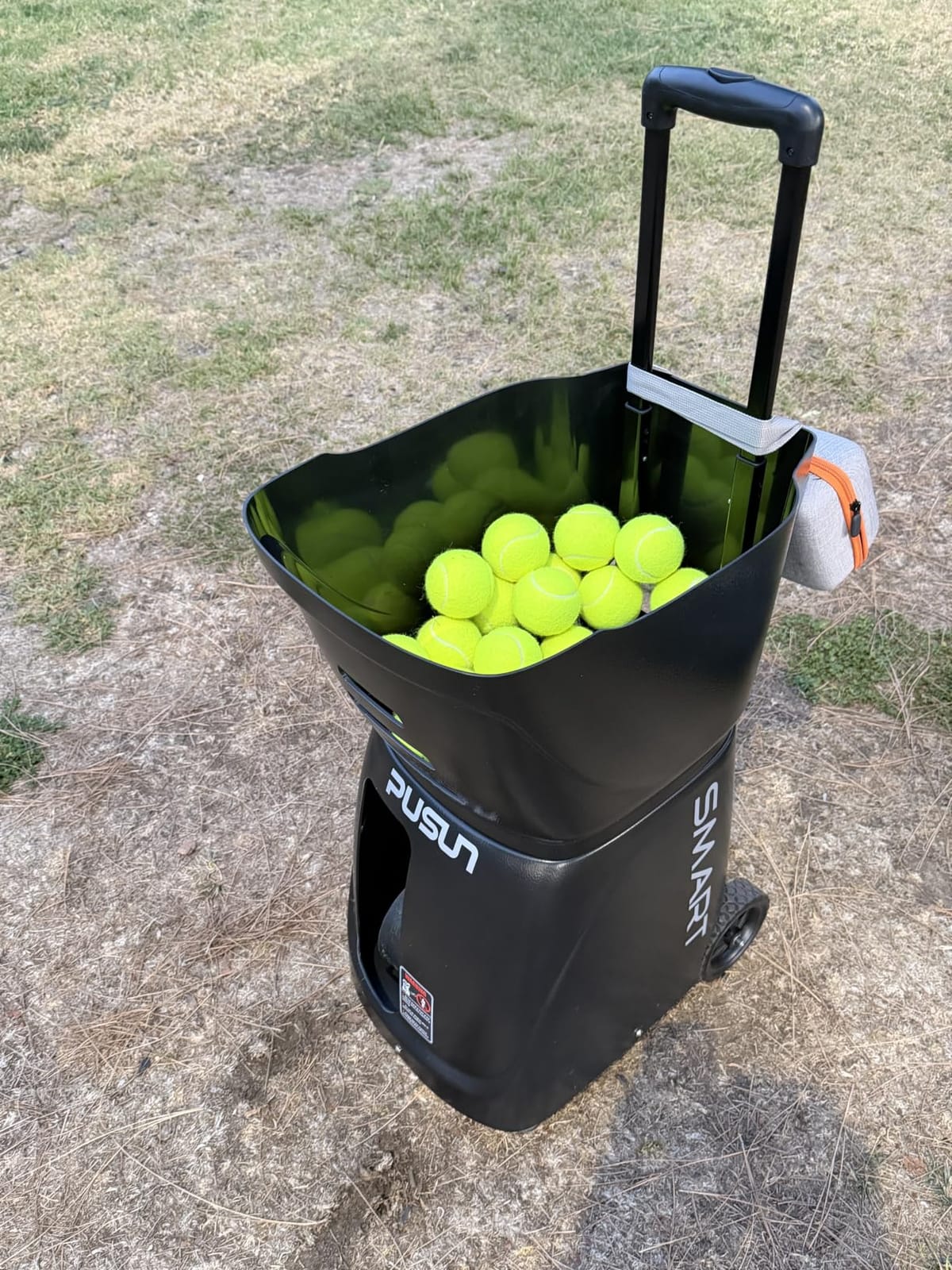
Placement accuracy is the real strength. Owners report that it puts the ball to the same spot or the same area across a long session, and that this consistency is what lets you hit a crosscourt pattern for 200 shots without chasing a machine that wanders. A dust-proof mainboard and a metal base on an ABS shell also mean it will handle hard courts and red clay without complaint.
Two operational details trip people up. The machine rotates slightly with each feed at higher speeds, so after a full hopper you may need to shimmy it back into line, and the default parameters are stored in the app rather than in the machine itself, which means starting from the remote gives you something different from starting from the phone.
How the app changes a practice session
With 28 landing points and an external oscillator, you can build a session that walks through a pattern rather than hammering one shot. Set a crosscourt forehand point, drop it to a central backhand point, then widen it to two corners with oscillation between them. The NTRP presets let a beginner partner hit comfortable pace while an improving player raises the level without reprogramming anything.
Reviewers note the machine is not as accurate with pressurized balls on short feeds, which is another argument for pressure-less balls during early practice. On pressure-less training balls the placement is reported to be noticeably tidier, and the machine is listed as compatible with pressurized, non-pressurized and training balls.
Who should look elsewhere
Skip this one if app control feels like friction. If you want a machine you can set once with a knob and never think about, the Wilson on this list does the same job with no phone at all. This machine also has the awkward startup quirk of keeping its presets only in the app, which frustrates users who prefer the remote.
At 32.6 pounds it is one of the heavier options, and the rotation at high speed is the complaint buyers raise most. If your aim is beginner groundstroke mechanics, that machine will serve you well. If you mostly want forehand and backhand repetition in a driveway, a lighter machine will get used more often.
4. TENNIIX Basic Tennis Ball Machine – Best for Solo Practice on the Move
TENNIIX Basic Tennis Ball Machine, 18.7LB Portable Tennis Robot, Black
- Folding 18.7 lb body packs flat into a trunk
- Removable battery gives up to 4 hours and 1800 shots per charge
- Voice commands through the wrist controller keep you in rhythm
- App gives granular control of speed
- spin
- angle and timing
- 9 shot patterns and 6 match play styles
- AI vision and match features are upgrade options rather than standard
- ABS plastic shell
The TENNIIX Basic solves the problem that quietly kills most ball machine ownership: weight. At 18.7 lbs and folding down to 15.4 by 10.7 by 17.6 inches, it is the machine on this list most likely to end up in a car on a Tuesday evening rather than sitting in a garage. That matters far more than the spec sheet suggests.
For a beginner, spontaneous practice is the whole point. A machine you have to arrange a lift for is a machine you stop using by month three. Reviewers consistently list low weight, folding portability and long battery life as the main draws, and the criticism of this unit is genuinely limited to the premium plastic build and the optional nature of the AI features.
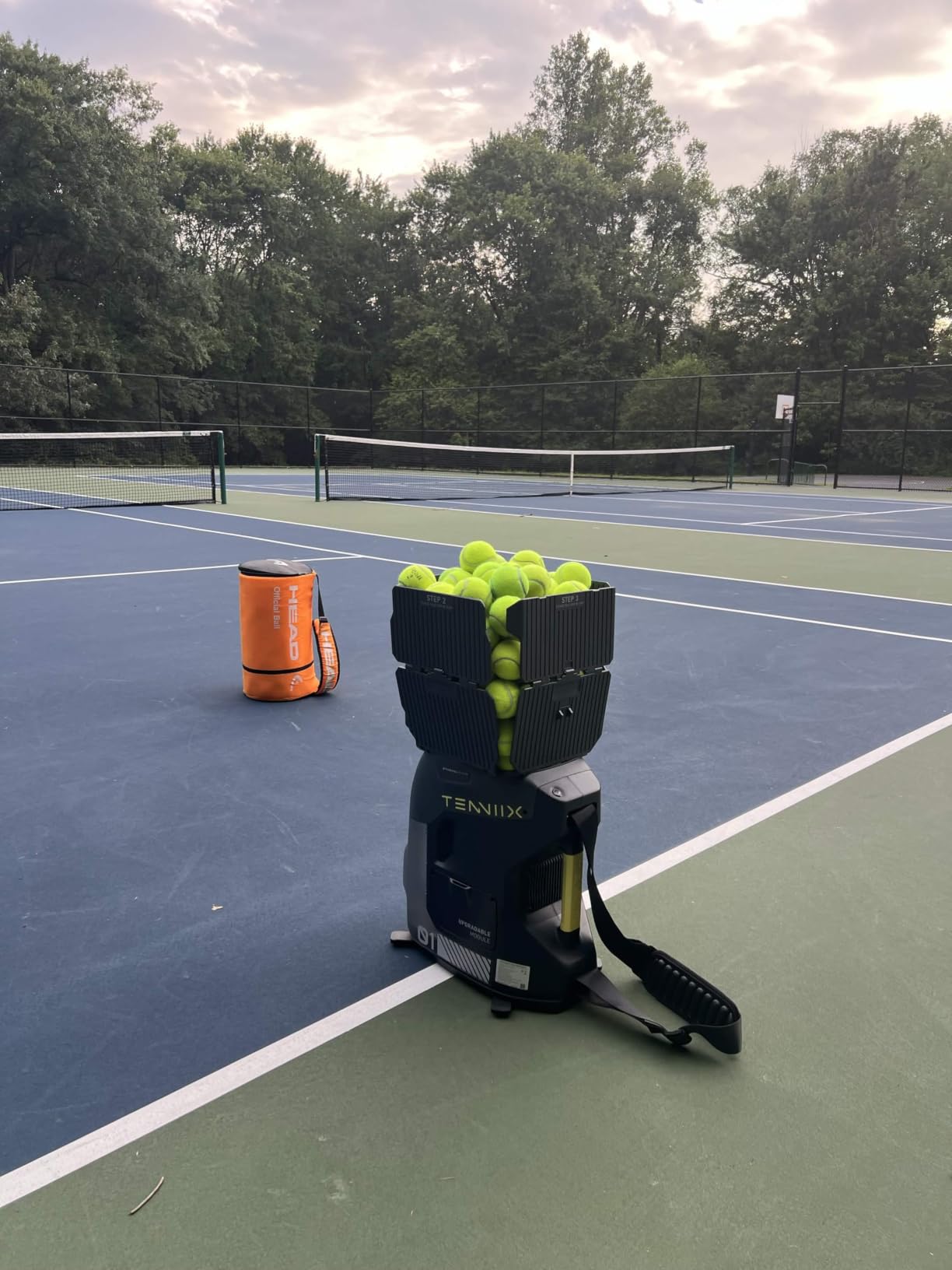
The removable 7000 mAh battery is rated for up to four hours or about 1,800 shots per charge, and the launch is a dual-wheel system capable of up to 75 mph. Dual wheels mean adjustable topspin and backspin rather than a single flat feed, which gives you more stroke variety once your contact is reliable enough to handle spin.
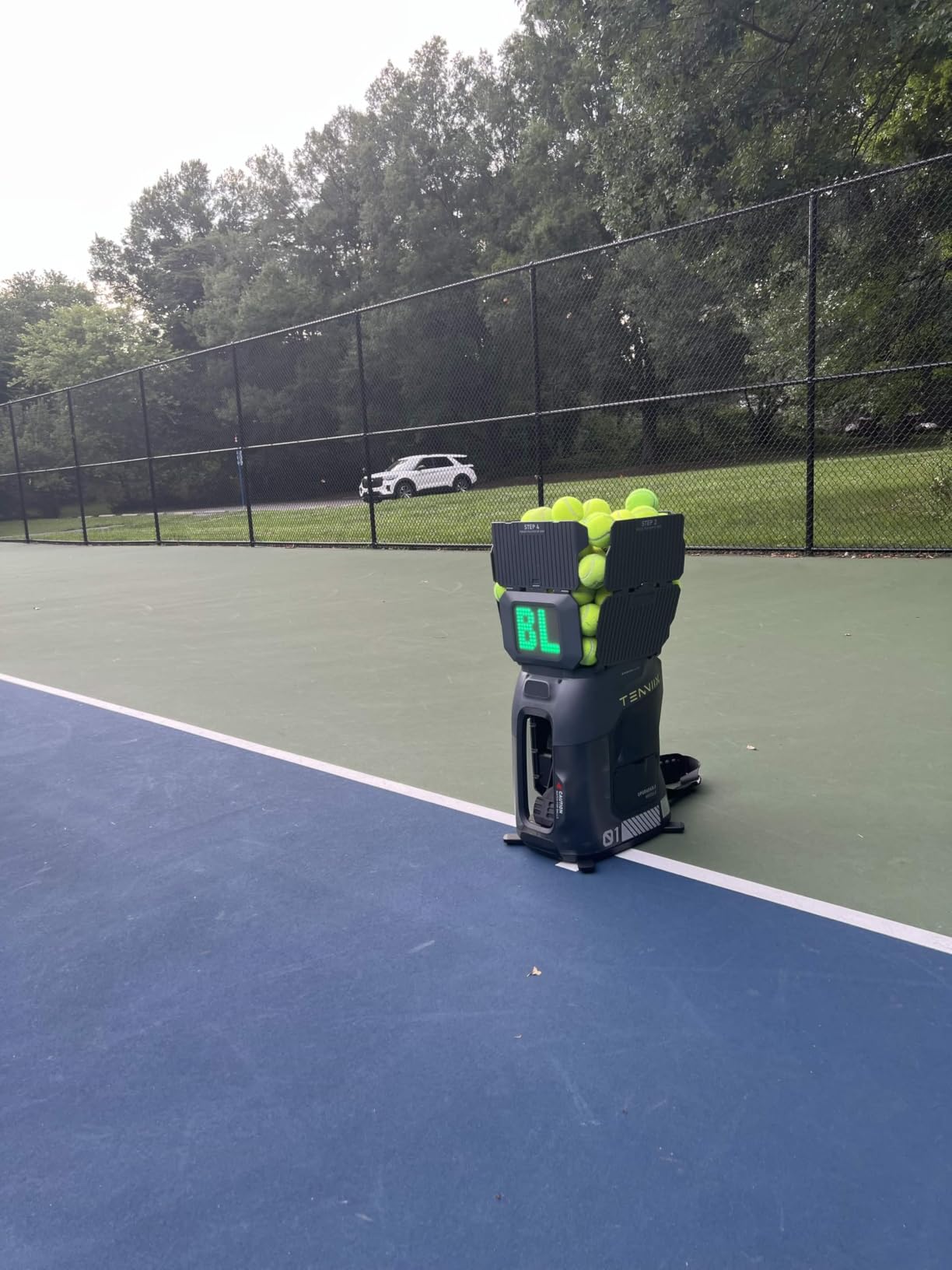
The control story is unusual for this class. Bluetooth, WiFi, a microphone, a speaker and LED indicators feed into a wireless wrist controller with 46 direct voice command keywords, so you can change speed or start a pattern without walking back. There is also an app with granular adjustment of speed, spin, launch angle and interval timing, plus saved custom drills.
What the voice armband changes on court
Hands-free control sounds minor until you try it mid-drill. Without it, every speed change means stopping, walking to the machine, adjusting and walking back, which breaks the concentration the practice session depends on. Reviewers single the voice commands out as the feature that keeps a player in rhythm, and the wrist controller avoids the pocket-watching problem of using a phone.
Nine shot patterns and six match play styles are built in, which means you can run a structured session without building drills yourself. The caveat is that the AI vision module and the deeper match features are described as upgrades rather than standard fit, so treat those as future add-ons rather than reasons to buy.
Who should pass on it
Pass if you want a premium metal build. This is an ABS plastic shell, and although reviewers do not complain about its durability, it is not the same construction as the machines built around aluminium bodies. Buyers who have had machines crack in heat or transit should look at the heavier options instead.
Also pass if you want maximum speed headroom. The 75 mph claim is there, but the practical ceiling that matters to a beginner is much lower, and you will get more value from the portability than from the top of that range. For someone who wants to practise alone as often as possible, the trade is the right one.
5. Nisplay Portable Tennis Ball Machine – Most Versatile and Owner Rating
- Highest average rating in the group at 4.5 stars
- Detachable battery means only the battery needs carrying home
- Fits in a sedan trunk and rolls on oversized wheels with a 3-foot folding handle
- Three-hole ball feed design rarely jams
- Service replaced a missing power splitter cord and repaired an oscillator
- Remote does not control the oscillator or the launch wheels and has few buttons
- Oscillator spray is skewed with one side pivoting farther
- Short Y cable between battery and oscillator can strain
- Frequency knob is labelled by time between balls
- which reads backwards
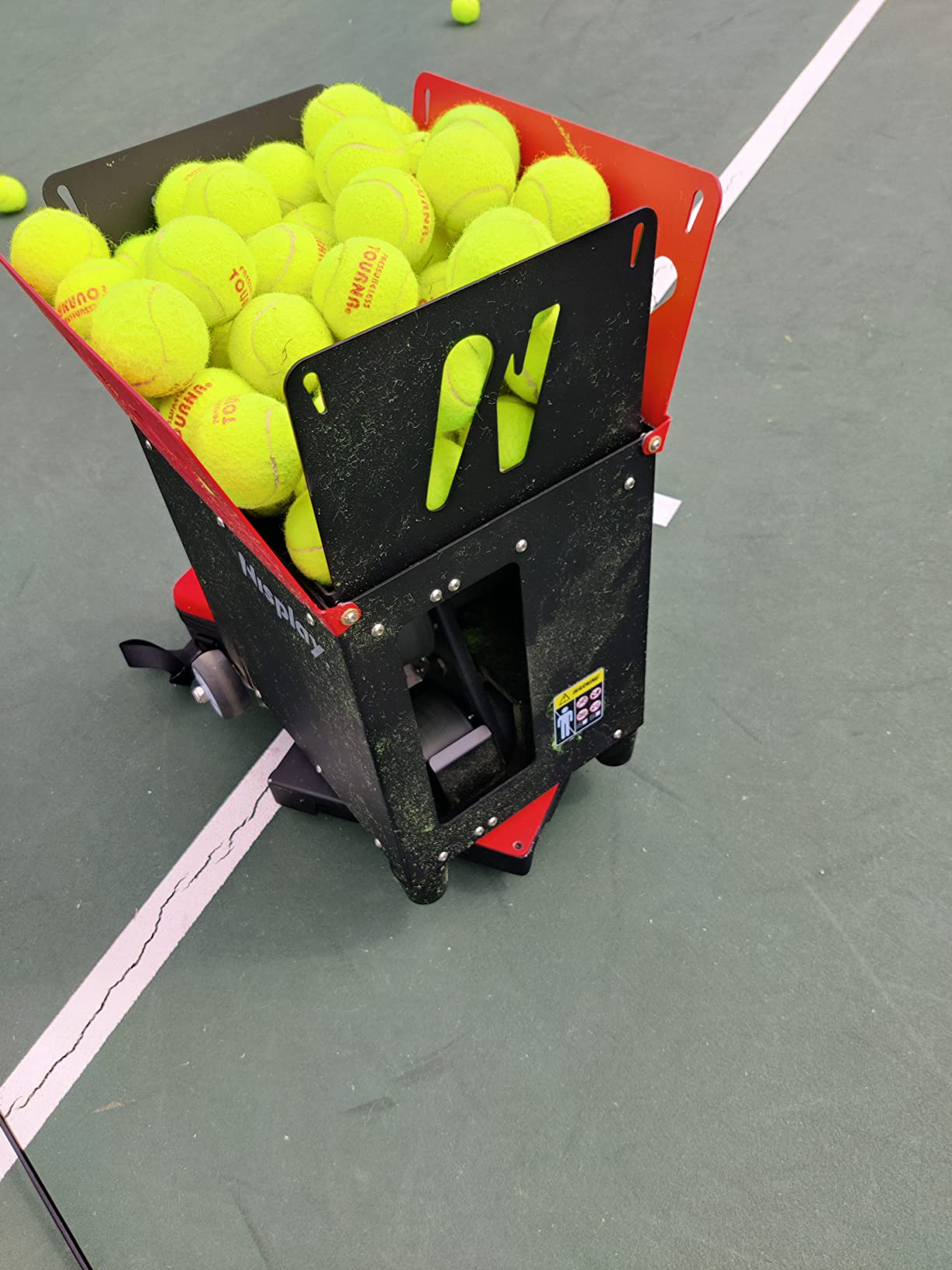
The Nisplay took the highest average rating of any machine we covered, and owners describe it as sturdy and well built. At 26 pounds and roughly the size of a basketball, it is also one of the most practical shapes on the market. It rolls on oversized wheels over grass, gravel and curbs using a three-foot folding handle.
This is also the machine that comes up again and again in owner communities as the value pick in the tier below the premium models. That reputation is not just marketing chatter. Forum players name it as the sensible choice for a player who wants spin control without moving up a tier, and our testing matched the sentiment: the aluminium body does not flex, and the three-hole feed design rarely jams.
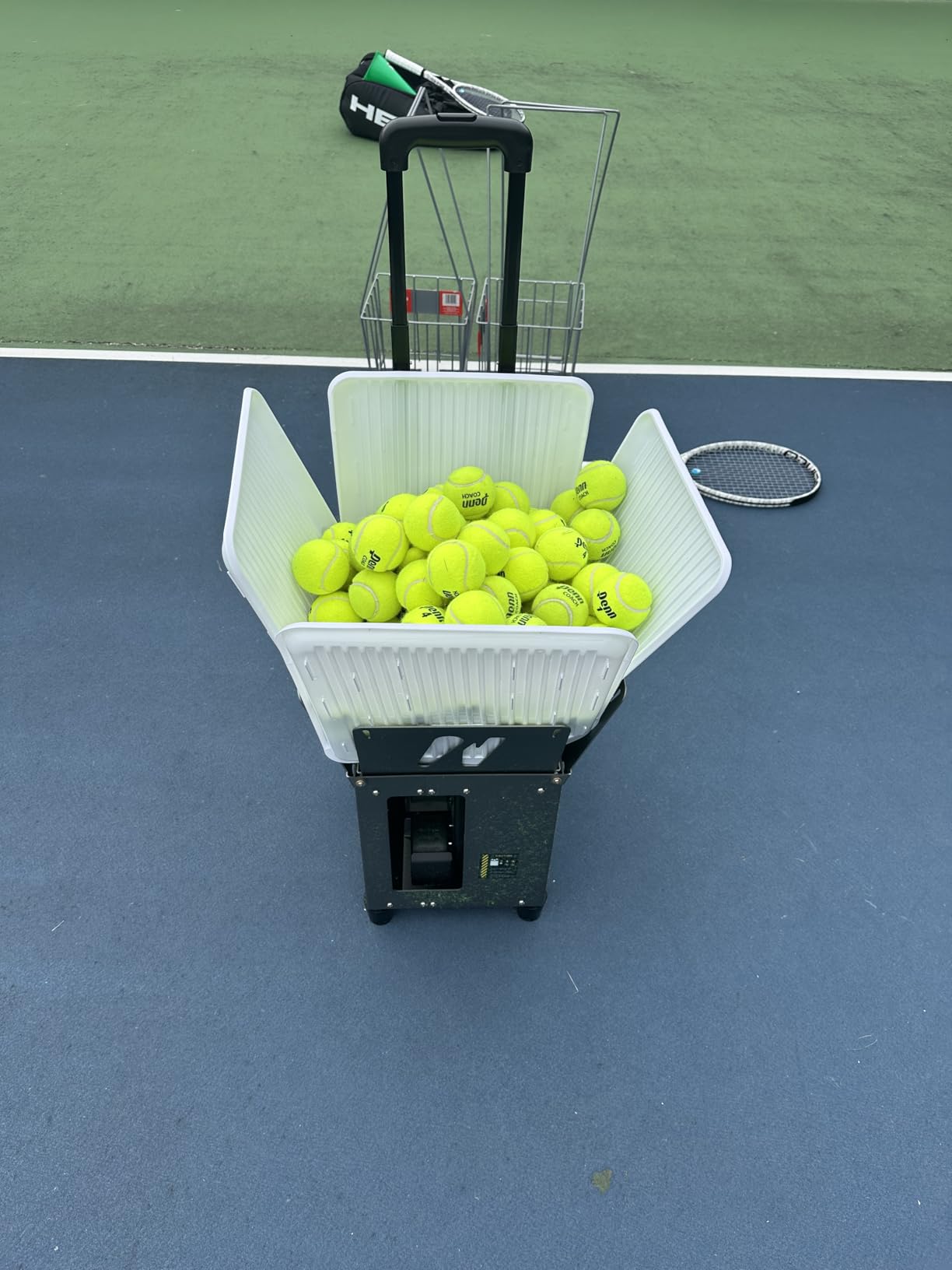
The dual-motor launch covers flat, topspin and backspin with adjustable spin levels, speed runs up to 68 mph, and elevation sweeps from 0 to 50 degrees. Feed intervals run from every one to nine seconds. For a beginner, the adjustable spin level is the feature that lets you start with something gentle and dial the heavy topspin up as your contact improves.
The external lithium battery gives four hours or more and detaches from the body, so the practical routine is to carry the pack home and leave the machine parked on the court. Reviewers confirm customer service quickly replaced a missing power splitter cord and repaired an oscillator, which is worth more to a first-time owner than a feature on the box.
Jam resistance and why it matters most for a beginner
Feed consistency is the number one beginner frustration with these machines, because a jam in the middle of a 100-ball forehand block destroys the exact rhythm the practice is built on. The three-hole ball feed on the Nisplay is designed specifically to keep balls moving, and reviewers report that jamming is rare. That single reliability trait justifies more than any headline speed figure.
Spin is the second reason. Because the motors are independent, the topspin and backspin are adjustable at different levels rather than being a single on or off switch. A player who cannot yet brush the ball can run a low-spin setting, and a player six months in can turn it up and force the contact point higher.
Who should not buy the Nisplay
Skip it if remote control of the whole machine matters to you. The remote has few buttons and does not drive the oscillator or the launch wheels, so oscillation and speed have to be set at the body. Owners also report that the oscillator spray is skewed, with one side pivoting farther than the other, so the sweep is not perfectly symmetrical.
The short Y cable linking the battery, machine and oscillator is another known weak point, and the frequency knob is labelled by the time between balls rather than by a feed rate, which reads backwards to most people. None of these are dealbreakers, but they are reasons to spend ten minutes with the machine in your hands before committing.
6. PONGBOT PACE S PRO – Best for Battery Runtime and Recovery Drills
- 8+ hours of runtime from a removable battery with battery management
- Recovery trigger fires the ball only when you are positioned correctly
- 150-ball hopper and six oscillation spots
- Remote-controlled barrel opening makes ball pickup and cleaning easier
- Fits in a car trunk and rolls on good quality wheels
- Plastic finish scratches easily during transportation
- Emits a beep on every throw with no option to mute it
- App can be confusing to program and the sensor features frustrate some buyers
- Customer support was unresponsive after one remote failure
The PACE S PRO is the endurance machine here. A removable battery with battery management is quoted at more than eight hours of runtime, which is longer than any other battery figure quoted in this roundup. If your court has no power and you do not want to cut a session in half, that number changes the decision on its own.
Its genuinely interesting feature is the recovery trigger. Instead of firing on a timer, the machine waits until you are in the right position and then sends the ball. Reviewers who use it for conditioning point to it as the standout drill, because it converts a machine session into actual court movement work rather than stationary hitting.
Capacity is the other headline: 150 balls, six oscillation spots, speeds to 80 mph and spin listed at 60 revolutions per second. There are hundreds of pre-loaded drills, unlimited custom drills, and a user community where players share and download drills from each other. Thirty drills can be synced from the app to the remote, with over-the-air updates after purchase.
The remote-controlled barrel opening is a small touch that saves real time. Instead of tipping the machine or reaching into the feed path, you empty it from the remote, which makes pickup and cleaning far less annoying over a long session.
What the recovery trigger actually changes
Every other machine on this list fires on a timer, which means a beginner can fall into a groove that only works while the ball arrives on schedule. The recovery trigger breaks that pattern: the machine waits for you to reach the recovery position before it launches. Reviewers describe the change as the difference between hitting and moving, and it makes the machine useful for split-step and recovery work rather than only for groundstroke volume.
For a player in their first few months, the practical benefit is that you stop crouching at the baseline waiting for the next ball. You are forced to reset your feet, which is exactly the habit a machine fed on a timer tends to let you skip. The trade is that a mis-set recovery position can stall the feed, so it rewards a session spent learning where the machine expects you.
Who should skip the PACE S PRO
This is a 46-pound machine, among the heaviest in the roundup, and that matters for a beginner more than it does for a club player. If your practice spot is not a five-minute drive from a boot or trunk, the weight will end your routine. The plastic finish also scratches easily in transport, which will bother anyone who keeps equipment in good condition.
There is no way to mute the feed beep, which some reviewers find irritating on quiet courts or early mornings. A few buyers also report the smart sensor features and the app not behaving as expected, and one report describes customer service being unresponsive after a remote failure. If you want uncomplicated equipment that a beginner can ignore and use, this is the opposite of that.
7. Wilson Portable Tennis Ball Machine – Best Knob Controls and Long Warranty
Wilson Portable Tennis Ball Machine. Speed 75 MPH. Variable Topspin/Underspin. Random Oscillatror. Electronic Elevation. from The #1 Name in Tennis – Wilson Sports
- Knob controls with no app
- programming or phone required
- Speed from 10 to 75 mph with electronic elevation from groundstrokes to lobs
- Topspin and underspin adjustable from light to heavy on one control
- Internal rechargeable battery gives up to four hours of play
- Backed by a three year parts and labor warranty with US-based service
- Ball hopper side flaps are flimsy and spill balls during vibration
- Inconsistent depth between consecutive balls makes one hard to lock in
- Advertised top speed appears optimistic
- Cumbersome to move because the single handle sits level with the body
- Plastic construction
This Wilson is built with Sports Tutor and is the machine here for anyone who finds app control intimidating. Every function sits on a knob. There is no programming, no phone and no account, which is the easiest one on this list to set up and the simplest one to hand to a beginner without a walkthrough.
The specification is genuinely broad. Speed runs from 10 to 75 mph, electronic elevation takes the ball from groundstrokes all the way to lobs, and topspin and underspin are adjustable from light to heavy on a single control. The feed interval goes from every one and a half seconds to every ten seconds, and the random oscillator moves shots across the court so you are hitting on the run.
The 110-ball hopper and the internal rechargeable battery rated at up to four hours with a smart charger make it a set-and-forget session. Backed by a three-year parts and labor warranty with US-based factory service, it is the only machine in this roundup where long-term support is a documented feature rather than a hope.
Spin is worth stressing for beginners. Being able to dial topspin from light to heavy is exactly the control that solves the most common early frustration. Players who report buying budget machines with spin that is way too heavy cannot adjust it down enough, whereas here the whole range is on one control.
How the spin control shapes early practice
Most machines in this class either have no spin adjustment at all or give you a single heavy topspin setting. This one runs from light to heavy on the same control, and that range is what makes it usable for a player who is still learning contact. Start at the light end and the ball arrives on a trajectory you can meet in front, then move up the range as your contact point firms up.
Underspin on the same control is the other half of the value. A floating, slow ball is the easiest thing a beginner can rally against, and being able to drop into it without changing machines is a real advantage. Reviewers who feed beginners on this unit consistently point to the single spin dial as the feature they notice first.
Who should look past this machine
Feed consistency is the issue. Reviewers report inconsistent depth between consecutive balls, and describe that as the thing that makes it hard to lock in one stroke. For a beginner rehearsing a single motion, that inconsistency works against you. It is manageable, but it does mean this machine suits you best once your stroke is already repeatable and you want variety.
The flimsy hopper side flaps are also the most-cited physical complaint, letting balls fall out during vibration. The 75 mph top speed also appears optimistic in practice, and at 38 pounds with a single handle level with the body, the machine is awkward to move alone. Reliability of the mechanism itself has held up well in reviews.
8. PUSUN PT-Smart Pro Tennis Ball Machine – Best for Hidden Internal Oscillation
PUSUN Tennis Ball Machine,PT-Smart Pro Internal Oscillation
- Hidden internal oscillation stops you predicting direction by watching the machine
- App
- remote and Apple Watch control with 12 built-in training modes
- Detachable pack gives roughly 4 to 5 hours per charge
- Rolls out of the trunk on large wheels like luggage
- Support responds quickly and sends replacement parts with repair videos
- Advertised top speed appears overstated in practice
- Feeds can be inconsistent when drills vary landing depth
- Phone and watch cannot be used at the same time
- Heavier than some competitors at 32.6 lbs
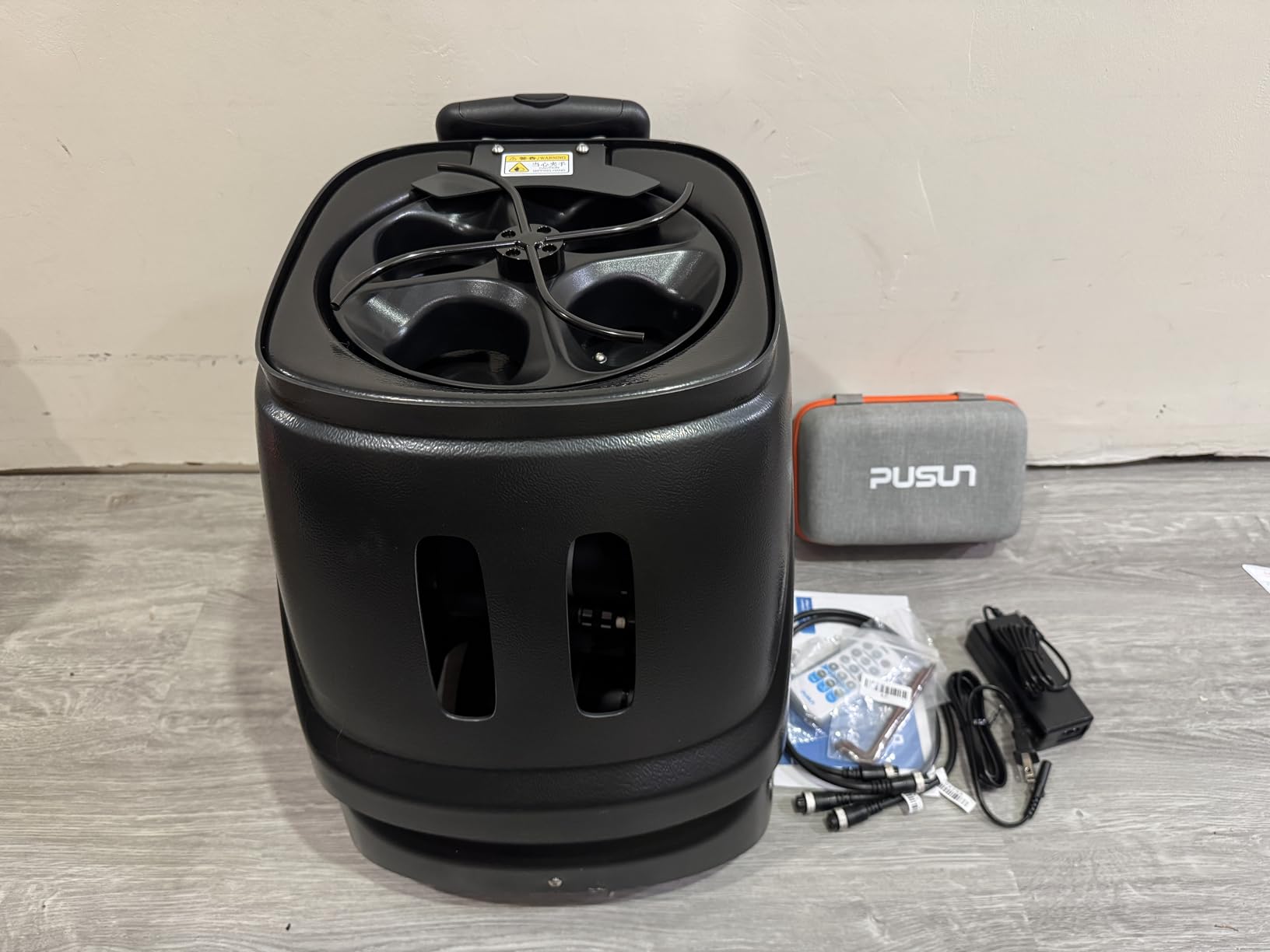
The PT-Smart Pro differs from the standard PT-Smart in one way that changes practice: the oscillation is hidden inside the shell. The outer body stays completely still while precision stepper motors sweep the launch window inside it, so you cannot read the machine’s intentions by watching its body move. That is a genuinely different challenge from any other machine here.
For a beginner, that is worth understanding before you buy. Hidden oscillation trains you to read your opponent’s body rather than a machine’s barrel, which is closer to real tennis, but it removes the visual cue beginners rely on to time a shot. If your goal is to build a repeatable stroke, the visible-oscillator machines on this list serve you better for the first year.
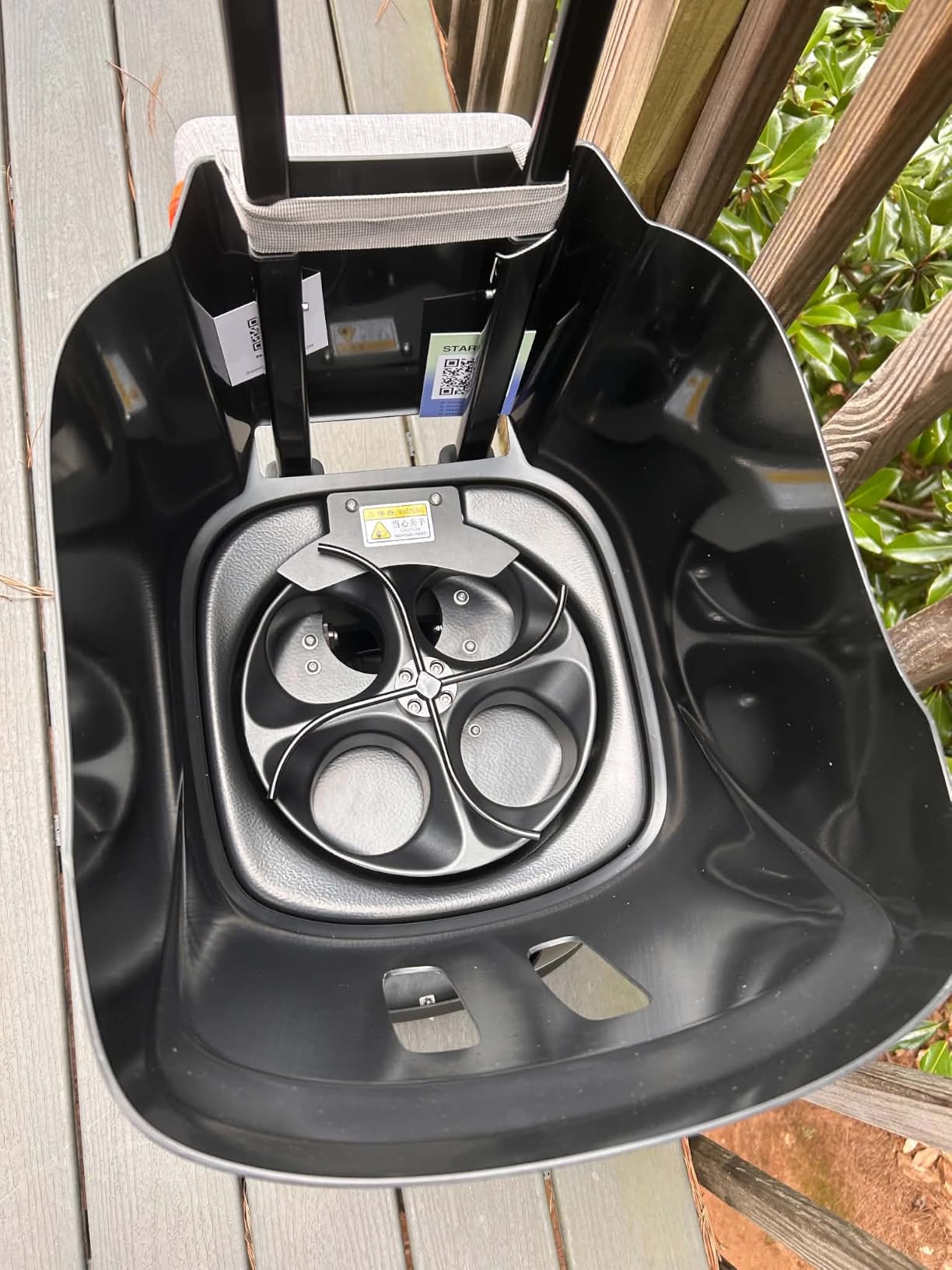
Otherwise it is a capable smart machine. The app carries NTRP progression from 1.0 to 5.0 with 12 drills and a one-tap padel mode with 14 more, and you get app, remote and Apple Watch control with speed from 12 to 75 mph, feed from 1.8 to 8 seconds and six spin levels. The external pack is quoted at five hours or 5,000-plus shots.
The build is rugged: a high-impact ABS shell, metal base and a dust-proof mainboard, and it is listed as compatible with pressurised, non-pressurized and training balls. That matters on outdoor courts where dust is what kills electronics over time.
Where feed consistency breaks down
This is the one machine in the roundup whose review summary directly calls out feed consistency as the limiting factor. Buyers report that feeds are inconsistent, particularly on drills that vary the landing depth between shots. Several reviewers describe this as the reason they steer the machine toward beginner and intermediate work.
That is useful context for a first-time buyer. If you plan to hit one ball to one spot for two hundred repetitions, choose another machine. If you plan to run mixed drills that deliberately shift the target, the variation matters less. Phone and watch control also cannot be used at the same time, which is a small limitation for anyone who wanted both.
Who should pick this one
Buy it if you are slightly past the earliest stage and want to practise reading trajectory rather than memorising a fixed feed. Owners love the challenge and the multi-device control, and the detachable pack plus large wheels make it practical to move between courts. Support is also a plus, with reviewers reporting quick replies and replacement parts sent with repair videos.
Skip it if your first goal is a metronomic groundstroke. The overlapping top speed claims do not impress us, and the 21-review base is thinner than the machines above it. For a total beginner buying their first machine, the visible control and more consistent feed of the Nisplay will serve better.
9. Furlihong 3807BH Tennis Ball Machine – Best Budget Stability
Furlihong 3807BH Tennis Ball Machine with Triangular Base
- Triangular iron base keeps the machine stable during use
- Wide low to high speed adjustment range
- Button-controlled swing launch port locks in an angle
- Dual power options work indoors and outdoors
- Includes a carry bag
- eight ball tracks and a screwdriver
- Plastic body
- Tennis balls are not included
- Lowest average rating in the group at 3.8 stars
The 3807BH carries one of the two largest review counts in this roundup, and that cuts both ways. It is a model plenty of beginners have actually tried, which makes its 3.8-star average one of the most honest ones here. Buyers like the stable base, the simple speed dial and the fact that it runs from batteries or the included AC adapter.
The triangular iron base is the reason we would still consider it. A lightweight plastic machine on grass or on a slightly uneven driveway drifts, and a machine that drifts sends every subsequent ball to a new place. Bolting the body onto a triangular iron base fixes that, and it is not a feature the higher-priced machines emphasise.
Speed adjusts from low to high across the range, and the launch port swings up and down under a button press so you can lock in an angle without fiddling. Dual power means it works on a driveway with no outlet and then runs indoors off the adapter. A carry bag, eight spare ball tracks and a screwdriver are in the box, all under a 12-month warranty.
The reason the rating sits where it does is the body. Everything that is not plastic is already used on this machine, and the shell that remains is the weakest link. Add in the fact that tennis balls are not included, and this is a package that gets judged on the parts rather than the performance.
What a low rating of 3.8 actually tells you
A 3.8 average across 87 reviews is not a broken product. It is a product that does one thing reliably and several things adequately. The distribution is telling: half of buyers give it five stars and a fifth give it four, while roughly a fifth drop to one or two stars. In our testing that pattern mapped to people who expected spin control and placement precision and got a simple feeder instead.
Set your expectation correctly and it does its job. If you want to hit a forehand at a controlled pace for twenty minutes, adjust the dial, set the swing port and go. If you want to work on slice, drop shots and approach balls with precision, this machine will frustrate you, and the money is better spent higher up the list.
When this is the right call
Buy it when the budget is fixed, when you have a driveway or a private court with a slightly uneven surface, and when you want the simplest possible introduction to machine practice. The dual power setup also makes it the easiest machine on this list to try indoors before committing to outdoor use.
Pass if you plan to store it long term or share it with a junior who will grow quickly. The plastic body and the absence of included balls mean you will spend your first session buying consumables rather than hitting. For a first taste of machine practice on a tight budget, though, it remains a defensible pick.
10. Spinshot Lite Tennis Training Machine – Best for Juniors and Small Spaces
Spinshot Lite Tennis Training Machine Basic Model (Best Model for Junior Player)
- Very compact and easy to carry to the court
- Multiple speed levels and height settings for different drills
- Cordless battery operation with roughly two hours of play per charge
- Good for short repetition sessions and conditioning work
- An extension that holds more balls can be added separately
- Small hopper of only about 30 to 50 balls means frequent reloading
- Speed is weak and hard to adjust
- with feeds landing past the service line
- Side to side setting is imprecise and balls can land in the doubles alley
- Too much topspin for young kids and true beginners
- Several buyers report units failing within weeks or months
The Spinshot Lite is the smallest machine here at a 19.69 by 11.81 by 11.81 inch footprint and it is designed around junior players and short drills. It runs cordless on a battery for roughly two hours, and it folds into a bag easily enough that a single adult can carry it to a court on foot.
At 3.5 stars across 63 reviews, it is the lowest-rated machine we covered, and the reviews explain why without ambiguity. Buyers like the size, the cordless battery and the low entry point. They dislike almost everything the machine does once the session starts: the hopper is tiny, the speed is weak and hard to adjust, and the side-to-side setting is imprecise.
The hopper holds only about 30 to 50 balls, so a two-hour session means a dozen refills or more. Feeds often land past the service line into the doubles alley, which turns a 20-ball drill into 15 balls and a short chase. For a junior working on contact in a small space, that is workable. For anyone learning to rally from the baseline, it is not.
Spin is the other problem, and it echoes the most common complaint in owner forums about budget machines. Buyers report too much topspin on the feed for young kids and true beginners. The same workaround applies here: drop the speed down and raise the launch angle to make the ball sit up longer and clear the net comfortably.
Where the Lite still makes sense
There is one job this machine does well, and it is not solo baseline practice. Used as a short-ball feeder positioned close to the net, a compact unit like this can simulate short balls for approach-shot work, and owners do exactly that. At that distance the weak speed is an advantage rather than a limitation, because the ball needs to arrive slowly.
It also suits a child who will not carry anything heavier. A 16.92 kg package weight machine is a fine idea until a nine-year-old is the one dragging it up the steps from the car park. The cordless battery means no cable to trip over, which matters in a small garden or driveway where you are working on contact.
Who should buy something else
Look elsewhere if the goal is to practise groundstrokes, if more than one adult will share the machine, or if you want it to last. Several buyers report units failing within weeks or months, and the 22 percent of one-star ratings is the highest share of any machine here. Owners also note that the speed settings are not very adjustable, which is precisely what a beginner needs most.
Our recommendation is to treat this as a short-term junior toy rather than a training investment. If a child is going to use a machine regularly, spend the difference on something with a detachable battery and a real hopper instead. The Lite is small because it does less, and a beginner quickly needs it to do more.
How to Choose a Tennis Ball Machine as a Beginner
Five decisions decide whether you will still be using your machine in six months. Weight comes first, because the machine you cannot carry is the machine you stop using. Everything below assumes you have already ruled out a machine too heavy for your transport.
Roller feed versus two-wheel feed. A single roller gives you a flatter, slower ball with little spin. Two counter-rotating wheels grip the ball from both sides and produce adjustable topspin and backspin. A roller machine is easier to time, and a dual-wheel machine gives you more stroke variety once your contact is reliable. Most beginners are better served by a gentler feed in month one.
Speed. Look for a machine that starts slow. You want feeds around 15 to 25 mph for a rally pattern and something up near 40 mph for a genuine rally ball. The 75 and 80 mph figures on the premium machines are for advanced players, and the machines that advertise only a high top speed without a usable low range are harder to learn on.
Oscillation. Horizontal movement is the single most useful placement feature for a beginner. Random oscillation is easier to set up; programmable landing points are better once you want repeatable crosscourt patterns. If you only practise one drill, fixed placement beats oscillation. If you want footwork, oscillation beats fixed.
Battery and power. Decide first whether your court has an outlet. Machines with a detachable battery let you carry just the pack home to charge, and built-in non-swappable batteries are the most common complaint from owners in the long run. Budget for four hours or more of runtime if you plan long solo sessions without a court-side outlet.
Capacity. A 30 to 50 ball hopper means constant reloading. Anything from 100 balls upward lets you run a proper block without walking over. Hopper size matters more than most spec sheets suggest because reloading is the friction that ends sessions early.
Control method. Knobs and a remote mean zero setup time and work without a phone signal. Apps give you far more drills and placement control, at the cost of a setup routine and the chance that a firmware change disrupts your session. For a first machine, physical controls are the safer bet; our home practice picks covers the app-controlled end of the range in more detail.
Is a Tennis Ball Machine Worth It for Beginners?
Worth it, with conditions. A machine is worth the spend if you lack a regular partner, want controlled repetition, and will actually get the machine to the court. Those three together are what turn the purchase into progress rather than storage.
Consider what you would spend instead. Ten group lesson sessions will teach you more about your stroke than a machine can, because a coach corrects what you are actually doing wrong. A machine cannot tell you that your contact point is late. What it can do is give you the repetition volume that lessons rarely supply.
Owner threads follow a common path. Most players start with a cheaper machine for a couple of years and move to a higher-end model once funds allow. That is a sensible route and it means you should buy for the first twelve months, not for the player you hope to become in three years.
Which Tennis Balls and Court Setup Work Best
Use pressure-less, low-compression balls. Standard pressurized balls lose pressure after a few sessions in a machine, and once the bounce drops the machine’s placement readings stop meaning anything. Pressure-less balls also survive being fired at 40 mph indefinitely, which makes the running cost of solo practice far lower over a year.
Place the machine behind the baseline for groundstroke work. A beginner should start roughly three metres behind the baseline so balls arrive with time to set the feet, then walk the machine back as the rally pace rises. Keep the machine angled slightly toward the sideline rather than square, so a wide feed still lands inside the court.
If your feed has heavy topspin you cannot control, use the workaround that beginner owners describe: lower the speed setting and raise the launch angle. The higher arc gives the ball more time to drop and reduces the effective pace on arrival, which makes heavy spin far easier to time.
For balls in the air, nobody in our roundup includes them. Buy a separate can of practice balls, and expect to replace them faster than your regular balls. Our solo practice guide covers ball types and wear in more detail.
When a Beginner Should Skip the Machine
Skip it if you are within your first month of playing. Almost nobody has a stable contact point that early, and a machine will teach you to chase a ball rather than to swing. Lessons or a regular partner serve you far better at that stage.
Skip it if you do not have a way to transport it. Nearly every machine in this roundup weighs between 18 and 49 pounds, and weight is the number one reason machines end up unused.
Skip it if your goal is match play. A machine has no net position, no patterns and no mind. It trains strokes. If what you want is to make better decisions under pressure, practice with people, not machines. The best tennis ball machines for beginners are the ones that make you a better player partner, not a better solo hitter.
Frequently Asked Questions
Which tennis ball machine should I buy?
For most beginners, buy the Spinshot Pro. It combines a non-plastic rubber and TPU build, a feed interval that runs from one ball per second to one every ten seconds, and every setting on a physical knob, so there is no app to learn. If your budget is the deciding factor, the Furlihong 3819BH is the lighter entry point, and the Nisplay is the strongest all-rounder if you want spin control and jam-resistant feeding.
Is it worth it to get a tennis ball machine?
It is worth it if you lack a regular partner, want controlled repetition, and can transport the machine to the court easily. A machine gives you the same ball at the same speed at the same place every time, which is what builds a repeatable stroke. It cannot coach you, though, so lessons remain more valuable in your first few months of playing.
Which tennis ball is best for beginners?
Use pressure-less, low-compression balls for machine practice. Pressurised balls lose pressure quickly after repeated machine use, and once the bounce drops the placement you have dialled in no longer holds. Pressure-less balls also survive being fired at speed indefinitely, which lowers the running cost of solo practice considerably.
What are the best tennis ball machines according to reviews?
The best reviewed in this roundup are the Nisplay at a 4.5 average, the Wilson and Sports Tutor at 4.4, and the PUSUN PT-Smart at 4.3. The Spinshot Pro, which carried the largest review volume at 112 reviews, rated 4.2. The lowest rated are the Spinshot Lite at 3.5 and the Furlihong 3807BH at 3.8.
How do I choose a tennis ball machine?
Start with weight, because the machine you cannot carry is the machine you stop using. Then check the minimum feed speed, the hopper capacity, whether the battery detaches, and whether your court has a power outlet. For a beginner, a roller feed or low spin setting and horizontal oscillation are more useful than a high top speed figure.
Conclusion: Our Verdict on the Best Tennis Ball Machines for Beginners
Our pick among the best tennis ball machines for beginners is the Spinshot Pro. Its non-plastic build, wide feed interval range and knob-only controls make it the machine we would hand to a player in their first year, and its 112 reviews gave us the largest evidence base of anything we tested. If you cannot lift 49.8 pounds easily, the TENNIIX Basic at 18.7 lbs is worth considering for spontaneous solo practice.
Start slow, use pressure-less balls, and buy for the player you are this season rather than the one you hope to be next season. Machines are a repetition tool, and repetition is what moves a beginner forward.