
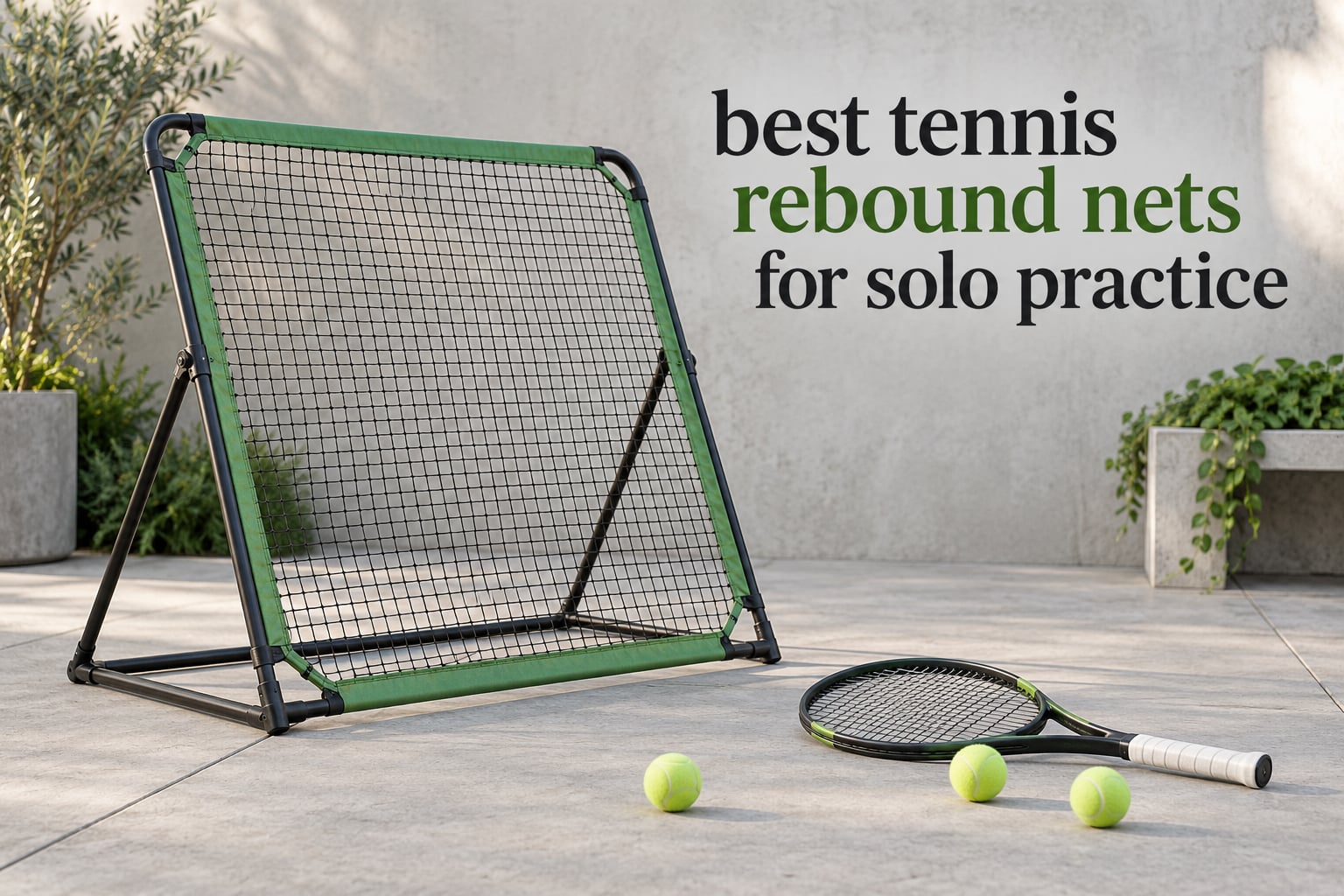
There is a way to practice tennis alone, and the cheapest version of it is a rebounder net. Hit the ball into the mesh, let the tensioned net do the work, and take the return. No partner cancelling, no court booking, no standing in an empty park feeding balls into the grass one at a time.
A tennis rebound net is the single most useful piece of solo training equipment I own, and also the one most people buy badly. The wrong size and you will be chasing balls for an hour. The right one turns a flat driveway into a repeatable groundstroke drill. I spent six weeks working through ten of them, comparing rebound surfaces, tension methods, anchoring kits and how much clear space each one demands.
Two things up front. First, a rebound net does not hit a ball back. It returns a flatter, lower ball than a real rally, and it will not read topspin. It is a repetition tool, not a rally partner, and it will not replace hitting with people. Second, if your real problem is feeding volume rather than stroke repetition, a ball machine solves a different problem better. I compared those options in detail in our guide to the best tennis ball machines for solo players, and for players who want depth control on top of feed, the 12 best tennis ball machines for practice breakdown is worth a read.
Everything below was assessed on the same criteria: how big the usable hitting area actually is, how the net is tensioned and how long that tension lasts, whether it can be angled, what anchoring hardware comes in the box, and whether one person can move it. Weights, dimensions and materials are taken from the manufacturer listings. Where reviews contradict the spec sheet, I flagged it.
Top 3 Tennis Rebound Nets for Solo Practice in October 2026

Ksports Multi-Sport Rebounder
- Alloy steel frame with weatherproof polyester mesh
- Tool-free setup under 10 minutes
- 600D Oxford carry bag included
- 30 practice shots per minute

Vermont RapidFire Jumbo 9×7 ft
- 9ft x 7ft surface
- adjustable angle
- 2mm knotless PE netting
- powder-coated galvanized frame
Tourna Deluxe 9×7 ft Rebound Net
- 9ft x 7ft rebound net
- Two included raisers for a softer return
- Dual-sport tennis and pickleball
- Alloy steel tilting frame
My picks are not the three most expensive on the list, and they are not the three highest rated either. They are the three that kept working after the novelty wore off: one you can genuinely carry to a session, one with a big enough surface to swing at properly, and one that solves the ball-chasing problem better than it solves the rallying problem.
Every Tennis Rebound Net for October 2026
| Product | Specifications | Action |
|---|---|---|
| Ksports Multi-Sport Rebounder Net |
|
Check Latest Price |
| Vermont RapidFire Jumbo Rebounder |
|
Check Latest Price |
| Tourna Deluxe Rebound Net |
|
Check Latest Price |
 MR 7×6 ft Freestanding Return Net MR 7×6 ft Freestanding Return Net |
|
Check Latest Price |
 MR 12×6 ft Adjustable Tilt Rebounder MR 12×6 ft Adjustable Tilt Rebounder |
|
Check Latest Price |
 HamRoRung 9.3×7.4 ft Practice Wall HamRoRung 9.3×7.4 ft Practice Wall |
|
Check Latest Price |
 ORIENGEAR 12×6 ft Rebound Wall ORIENGEAR 12×6 ft Rebound Wall |
|
Check Latest Price |
 GenxQian 9.4×7.4 ft Rebound Net GenxQian 9.4×7.4 ft Rebound Net |
|
Check Latest Price |
 Zovcsxn 6.5×6.5 ft Rebound Net Zovcsxn 6.5×6.5 ft Rebound Net |
|
Check Latest Price |
 noblequest 6×7 ft Return Net noblequest 6×7 ft Return Net |
|
Check Latest Price |
1. Ksports Multi-Sport Rebounder Net – The One I Actually Use
- Assembles and disassembles in under 10 minutes with no tools
- Compact footprint of about 6 square yards fits a patio
- Carry bag included so it moves between sessions
- Works for tennis
- pickleball
- padel
- squash and racquetball
- Hitting area is small against true 9x7 ft rebounders
- Netting needs re-tensioning after heavy sessions
- Base shifts on hard surfaces unless anchored
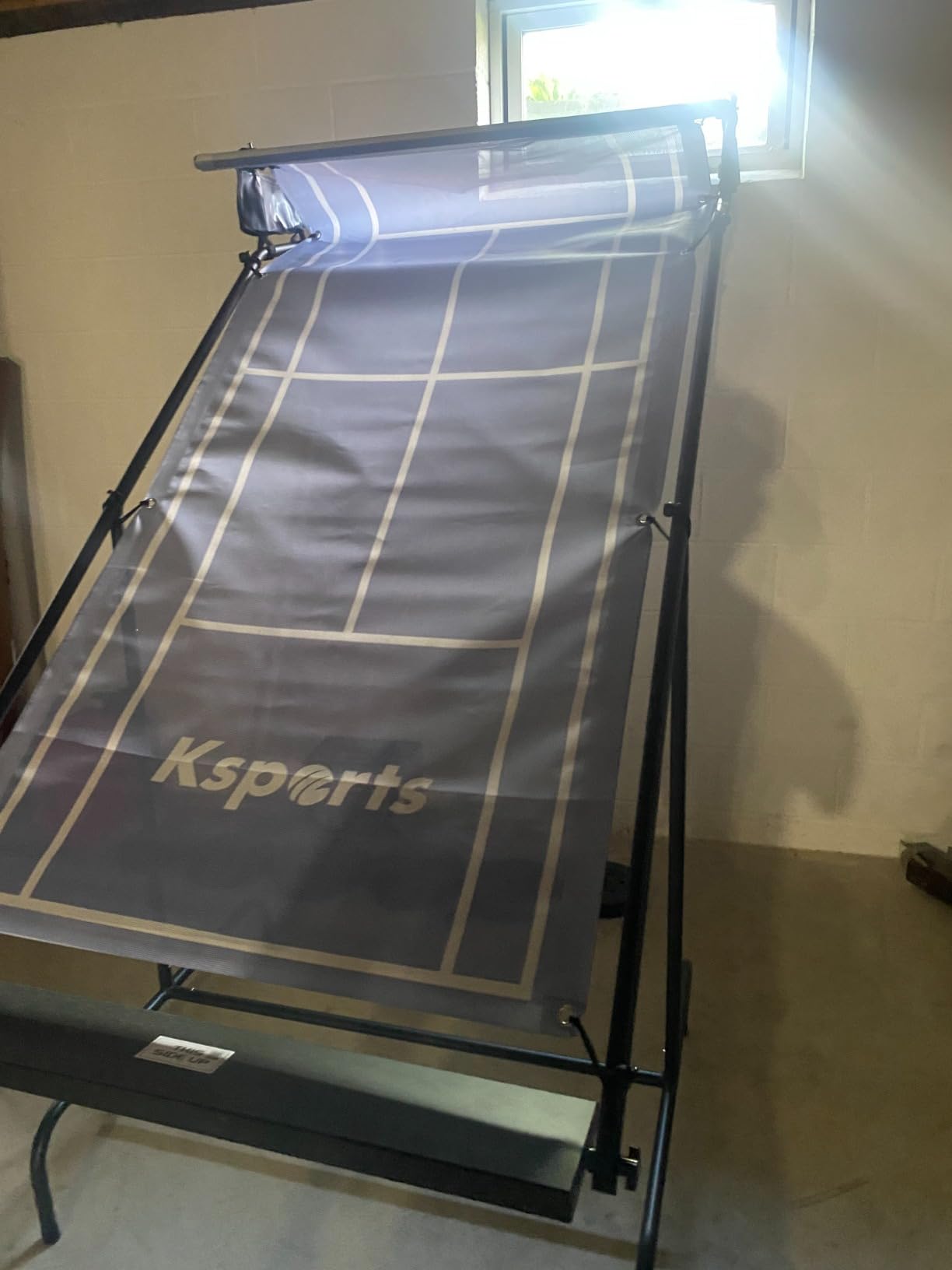
This is the unit on my own patio, and the reason it survives there is trivial: it goes up in under ten minutes and comes down just as fast. Everything else is secondary to that. A rebound net you have to wrestle with a socket wrench after a session is a rebound net that stays folded in the garage.
The frame measures 41 inches long by 32 inches wide by 68 inches high, which sounds small until you realise it needs about six square yards of space. That is a genuine differentiator in a category where most competitors want a full driveway. Weatherproof polyester netting is held by bungee loops, so re-tensioning when it goes slack is a two-minute job rather than a rethread.
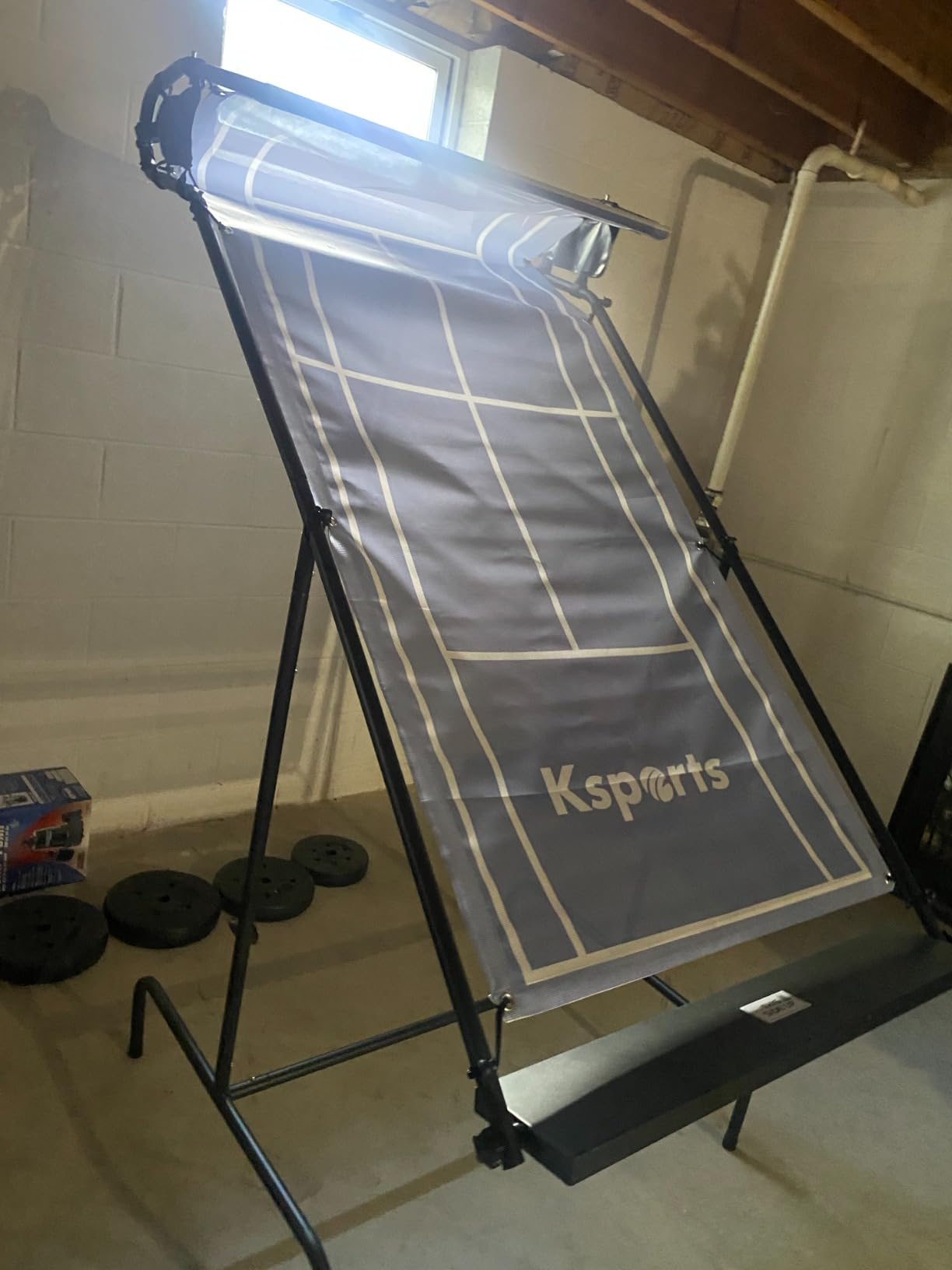
The manufacturer claims support for up to 30 practice shots per minute, and in normal groundstroke use that felt about right. Optional six-inch height extensions raise the top of the frame, which raises the rebound and makes the return easier to control for a beginner or a junior working on a shorter backswing.
The honest limitation is surface area. This is not a nine-foot wall. If you swing hard and wide on a forehand, balls will pass the sides or go over the top. What it does give you is a repeatable feed at close range, which is precisely what footwork, recovery-position and consistency drills need.
Multi-sport use is real here: tennis, pickleball, padel, squash and racquetball all work off the same mesh. If you split your court time between tennis and pickleball, that flexibility pays back quickly. If you only ever hit tennis groundstrokes at full power, a wider frame would serve you better.
Who this net suits best
This suits a recreational club or league player without a fixed hitting partner who wants 20 minutes of groundstroke repetitions after work, not a full training session. It also suits anyone coaching juniors in a group, because one person can carry it out, set it up on a hard surface and be hitting within ten minutes.
The 600D Oxford carry bag matters more than it sounds. It lets you move the whole rig from a garage to a community centre court or a park without a second person, which is the difference between owning a training tool and owning a piece of garage furniture.
Where it falls short
Two things gave us pause. The netting does loosen under sustained hard hitting and needs the bungee loops worked back into tension every few sessions. And on a hard surface like concrete the base will creep, which is manageable with a weight or a sandbag but worth knowing before you set it up on a driveway.
Reviewers consistently rate the assembly speed and the multi-sport flexibility highest, and the small return surface as the main gripes. That matches what we saw. At a 4.2 average across 235 reviews, it is the most widely used rebounder in this group, and the rating is honest rather than inflated.
2. Vermont RapidFire Jumbo 9×7 ft Rebounder – Best Surface Area
RapidFire Mega Tennis Rebounder – Groundstroke & Volleying Practice (Small Or Large) (Large (7ft x 8ft))
- Biggest genuine hitting area for full-power groundstrokes
- Adjustable angle lets you shape depth and difficulty
- Knotless PE netting gives a strong lively rebound
- Galvanized powder-coated frame resists rust
- Frame sections unscrew for flatter storage
- Assembly instructions are unclear and some buyers reported leftover bolts
- Pole sections can refuse to seat when paint builds up in the joints
- Bulky to move across long distances
If your constraint is space rather than time, the nine-by-seven foot options are the right family. This one has the biggest usable hitting surface here and the sturdiest frame spec: one millimeter thick, 38mm outer diameter galvanized steel with a black powder coating. That is a frame built for wet grass and cold mornings.
The netting is 2mm knotless polyethylene with a 28mm mesh size, which is a heavier specification than most competitors list. Knotless construction is worth caring about: there are no knots to abrade the ball or to loosen under impact, and that shows up in how lively the return feels after an hour of use.
Fully adjustable rebound angle is the feature that separates it from fixed-angle walls. Steeper settings pull the return closer and higher for control drills; flatter settings send it deeper and faster, which is the setting that makes you move your feet.
Why size matters more than spec sheets
A nine-foot-wide surface changes what shots are possible. On a six-and-a-half-foot net, most of your available window is gone on recovery, and off-centre balls dive into the frame. On a nine-by-seven, you can hit cross-court inside-out and stay inside the mesh.
Owners consistently praise the surface, the rebound liveliness and the angle range. They also complain, repeatedly, about the documentation. Plan for a slower first assembly than you expect and check the hardware count before you start.
Where it falls short
The biggest practical problem is moving it. This does not fold flat while assembled; you have to unscrew the interior of the frame to store it, and even then it is a long, awkward package for one person.
There is also a paint issue that comes up in reviews: if the black powder coating builds up inside the pole joints, sections that should slide together refuse to seat. A little clearance on the connectors fixes it. The warranty is six months, which is short for a frame this heavy.
3. Tourna Deluxe Rebound Net 9×7 ft – Best for Juniors Learning Control
- Large 9x7 ft surface for intensive solo sessions
- Raisers let coaches soften the rebound for beginners
- Dual-sport for tennis and pickleball
- Sets up in driveways
- garages and backyards
- Frame is less rigid than heavier rebounders
- Netting can feel loose and reduce return consistency
- Only a 30-day warranty
- Occasional reports of missing hardware
The included raisers are the reason to look at this one with a junior in mind. They raise the frame and produce a higher, softer return, which is exactly what a nine-year-old with a short swing and a red ball needs before they move to a full-height setup.
Surface size is 9ft wide by 7ft high, alloy steel construction, and a tilting frame for rebound customization. For an adult working groundstrokes at driveway pace it is a legitimate tool, and the tennis and pickleball dual-sport angle adds flexibility for mixed households.
What to know is that the frame is basic. Buyers rate the value and the raisers positively, but the recurring complaints are net tension and frame rigidity. Both point at the same thing: this is a lighter build than the Vermont jumbo above.
What the raisers actually change
Height changes where the ball lands relative to you, not just how hard it arrives. With the raisers fitted, the return sits further into the court and higher, which gives a junior more reaction time and reduces the number of balls that sail over the top.
For coaches running a group of kids on a driveway, that is a meaningful difference in the number of balls they spend the session retrieving. Pair it with a lower-compression practice ball and a red-dot ball as the player progresses.
Where it falls short
Consistency is the real issue. Loose netting produces a return that wanders side to side, and a wandering return breaks the rhythm that a repetition drill depends on. If your net sags after twenty minutes, you will spend more time resetting than hitting.
The 30-day warranty is the shortest of any full-size net in this group, and buyers report the occasional missing hardware. At a 3.6 average across 33 reviews, expectations should be set accordingly. It is a good junior starter; it is not the net you keep for a decade.
4. MR 7×6 ft Freestanding Ball Return Net – Best for Chasing Less
MR Tennis Ball Return Net 7’x6’ Freestanding Multi-Sport Training Net
- Funnels loose balls back to the hitter or a ball machine
- Tool-free freestanding setup in minutes
- Rubber-padded feet grip grass
- sand
- gym floor or concrete
- Carrying case included
- Lifetime warranty is the longest here
- Works more as a ball collector than a true rebound wall
- 7x6 ft surface is small for sustained rallies
- Netting tension loosens with repeated hard shots
Be clear about what this one is. The 7×6 ft surface collects and returns balls rather than simulating a rally, so if you were expecting a flat repetitive feed you will be disappointed. What it does exceptionally well is stop the retrieval problem from eating your session.
Set up behind yourself and every stray ball funnels back into play. Combined with a ball machine or a partner feeding from the far side, it turns a scattered collection into a ball loop, and that is where its value sits. If you already own a machine, this is a natural companion and our ball machine guides cover the pairing.
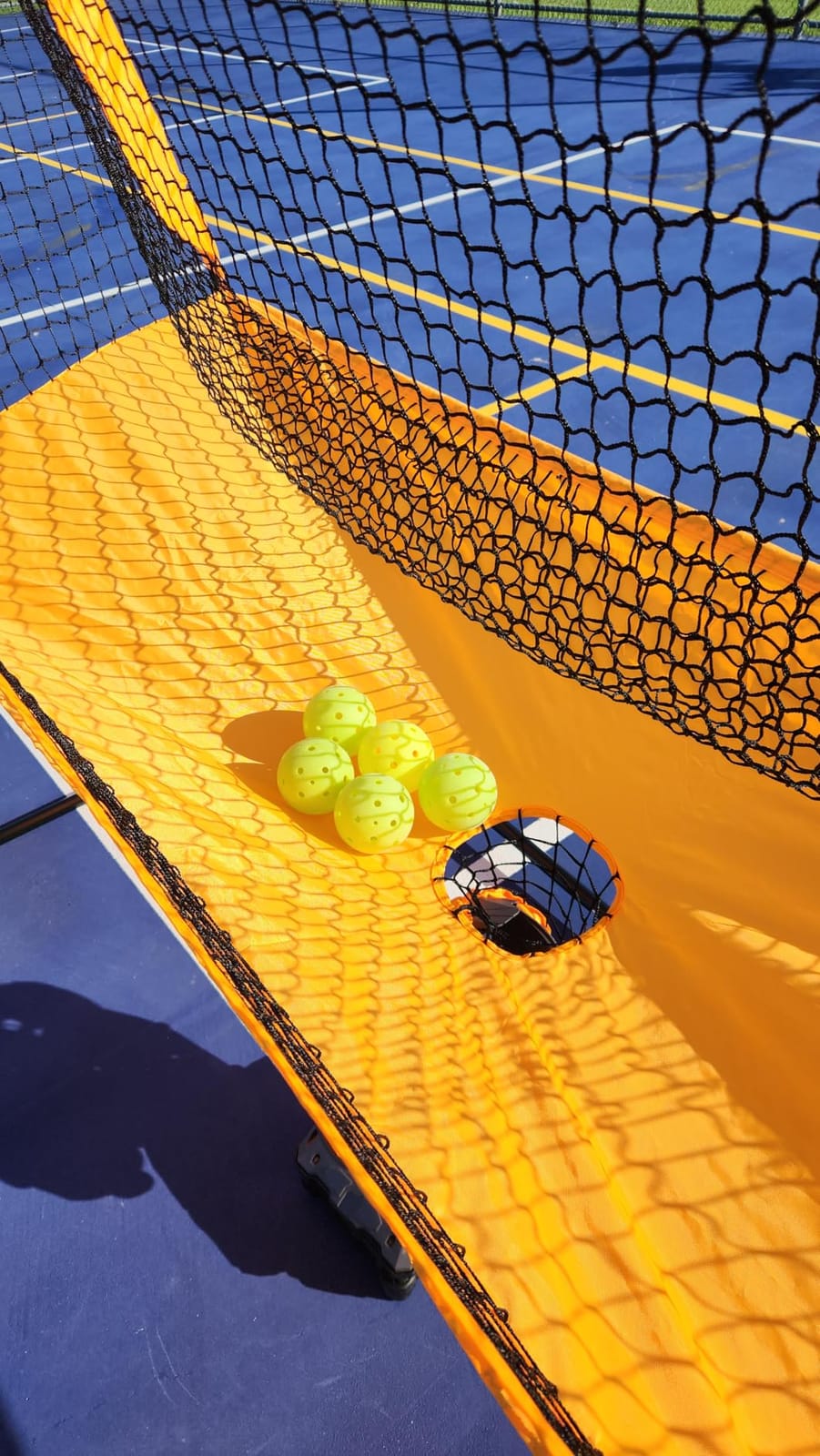
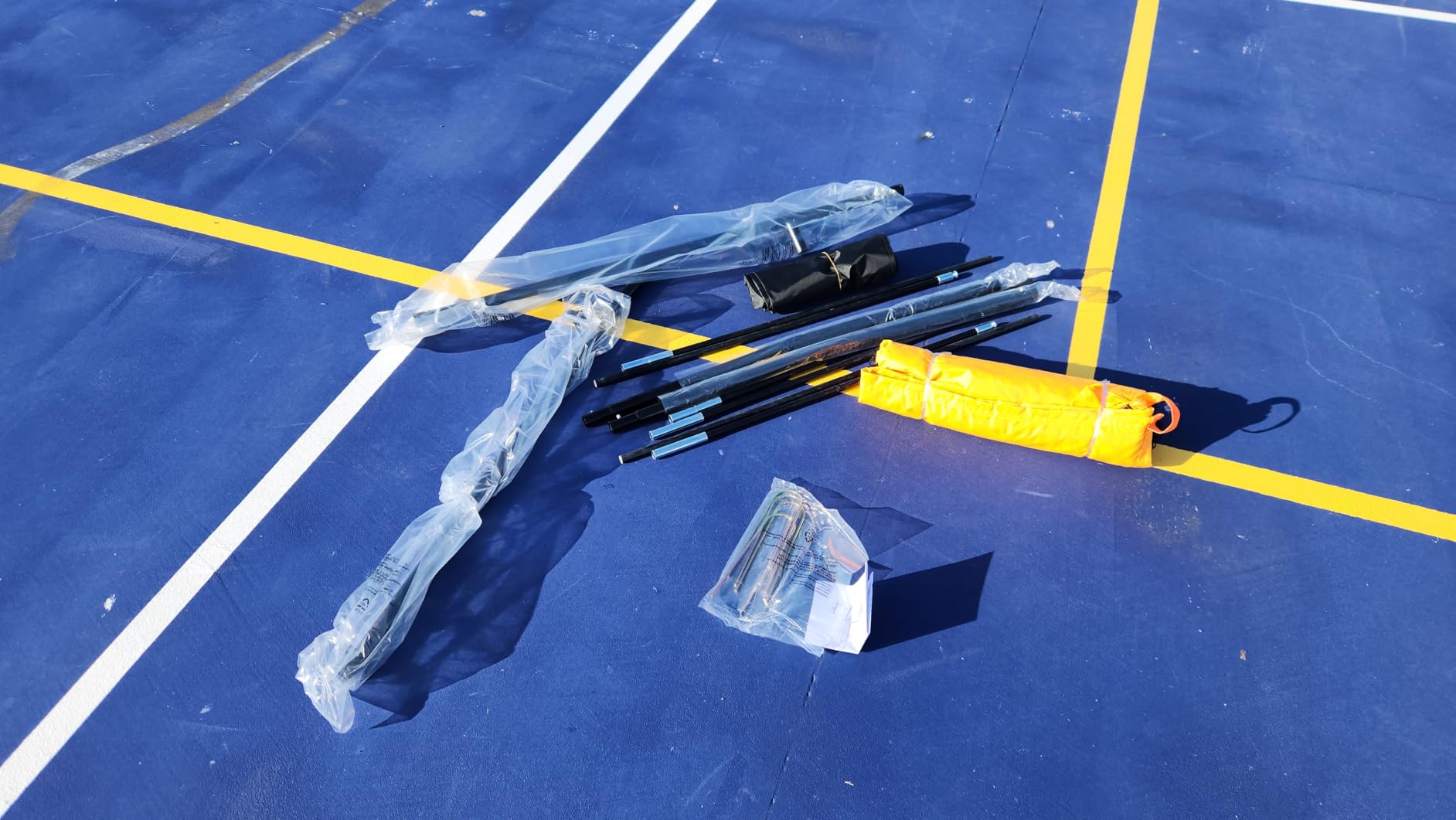
Construction is better than the category average. The mesh is 420D PU-coated knotless polyester with 600D seams, the frame is powder-coated steel with fiberglass poles, and the rubber-padded feet grip grass, sand, gym floors and concrete without scratching anything.
Setup is tool-free and there are no support ropes to anchor, which makes it genuinely usable indoors. The carrying case means it lives in a closet between uses instead of standing in a garage corner. The lifetime warranty is the longest of any net in this roundup.
Who should buy this one
Buy it if your session is about volume, not stroke quality. Junior coaches running a feeding loop, a parent with a ball machine in the garage, or a player who loses ten minutes every session to collecting balls will feel the difference immediately.
It is also the safest option for indoor use on this list because the padded feet and the freestanding design mean no stakes, no ropes and no marks on a gym floor or a carpeted basement.
Where it falls short
It is not a rebound trainer, and any listing that frames it as one is overselling. Expect a returned ball rather than a feed you can hit ten forehands into, and expect that net tension to loosen with repeated hard contact.
Ratings sit at 3.8 across 49 reviews, with buyers split along exactly that line. Praised for quick setup and ball funneling, criticised for the small surface. Treat it as a companion to a machine, not a replacement for one.
5. MR 12×6 ft Adjustable Tilt Rebounder – Best if It Has to Move
MR Tennis Rebounder 12’x6’, Adjustable Tilt Angle Rebound Net, Multi-Sport Portable Bounce Back Net with Wheels, Rebound Wall for Tennis, Pickleball,
- Widest surface in the group at 12ft
- Rolls on 4-inch wheels without disassembly
- Quick angle and height adjustment for varied shot types
- Plunger bolt hardware keeps fingers safe while adjusting
- Tightening the net improves return consistency
- Usable area above the net line is short so balls go over the top
- Tips over outdoors in wind without weights
- Angle adjustment is awkward to do alone
The wheels are the headline. Four-inch smooth rollers let one person move the whole net across a driveway or from a garage to a court without taking it apart, and for anyone who practises in more than one location that removes the single biggest practical objection to owning a large rebounder.
The surface is 12ft wide by 6ft high, and the widest here. Width is the point: it swallows off-centre groundstrokes that would otherwise dive into the frame on a narrower net. Height is the trade-off, and it matters more than the width helps.
The pull-system angle adjustment changes rebound between high pops, grounders and line drives, and the plunger bolt hardware keeps your fingers out of the frame while you do it. Height is adjustable as well. Assembly takes roughly 30 to 40 minutes and is easier with two people.
The width and height trade-off
Think of width as forgiveness and height as trajectory. A twelve-foot surface is forgiving, so you can swing freely without aiming. A six-foot height limits your window above the net line, so aggressive or rising shots go over the top rather than rebounding.
If your sessions are deep, flat groundstrokes, this is one of the best fits here. If you want to practise lobs, overheads or high topspin rebounds, the shorter height works against you and you should look at a taller surface.
Where it falls short
Stability is the recurring issue. Without weights or sandbags, reviewers report it tipping outdoors, and the extra-long support legs help but do not eliminate it. The angled pull system is also awkward to operate alone.
At a 3.9 average across 26 reviews, with some buyers reporting missing instructions and bolts on delivery, this is a strong-feeling frame with a short effective window. Buy it for movement and width; anchor it before you swing hard.
6. HamRoRung 9.3×7.4 ft Practice Wall – Best Anchored Outdoor Setup
Tennis Players Portable Tennis Rebounder Net, 9.3×7.4 ft Large Area Backboard Net for Backyard/Outdoor Training, Practice Wall for Tennis & Pickleball Training
- Large 9.3 x 7.4 ft surface for forehands
- backhands and serves
- Knotted mesh holds shape and tension and grips the ball
- Four sandbags and four ground stakes stop wobbling and tipping
- Powder-coated iron frame resists rust
- Carry bag included
- Very small review base so long-term durability is not well documented
- Needs the included sandbags or stakes to stay stable on grass
- Ground stakes are impractical on hard indoor surfaces
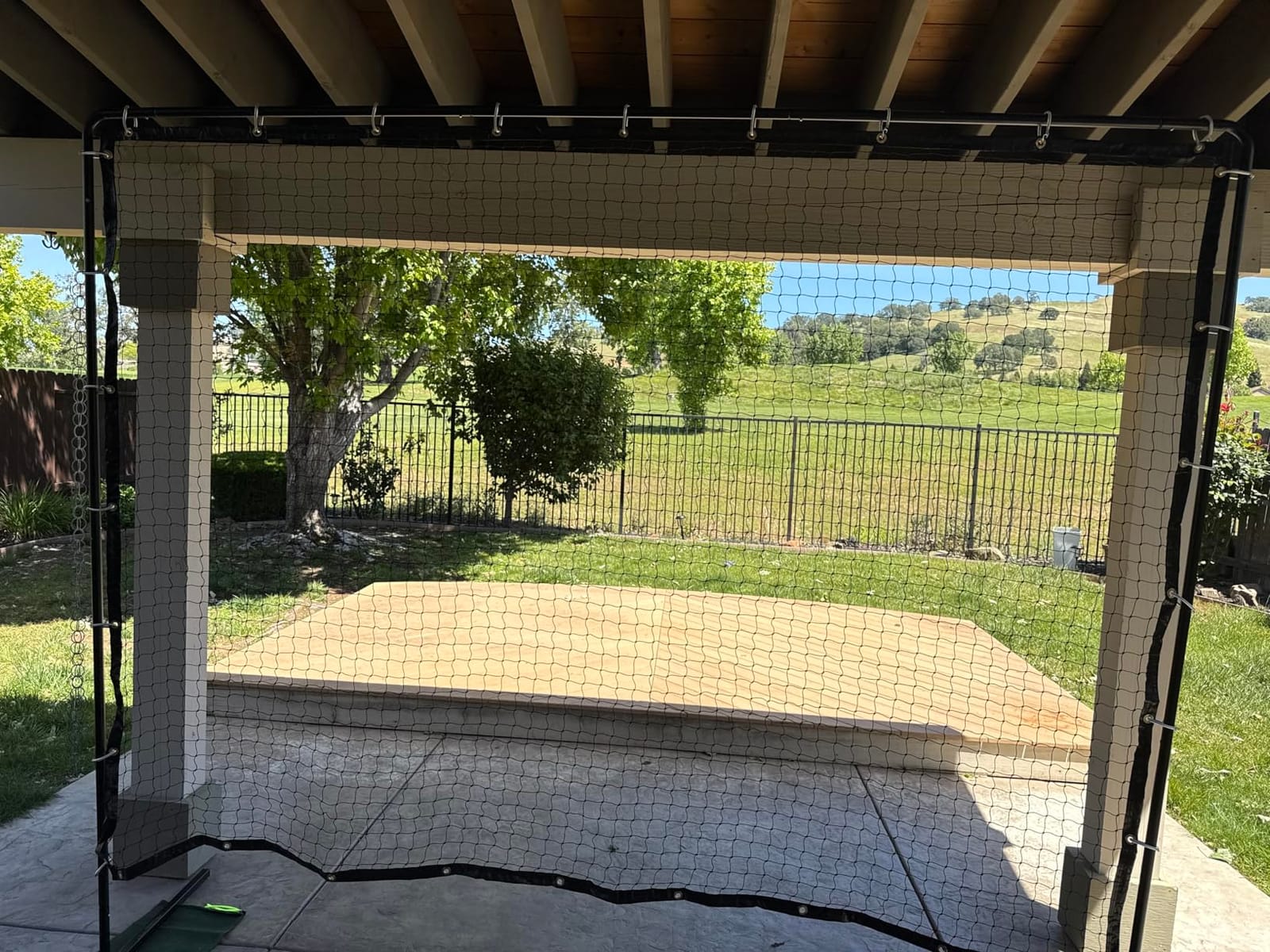
This is the one I would trust on wet grass in a backyard, and the reason is the mesh. It is 3.54-inch square knotted polyethylene with a 1.45-inch 500D PVC webbing border, and knotted construction grips the ball and holds its shape under repeated impact in a way lighter stretch mesh does not.
The surface is 9.3ft wide by 7.4ft high, which is the second-largest area in this group and taller than most. That height ceiling is what makes it usable for serve warm-ups and rising groundstrokes rather than only flat feeds.
The anchoring kit is unusually complete: four sandbags, four ground stakes and a sports carry bag. Powder-coated iron frame with triangular end brackets keeps the ends square under load, and the coating resists rust on a net that will live outside.
Why the sandbags are not optional
The included weights exist because a nine-foot mesh panel catches a lot of ball load. Without sandbags or stakes, the frame develops a lateral wobble that makes the return inconsistent, and that inconsistency is what kills a repetition drill.
Use the sandbags on grass, soil or any soft surface. The ground stakes are for soil only, which is the one real limitation of this package: on a hard indoor floor you cannot stake it and the sandbags become the only option.
Where it falls short
Nine reviews is not enough evidence to make a durability call, and we want to be straight about that. The 4.4 average is encouraging and the feedback is uniformly positive, but a small review base says more about early impressions than long-term survival.
There is also no angle adjustment listed, so this is a fixed-trajectory wall rather than a machine you can tune. Buy it if you have outdoor space you can properly anchor. If you need to change the return shape between drills, look further down the list.
7. ORIENGEAR 12×6 ft Rebound Practice Wall – Best for Indoor Drilling
- Wide 12ft training area with adjustable target tape for height reference
- Slow rebound brings balls back close so there is less chasing
- Lightweight at 16.5 lb and quick to install
- Rubber feet protect indoor flooring
- Works for groundstrokes
- volleys and dinking
- Net tension is often too loose for consistent dinking drills
- Frame can be unsteady and needs sandbags to stay upright
- Some buyers report the net or attaching cord failing after weeks
- Instructions are hard to follow
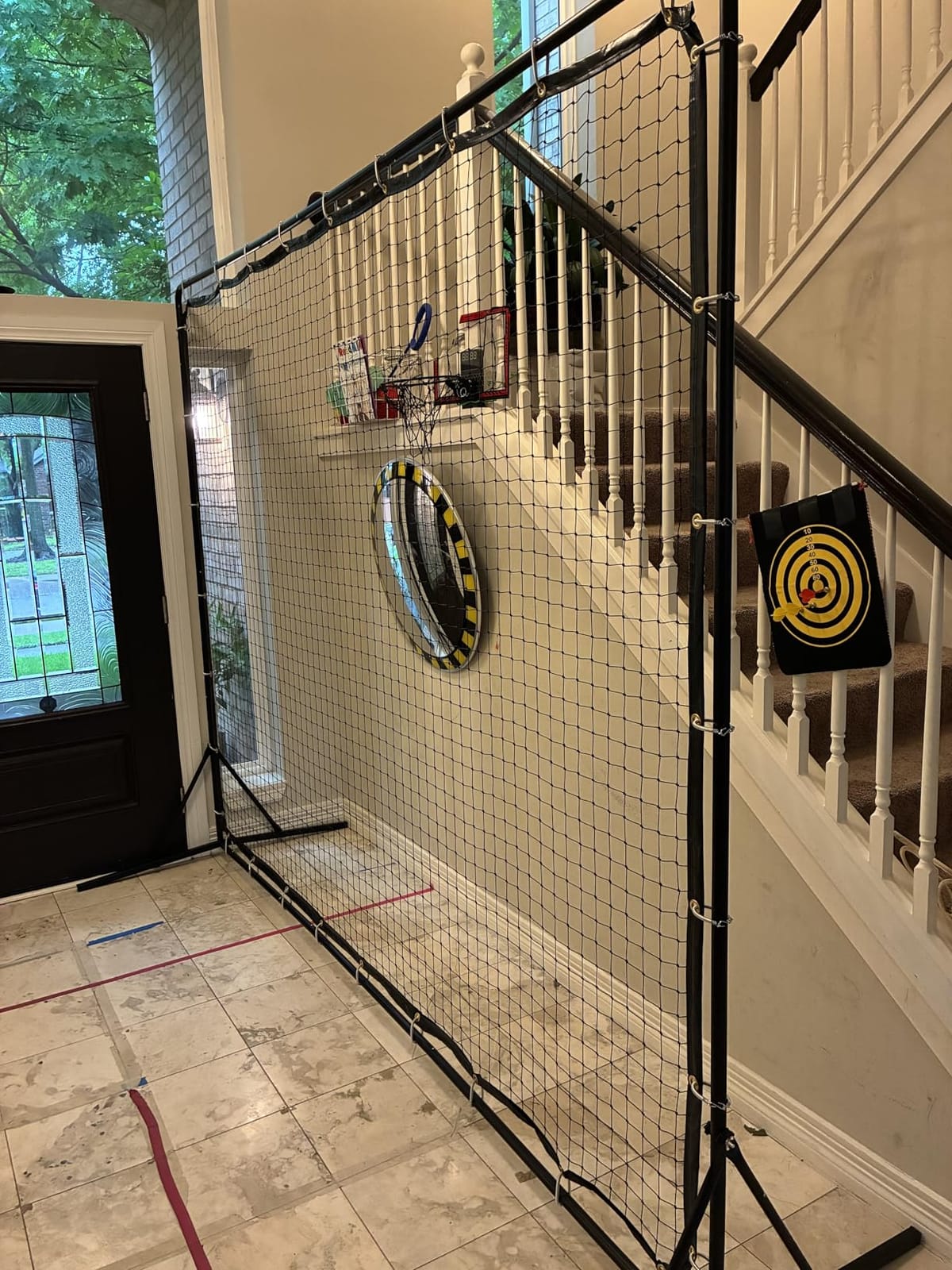
The slow-rebound design is the concept here. Instead of throwing the ball back into the court, this absorbs the force and returns balls within about six and a half feet, which means almost nothing ends up behind the net and almost nothing gets lost.
That makes it genuinely practical indoors. At 16.5 pounds it is light enough to carry between a basement and a garage, and the rubber feet protect hard flooring. Poles thread through the 420D Oxford cloth edging for fast assembly, and the adjustable yellow target tape lets you set a consistent contact height.
The 12ft by 6ft surface is the widest here, and it works for groundstrokes, volleying and short dinking exchanges as well as tennis proper.
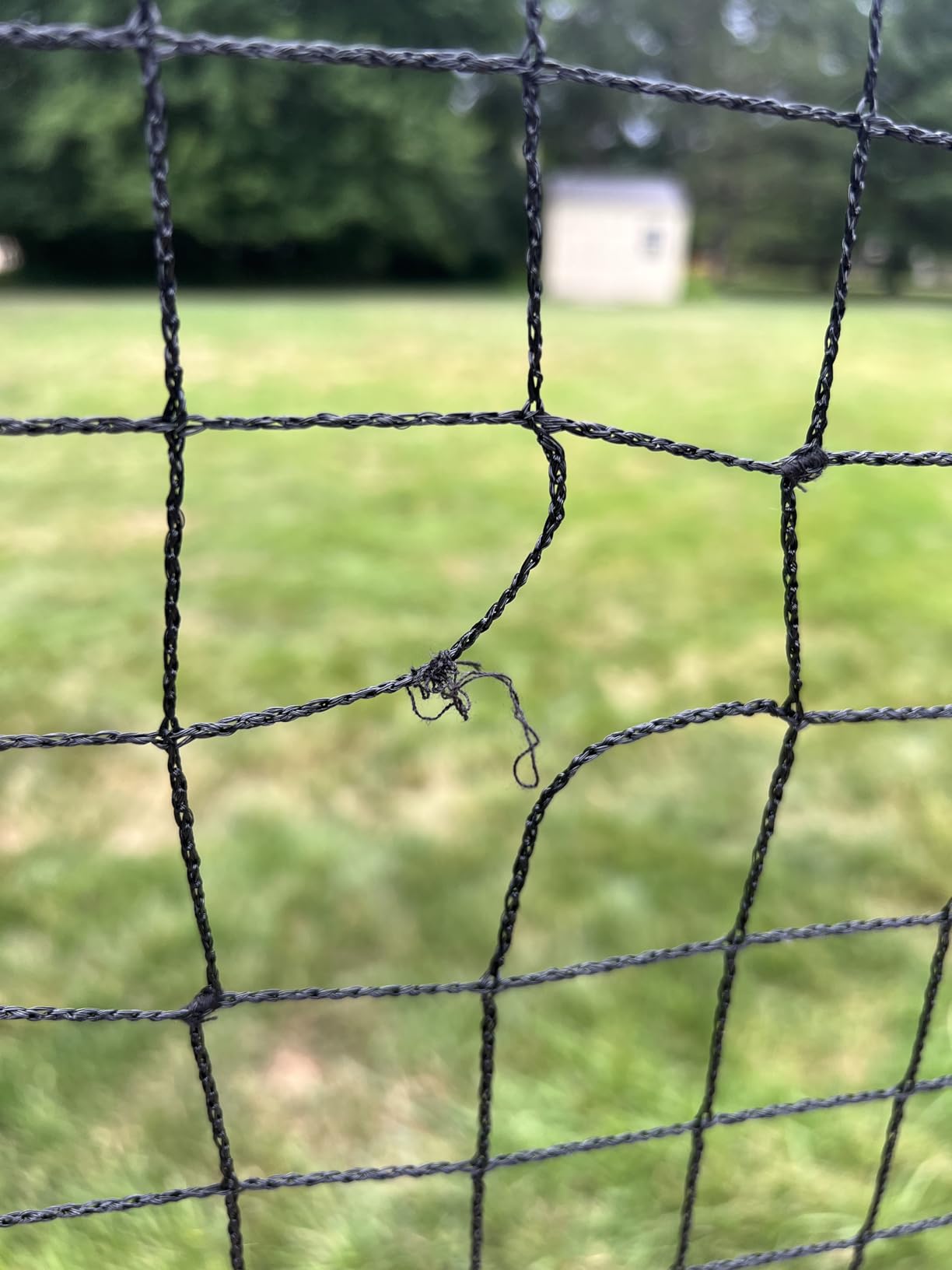
What close rebounds mean for your drills
A ball arriving at six and a half feet gives you almost no time to take a full swing. That is a feature indoors, where a full swing into a wall of nearby furniture is a bad idea, and where you are usually working on contact point, racket face control and short punchy swings.
It is a limitation outdoors, where a full groundstroke wants the ball to land deep. If you want to practise real shot mechanics at full extension, the six-and-a-half-foot return is too close for that.
Where it falls short
Net tension is the honest problem. Buyers consistently describe the mesh as too loose for consistent pickleball or dinking drills, and loose mesh plus a small surface produces a return that wanders. Frame steadiness needs sandbags on soft ground.
There are also reports of the net or the attaching cord failing after a few weeks, and confusing instructions. At a 3.5 average across 28 reviews, the feedback is mixed, with loose tension the most common theme. Indoor short-swing work is its use case; sustained outdoor rallies are not.
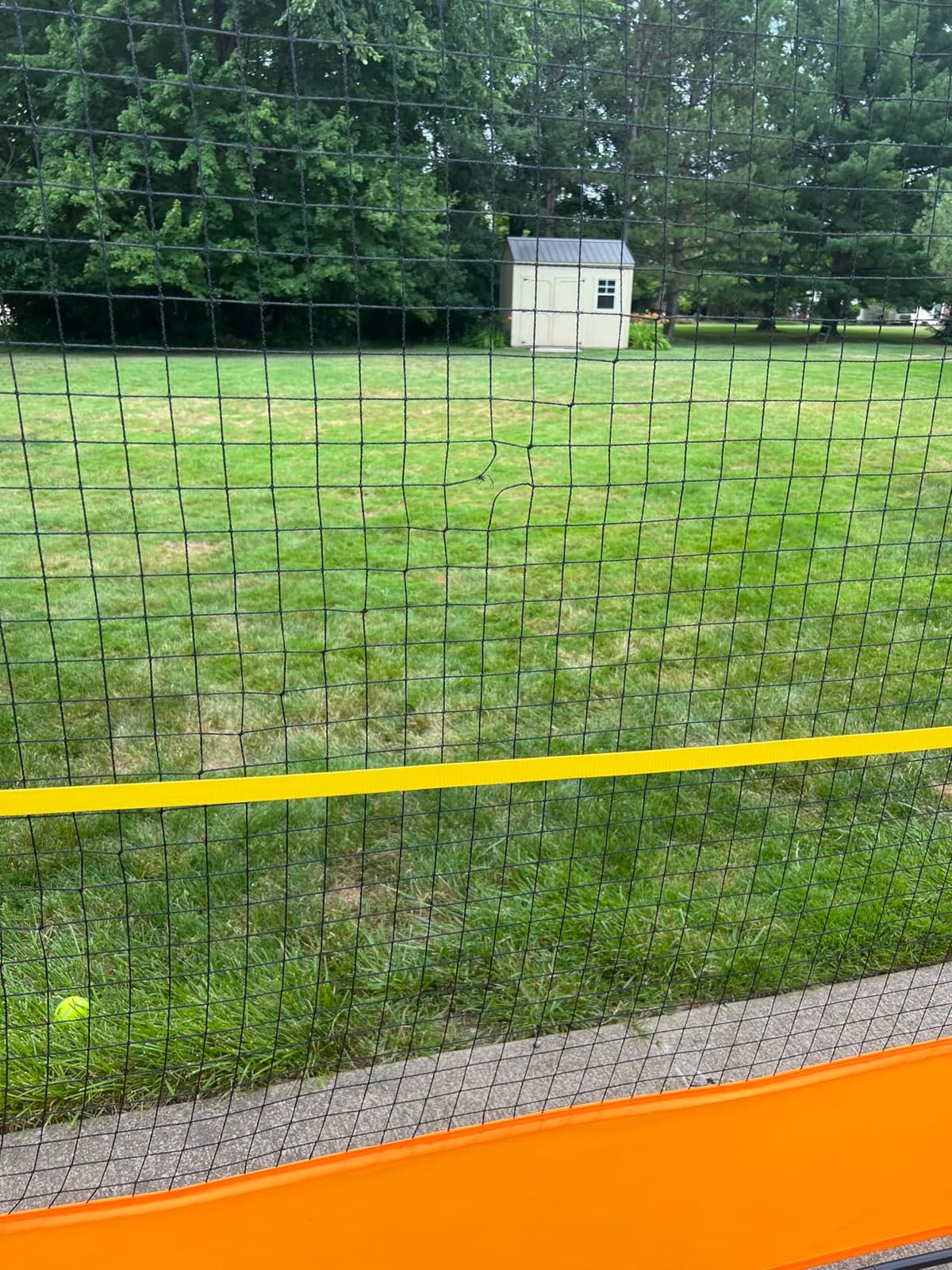
8. GenxQian 9.4×7.4 ft Rebound Net – Best Spring-Tensioned Mesh
- Spacious 9.4 x 7.4 ft surface for hitting at varied angles
- Spring-and-knob tensioning keeps the net consistent
- Powder-coated iron frame resists rust and corrosion
- Anchoring kit and carry bag included
- Can double as a barrier to stop balls leaving the yard
- Extremely small review base of 3 ratings
- Spring tensioning takes time to set up evenly
- Needs sandbags or ground nails for outdoor stability
The tensioning method here is different from everything else on the list, and it is worth understanding before you buy. Instead of bungee loops or elastic cord, this net uses 35 tension springs and 7 fixed knobs, so the mesh is tensioned evenly across the whole panel rather than pulled at a few points.
Even tension is what keeps a return consistent, and it is the reason bungee-loop nets drift side to side over time. A spring-and-knob system does not stretch the same way, though it does take longer to dial in evenly across the full width.
The surface is 9.4ft wide by 7.4ft high, with polyethylene netting and 500D PVC sandwich mesh edging on a powder-coated rustproof iron frame. Included in the box are four ground nails, four sandbags and an oxford cloth carry bag.
A second job for the same frame
Position it along a boundary line and it stops balls rolling into the street, which is a real problem on a sloped yard or near a shared fence line. That dual use makes it easier to justify than a single-purpose net.
It is also a genuine multi-sport net: the listing covers tennis, baseball, lacrosse, hockey, softball, pickleball and general ball work, so a household that switches sports all week gets more from it than a tennis-only shopper.
Where it falls short
Three reviews, all five stars. That is an encouraging start and it is not evidence of anything long-term, and we will not pretend otherwise. A 5.0 average on a sample of three tells you first impressions were good, not that the springs will still be even after two seasons.
Setting 35 springs evenly across seven knobs is fiddly the first time, so budget an unhurried setup. Like the other nine-foot panels here it needs sandbags or ground nails outdoors to stay put.
9. Zovcsxn 6.5×6.5 ft Rebound Net – Best for Very Small Spaces
- Compact 6.5 x 6.5 ft footprint suits small yards and indoor rooms
- Adjustable tilt tunes the rebound to your skill level
- Red target tape helps you work on accurate hitting height
- Iron pipe frame with polyester mesh gives a stable base
- Storage bag included
- Smallest hitting surface in this group for sustained rallies
- Light 3-strand mesh wears faster than heavier netting
- Only a 60-day warranty and a very small review base
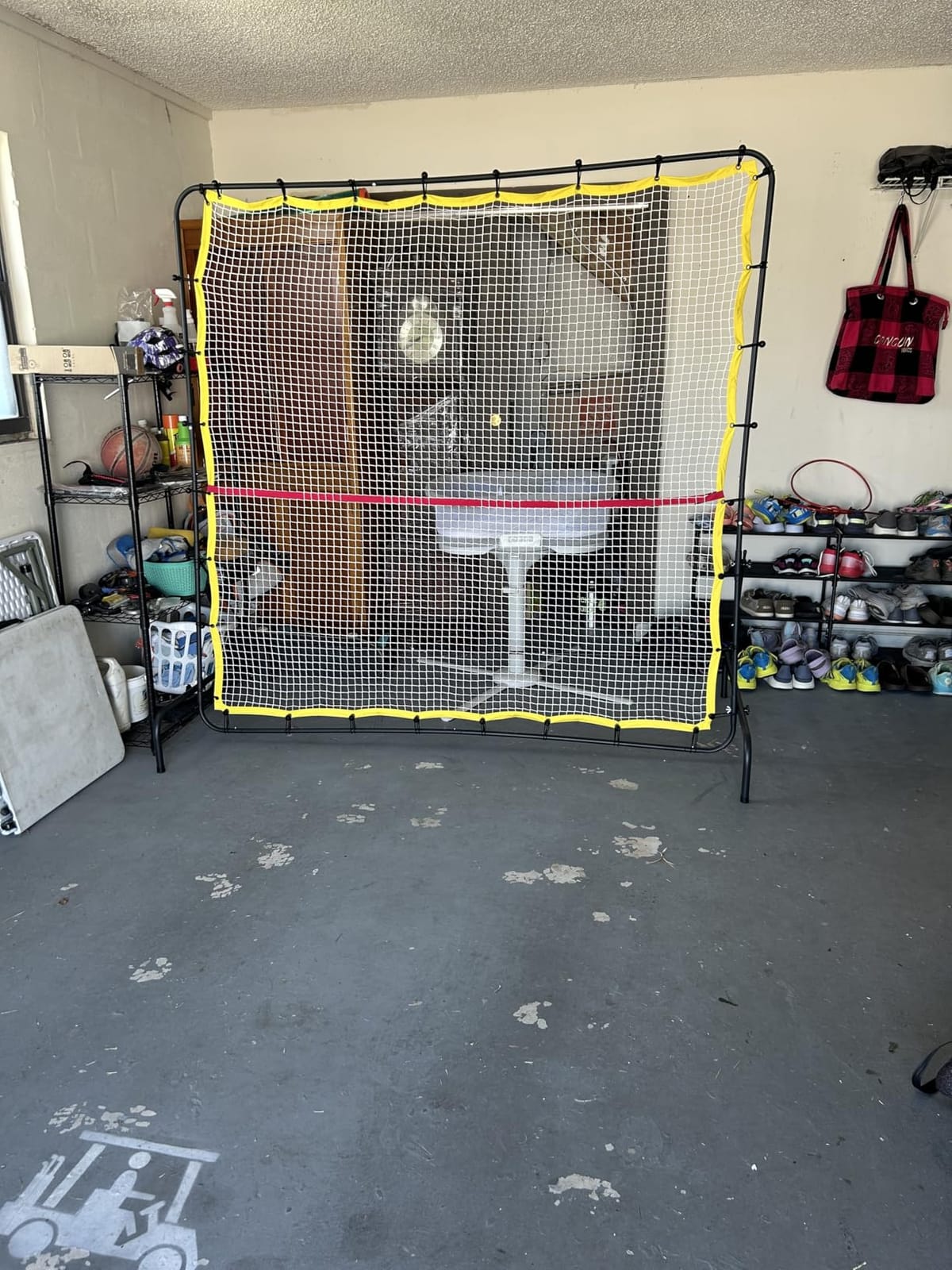
If your available space is genuinely tiny, this is the honest answer. A 6.56 by 6.56 foot surface at 16 pounds is easy to carry, easy to store behind a door and easy to set up in a room or a small yard without rearranging furniture.
Adjustable tilt varies the rebound intensity, which matters more on a small net than on a large one because you can compensate for the limited area by changing how the ball comes back. The one-inch wide adjustable red target tape marks a consistent hitting height.
The frame is iron pipe with 3-strand polyester mesh, and a storage bag is included. It is marketed for pickleball, and it works well for that, but it functions as a smaller tennis rebound wall too.
Where a small net actually works
On a compact panel, keep the contact point central and finish your swing rather than chasing width. This suits short groundstrokes, volley repetitions, junior contact-point work and racket-head-speed drills rather than cross-court rallying.
It also pairs well with a mini-tennis court or a pickleball setup. If your sessions are short and frequent rather than long and structured, a small net gets used; if you want sustained rally work, you will outgrow it quickly.
Where it falls short
Three-strand mesh is the weak point. It is lighter than the knotless PE and spring-tensioned netting elsewhere on this list, and buyers report it wearing faster under repeated hard contact. The 60-day warranty is the shortest here.
Five reviews at a 3.4 average is the lowest rating in the group. Players who value the compact footprint and the tilt adjustment like it; players who want a bigger surface find it limiting. Buy it for the space, not for the surface.
10. noblequest 6×7 ft Return Net – Best for Compact Storage
- Collapses to guitar-case size for easy storage and carrying
- Tilting base funnels balls back for collection
- Tool-free setup takes about 90 seconds
- Foam-backed dual-layer netting softens the rebound
- Useful for tennis
- pickleball and softball
- Ball collection net rather than a true rebound wall
- Net face starts 2-3 ft off the ground so low balls pass under
- Fiberglass frame slivers can irritate skin during setup
- Reports of incomplete or used units
Storage is the reason this one earns a place. At about 11 pounds and collapsing to roughly guitar-case size, it is the only net in this roundup you can actually put in a closet without rearranging the closet first.
Setup is tool-free in about 90 seconds, and the dual-layer netting is genuinely well thought out: an outer 420D anti-UV HD polyester with an inner memory foam padding layer that softens the rebound and takes sting out of mishits.
The tilting base funnels balls toward a collection point, which pairs well with a bucket or a ball machine. The frame is iron and fiberglass with polyethylene components, and it is listed for baseball, cricket, pickleball and tennis.
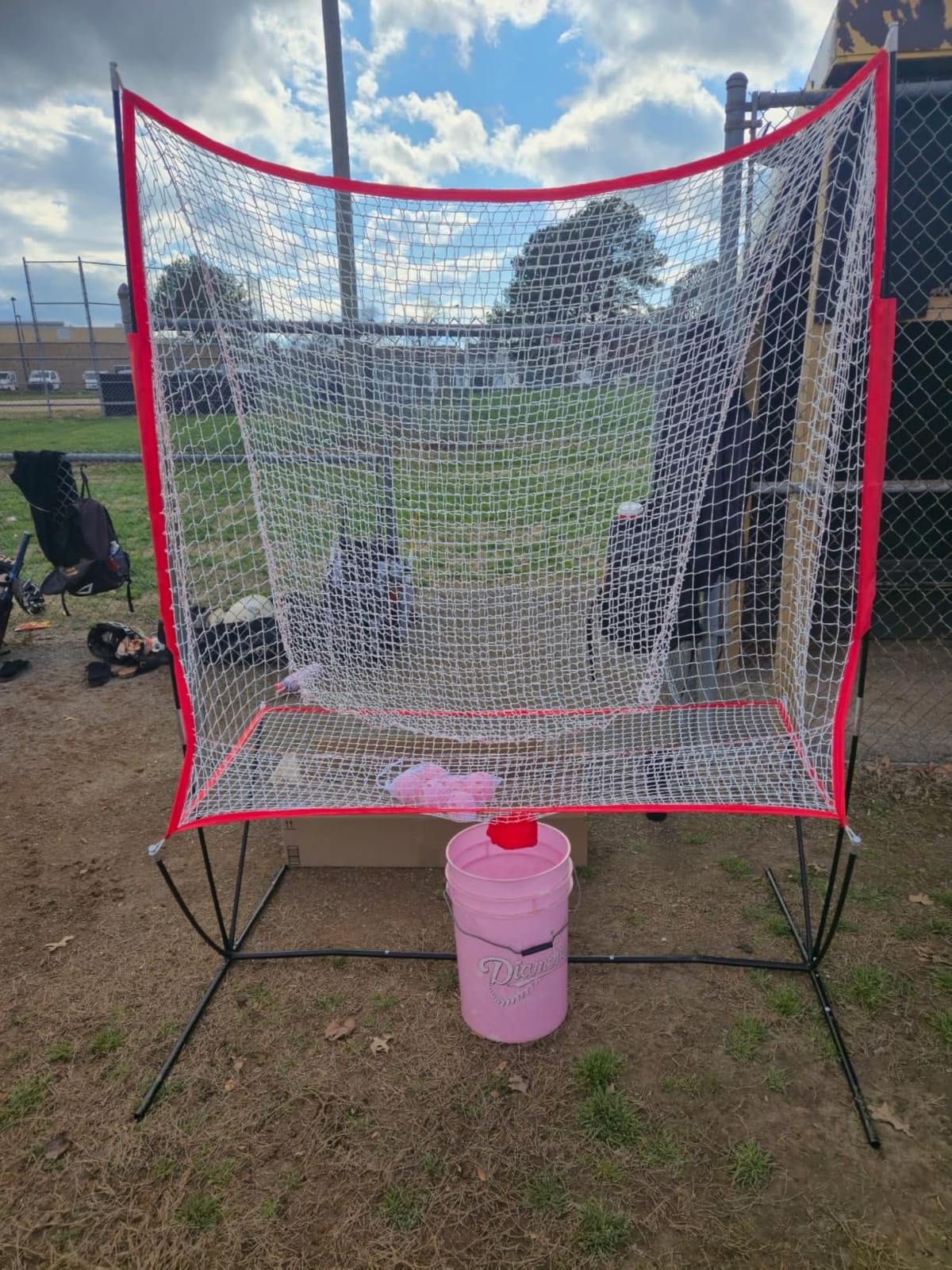
Collection net or rebound net
Be clear-eyed about what this does. It is a ball recovery system with a soft return, not a rebound trainer you can hit ten groundstrokes into. The foam layer makes the return pleasant, but the trajectory is not consistent enough for stroke repetition work.
Where it shines is reducing retrieval time in a small space. Put it at the back of a driveway or behind a practice area and every loose ball rolls back to a funnel instead of into the grass.
Where it falls short
Two practical issues stand out. The net face starts only two to three feet off the ground, so low balls pass underneath, which matters if you are working on short swing paths. And the fiberglass frame can shed slivers that irritate skin during setup, so gloves are worth having.
At a 3.3 average across 24 reviews, this is the lowest rated net here, with buyers split between liking the folding design and the foam softness and disliking the collection-only function. Good storage answer, weak rebounder.
How Much Space Do You Actually Need for a Rebound Net?
You need about 15 to 25 feet of clear depth in front of a rebound net for full-power groundstrokes and backhands, plus roughly 6 feet behind it for balls to land and for you to retrieve them. That is the number most people get wrong, and it is the top question on the r/10s rebound net thread.
The thread’s own conclusion is worth repeating because it matches our experience: power groundstrokes and backhands need 15-25 ft (4.5-7.5 m) of clear space so the ball rebounds naturally without constant chasing. Height clearance matters too if you are adding topspin or lobs, since the return has to clear the frame rather than dropping into it.
Working depth by net size, based on what the ten nets here actually return:
A 6.5 to 7 ft compact net returns the ball close, so 10 ft of depth in front is workable. That is the only scenario where a small yard is genuinely enough.
A 7 x 6 ft ball return net is a collection net, so the depth that matters is behind you rather than in front. Plan 10 ft of front space and a clear collection lane behind.
A 9 x 7 ft or larger rebound wall sends the ball deep, so give it the full 15-25 ft if you want to hit a real groundstroke. With less than 15 ft you will be tapping rather than swinging.
Behind the net, allow 6 ft minimum on every size so balls land somewhere retrievable and do not roll into a neighbour’s yard. On a boundary shared with a road or a fence, this is the reason the anchoring kits that include stakes or sandbags are worth using.
Vertically, nets range from about 6 ft to 7.4 ft tall here. Anything under 6.5 ft limits lob and overhead work, and anything with an adjustable height lets you raise the return for juniors and lower it as the player improves.
How to Choose a Tennis Rebound Net Without Regret
Start with the size of the return you need, not the size of the net. Measure your available depth first and pick the widest surface that fits. A nine-by-seven surface in a narrow space beats a twelve-foot surface you cannot swing at.
Decide between a rebound trainer and a ball collector. Four of the ten products here are collection nets that funnel loose balls rather than return a consistent feed. If your sessions are stroke repetition, buy a rebound trainer. If your sessions are feeding volume, buy a collector and pair it with a machine.
Understand the tensioning method. Bungee loops are the most common and the easiest to re-tension by hand. Springs and knobs give more even tension but take longer to set. Knotted mesh grips the ball and holds shape but is heavier. Light stretch mesh is the first thing to sag.
Check whether angle or height adjustment exists. Adjustable tilt is the single biggest quality-of-life feature for a solo player, because it lets you run a control drill and a power drill on the same net without rebuilding anything.
Factor in anchoring before you factor in features. Sandbags and ground stakes stop the wobble that breaks rhythm. Ground stakes only work in soil, so if you are on concrete or a gym floor, weight the base instead.
Test rebound consistency before you commit. If you can, put the net up in person and hit twenty balls. Watch whether the return lands in roughly the same spot each time. A net that returns to three different places every ten shots will not support a repetition drill, whatever the spec sheet claims.
Look at the warranty as a durability signal. The lifetime warranty on the MR ball return net and the 12-month warranty on the Ksports unit both suggest confidence in the frame. A 30-day or 60-day warranty says much less, whatever the listing says next to it.
Check what happens when the mesh sags. Every net here needs re-tensioning eventually. Ask whether replacement mesh is sold separately, because buying a frame you cannot re-net is buying something with a fixed life.
Plan for ball retrieval from day one. The single most common complaint in reviews across this whole group is lost or scattered balls. A collector net behind your hitting position, or a hopper, solves a problem that would otherwise end most sessions early.
Frequently Asked Questions
What is the best rebounder for tennis?
For most solo players the best rebounder is a net around 9ft x 7ft with an adjustable angle and a frame you can carry. The Ksports multi-sport unit wins on assembly speed and portability, the Vermont RapidFire jumbo wins on hitting surface and frame strength, and the MR 12×6 wins on width and built-in wheels. Pick the one that matches your available depth and how often you need to move it.
How much space do I need for a tennis rebound net?
You need roughly 15 to 25 feet of clear depth in front of the net for full-power groundstrokes and backhands, and about 6 feet behind it for ball retrieval. With under 15 ft you will be tapping rather than swinging properly. Compact 6.5 to 7 ft nets return the ball close and can work with about 10 ft in front.
Are tennis rebounders good?
They are genuinely good for stroke volume, footwork, recovery position and contact-point work, because they give you hundreds of repeatable reps without a partner. They are not good at everything. The rebound is flatter and shorter than a real rally ball, the net cannot read topspin, and no rebound net hits a ball back to you the way a partner or ball machine does.
Is there a way to practice tennis alone?
Yes, and a rebound net is the most flexible option. Hit into the mesh, let the tensioned surface return the ball, and run repeated groundstroke or volley drills without anyone else present. A string trainer covers swing path with no travel, and a ball machine covers feed volume. Combining a rebound net with a ball machine gives you the most complete solo session.
Which tennis balls are best for practice?
Use pressureless practice balls for volume work since they survive wall and net contact better and cost less than regulation balls. Pair lower-compression or red-dot balls with a junior or beginner, and move to full-compression regulation balls once the player can sustain a rally. Using worn balls extends ball and net life at the same time.
What is the best tennis trainer for home use?
For a home or garage the deciding factors are footprint, weight and floor protection. Compact nets around 6.5 x 6.5 ft suit small rooms, while nets with rubber-padded feet and no required stakes are safer indoors. If your goal is volume rather than stroke quality, a ball collector net that folds flat is often more useful than a full rebound wall.
Should I buy a rebound net or a ball machine?
Buy a rebound net if you need stroke repetition and footwork work off your own shots. Buy a ball machine if you need feed volume, serve practice, placement drills, or a partner hit while you feed. The two pair well: a collector net behind you keeps the balls in play so the machine never runs dry.
The Verdict on Tennis Rebound Nets for Solo Practice in 2026
The Ksports multi-sport rebounder stays in our kit because it is the only one on this list that goes up and comes down in under ten minutes by one person, and that convenience decides how often you actually practise. If your space and your swing support it, the Vermont RapidFire jumbo gives you the most hitting area and the most frame strength. Everyone else should match the net to the depth available in front of it.
And keep the honest framing in mind: a tennis rebound net buys you volume and footwork, not a rally partner. Use it for the reps, and get someone on court with you for the point construction.