
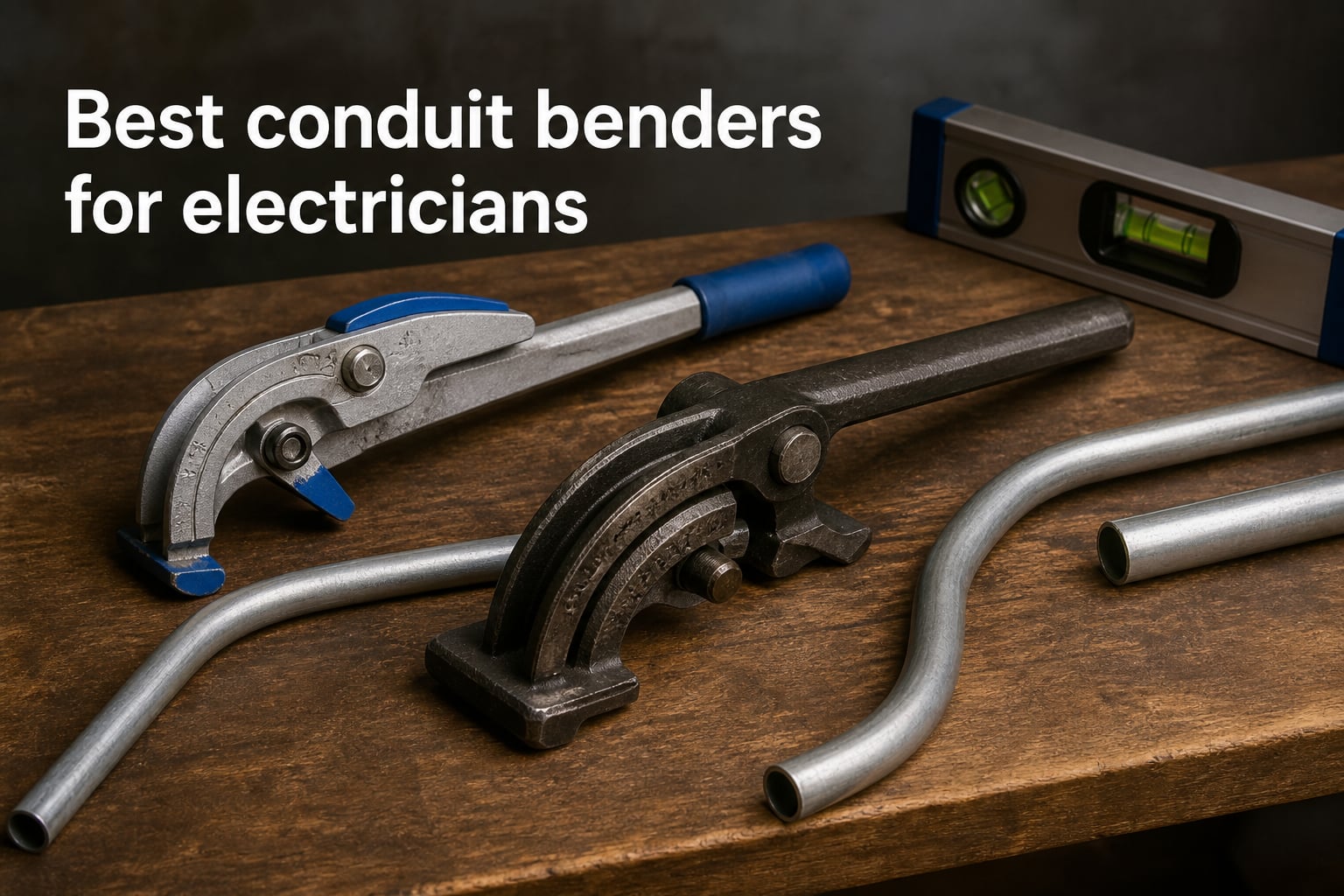
If you have ever wasted a stick of EMT on a bad bend, you already know why having the right conduit bender matters. A quality bender gives you clean, repeatable angles without kinking or flattening the pipe. After comparing the best conduit benders for electricians across materials, sizes, and bend accuracy, I narrowed the field to eight tools that stand out in 2026.
The tool electricians use to bend conduit is called a hand bender or conduit bender. It uses a bending shoe and foot pedal system so you can create stub-ups, offsets, saddles, and 90-degree bends in EMT, rigid, and IMC conduit. The difference between a great bender and a frustrating one comes down to material weight, marking visibility, and how well the head grips the pipe.
In this guide, I walk through eight top-rated options from Klein Tools, IDEAL, TEMCo, and Greenlee. Whether you need a lightweight aluminum bender for residential rough-in or a ductile iron workhorse for commercial jobs, you will find a recommendation that fits your work. I also cover the aluminum vs iron debate, size selection, and what features actually matter on the jobsite.
Top 3 Conduit Benders for Electricians in 2026

Klein Tools 51607 Aluminum Bender -…
- Angle Setter technology
- Wide foot pedal
- Bold cast markings
- Reinforced aluminum head

TEMCo Dual Shoe Bender – 1/2-Inch &…
- Two benders in one tool
- Offset multiplier chart
- 5-year warranty
- Standard bend radius

IDEAL Aluminum Bender – 3/4-Inch EMT (74-047)
- Heat-treated head
- Raised dual-side markings
- Serrated step
- Grooved internal hook
These three benders cover the range most electricians care about. The Klein 51607 earns the top spot for its Angle Setter technology that takes the guesswork out of degree bends. The TEMCo dual shoe gives you two sizes in one tool, and the IDEAL 74-047 delivers battle-tested aluminum performance at a solid value.
Best Conduit Benders for Electricians in October 2026
| Product | Specifications | Action |
|---|---|---|
| Klein Tools 51607 – 3/4-Inch EMT Aluminum Bender |
|
Check Latest Price |
 Klein Tools 51606 – 1/2-Inch EMT Aluminum Bender Klein Tools 51606 – 1/2-Inch EMT Aluminum Bender |
|
Check Latest Price |
| TEMCo Dual Shoe – 1/2 & 3/4-Inch EMT Bender |
|
Check Latest Price |
| IDEAL 74-047 – 3/4-Inch EMT Aluminum Bender |
|
Check Latest Price |
 IDEAL 74-027 – 3/4-Inch EMT Ductile Iron Bender IDEAL 74-027 – 3/4-Inch EMT Ductile Iron Bender |
|
Check Latest Price |
 Klein Tools 80148 ACCU-BEND 3/4-Inch Set with Level Klein Tools 80148 ACCU-BEND 3/4-Inch Set with Level |
|
Check Latest Price |
 IDEAL 74-034 – 1.25-Inch EMT Iron Bender IDEAL 74-034 – 1.25-Inch EMT Iron Bender |
|
Check Latest Price |
 Greenlee 1810 Little Kicker Offset Bender – 1/2-Inch EMT Greenlee 1810 Little Kicker Offset Bender – 1/2-Inch EMT |
|
Check Latest Price |
1. Klein Tools 51607 Aluminum Conduit Bender – 3/4-Inch EMT
Klein Tools 51607 Aluminum Conduit Bender Full Assy, 3/4 EMT, 1/2 RMC & IMC
- Angle Setter for accurate 10/22.5/30/45-degree bends
- Wide foot pedal for stability and leverage
- Bold cast markings for fast alignment
- Interior hook prevents conduit rolling
- Reinforced aluminum head for strength
- Requires adjustment for conduit springback
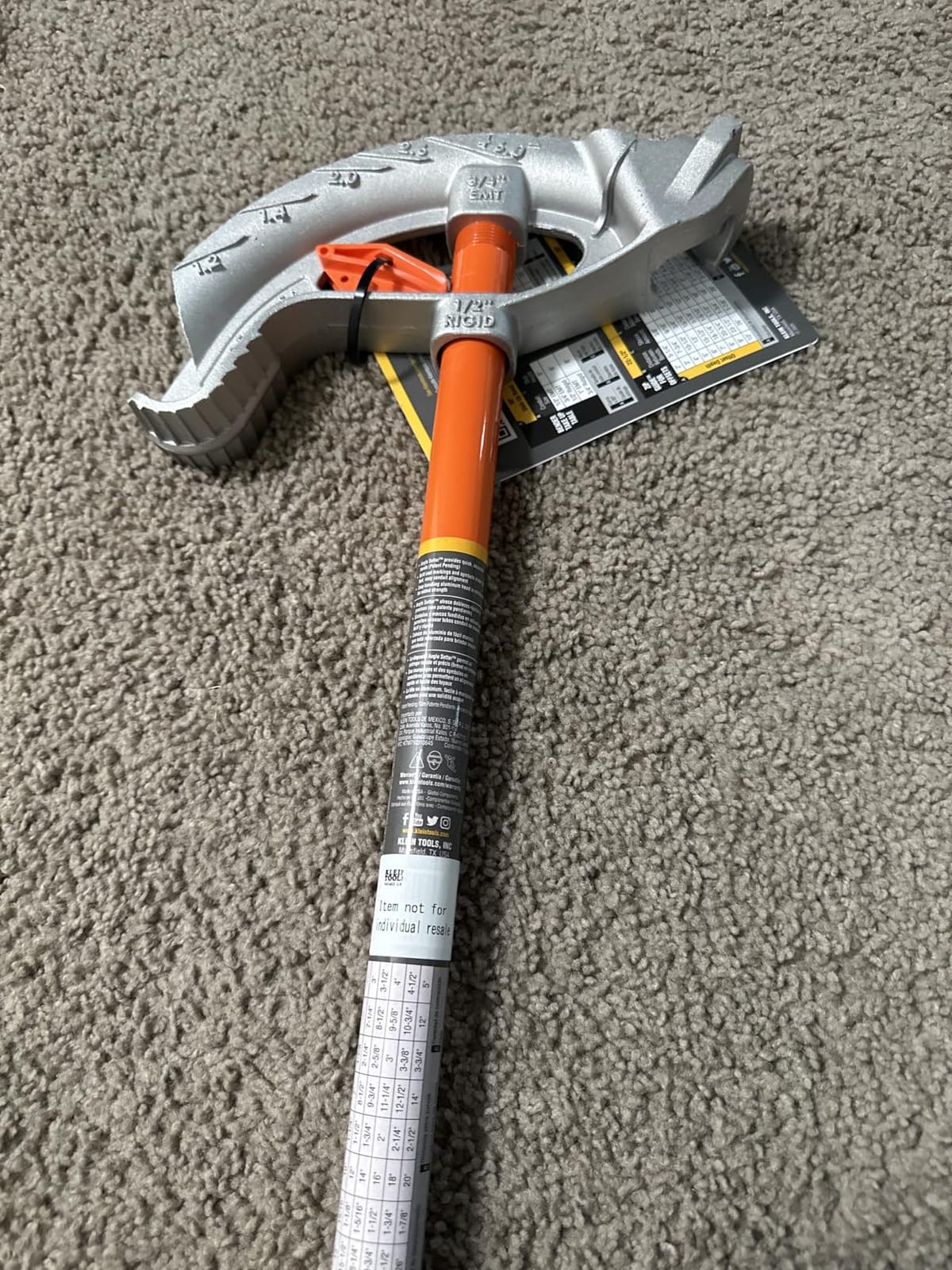
I have spent a lot of time with the Klein 51607, and the standout feature is the patent-pending Angle Setter. Instead of eyeballing your degree marks and hoping for the best, you set the Angle Setter to 10, 22.5, 30, or 45 degrees and let the tool do the work. This saves time and reduces wasted conduit on jobs where accuracy matters.
The wide foot pedal on this bender is a real improvement over narrower designs. It gives you a stable platform to push down on, which means better leverage and less foot fatigue when you are bending multiple sticks in a row. The bold cast markings are easy to read even in dim lighting, and the interior hook surface holds the conduit firmly so it does not twist or roll mid-bend.
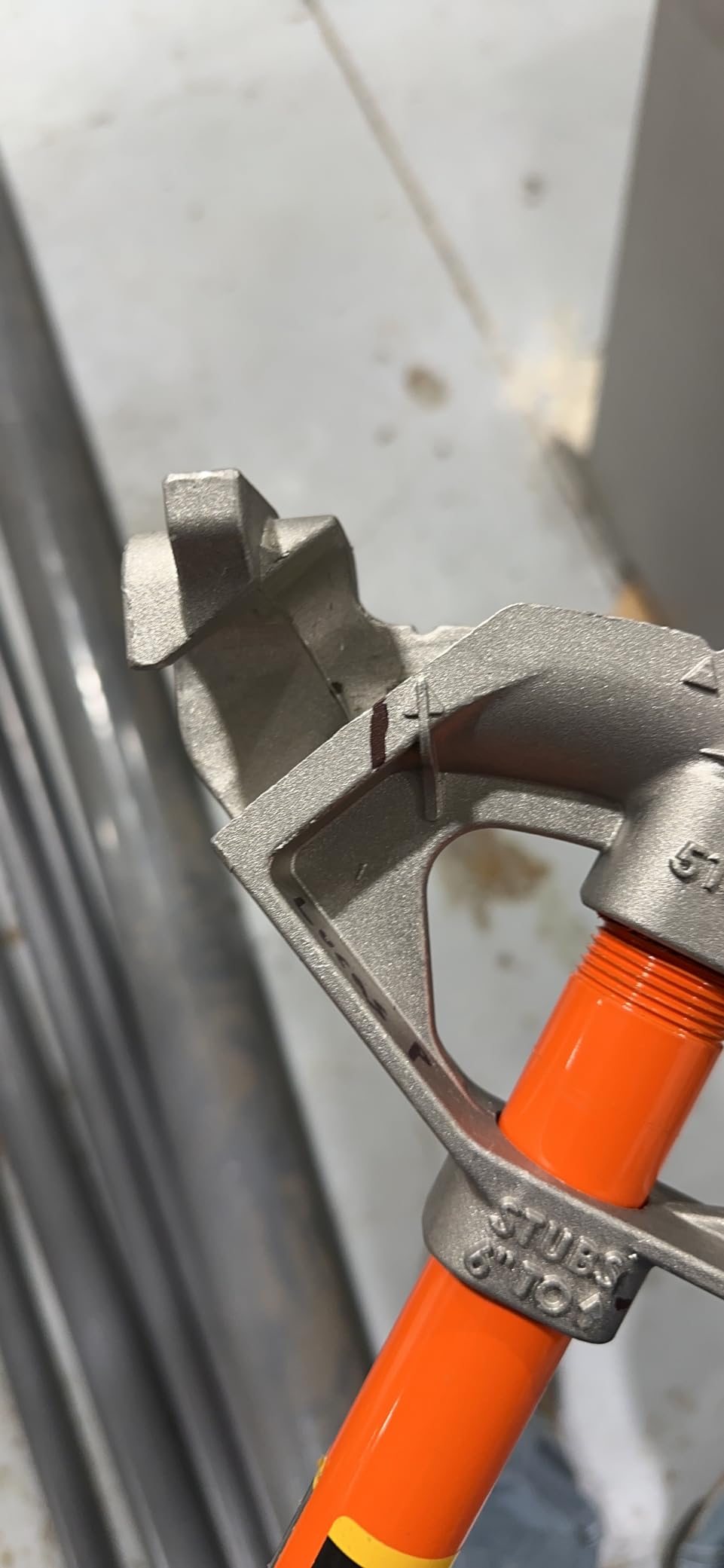
At 5.12 pounds, the aluminum head is light enough to carry around a jobsite all day without wearing you out. The reinforced construction means it can take drops and rough handling without deforming. With 91 percent of reviewers giving it five stars, the satisfaction level is about as high as you will find for any hand tool.
One thing I noticed is that you need to account for springback with this bender. EMT has a natural tendency to spring back slightly after bending, so you may need to overshoot your target angle by a degree or two. Once you get a feel for it, this becomes second nature.
What Size Conduit This Bender Handles
The Klein 51607 is designed for 3/4-inch EMT and 1/2-inch rigid conduit. This covers the most common residential and light commercial sizes. If your work involves mostly 1/2-inch EMT runs, the smaller Klein 51606 reviewed below is the better match.
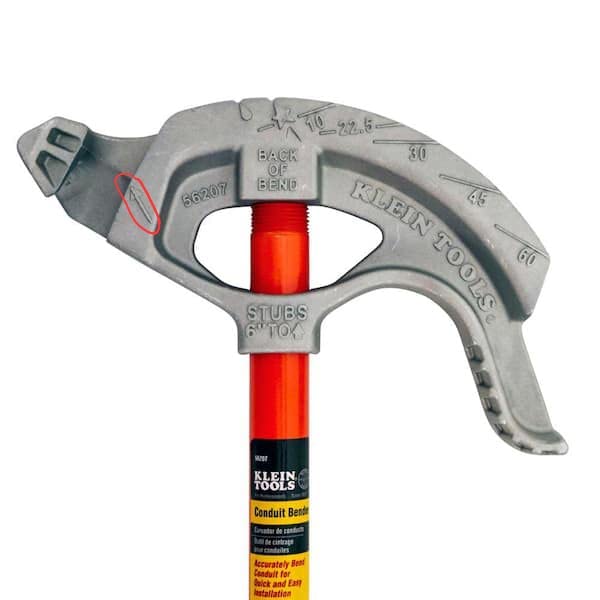
The bender includes markings for 10, 22.5, 30, 45, and 60 degrees. That range covers stub-ups, offsets, saddles, and back-to-back bends without needing a separate tool.
Angle Setter vs Traditional Markings
The Angle Setter is what separates this bender from the pack. Traditional benders rely on cast degree marks that you align by eye. The Angle Setter gives you a physical stop that takes human error out of the equation for the four most common bend angles.
If you bend conduit every day, this feature alone justifies choosing the Klein over a standard bender. Apprentices especially benefit because it builds muscle memory for correct angles faster.
2. Klein Tools 51606 Aluminum Conduit Bender – 1/2-Inch EMT
- Angle Setter for precise degree bends
- Wide foot pedal for leverage
- Interior clamp holds conduit while cutting
- Bold cast markings for alignment
- Interior hook prevents rolling
- Limited stock availability
The Klein 51606 is the 1/2-inch EMT sibling of the 51607. It shares the same Angle Setter technology, wide foot pedal, and bold cast markings. If your work centers on residential wiring where 1/2-inch EMT is the standard, this is the bender I would reach for.
What makes the 51606 slightly different is the interior clamp that securely holds the conduit while you cut it with a hacksaw. This is a small feature that saves time on the jobsite. Instead of fumbling with a separate clamp or vise, you can cut and bend with the same tool.
At 4.4 pounds, this is one of the lightest benders in the lineup. It is easy to carry on a tool belt or toss in a bucket. The aluminum construction means no rust concerns, even if it gets left out in damp conditions.
With an 86 percent five-star rate across 463 reviews, this bender has proven itself with working electricians. The only downside I found is that stock can be limited, so grab one when you see it available.
Best Use Cases for the 1/2-Inch Size
The 1/2-inch EMT bender is ideal for residential rough-in, small commercial projects, and retrofit work. Most branch circuit runs in homes use 1/2-inch conduit, so this size gets the most daily use for residential electricians.
If you do a mix of residential and commercial work, consider pairing this with a 3/4-inch bender so you are ready for any pipe size.
How the Interior Clamp Works
The interior clamp is a built-in feature that grips the conduit when you insert it into the bender head. This means you can saw through EMT without the pipe spinning or shifting, producing a clean, square cut every time.
This feature eliminates the need to carry a separate pipe vise to the jobsite for simple cuts. It is one of those details that shows Klein designed this tool around how electricians actually work.
3. TEMCo Dual Shoe Conduit Bender – 1/2-Inch and 3/4-Inch EMT
TEMCo 2 in 1 Dual Shoe Conduit Bender – 1/2″ & 3/4″ EMT, 1/2″ Rigid – 2 Benders in 1 Tool
- Two benders in one tool for 1/2 and 3/4 EMT
- Also bends 1/2-inch rigid and IMC
- Offset multiplier chart on handle
- 5-year limited warranty
- Standard bend radius
- Heavier than single-size benders at 7 pounds
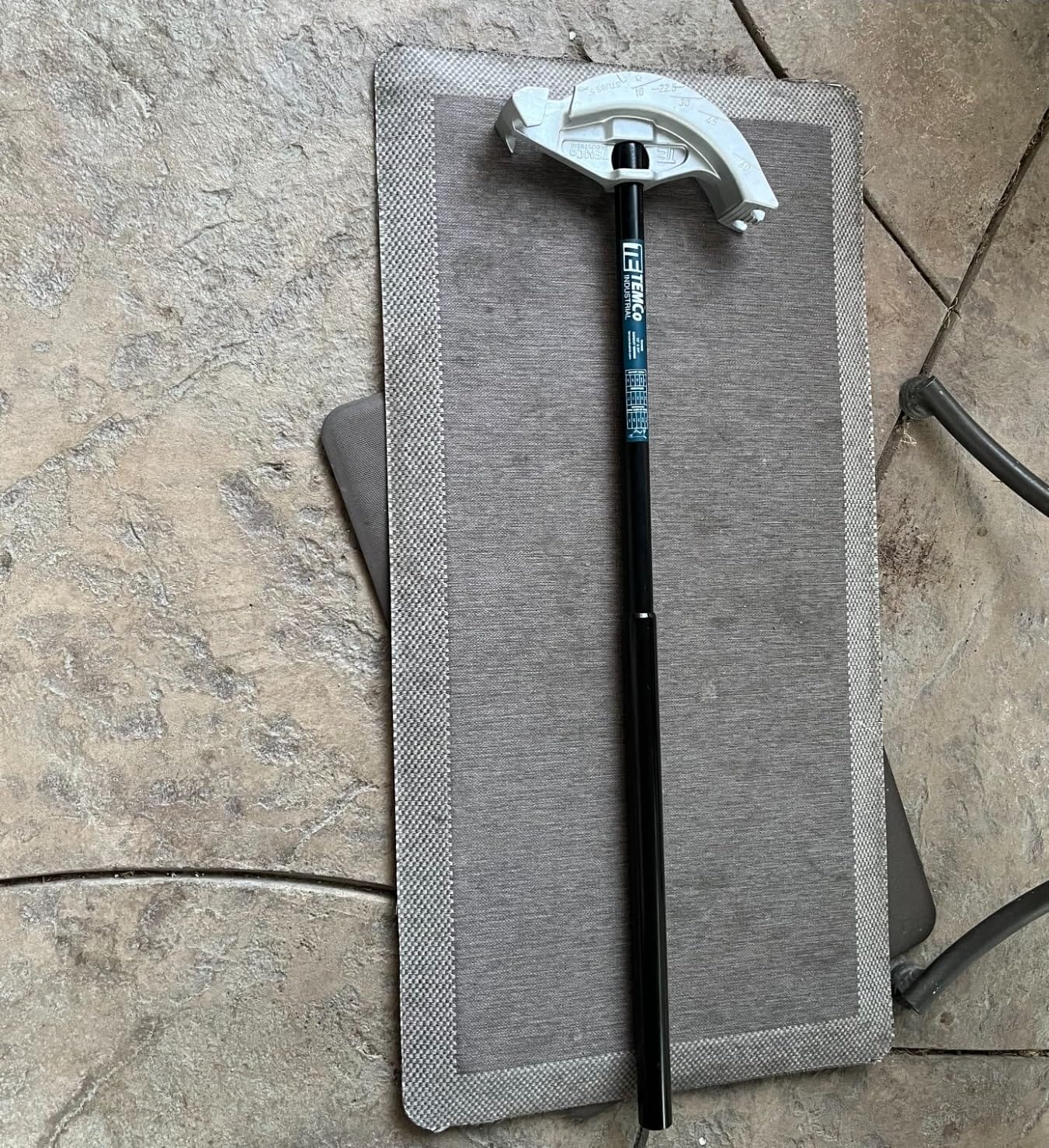
The TEMCo dual shoe bender solves a problem every electrician faces: needing two sizes on the same job without carrying two tools. One side bends 1/2-inch EMT, the other handles 3/4-inch EMT, and it also works on 1/2-inch rigid and IMC. For the price of a single bender, you get the functionality of two.
I found the offset multiplier chart molded into the handle genuinely useful. Instead of pulling out your phone or a cheat sheet to calculate multiplier formulas, the chart is right there on the tool. This speeds up offset bends considerably, especially for apprentices still learning the math.
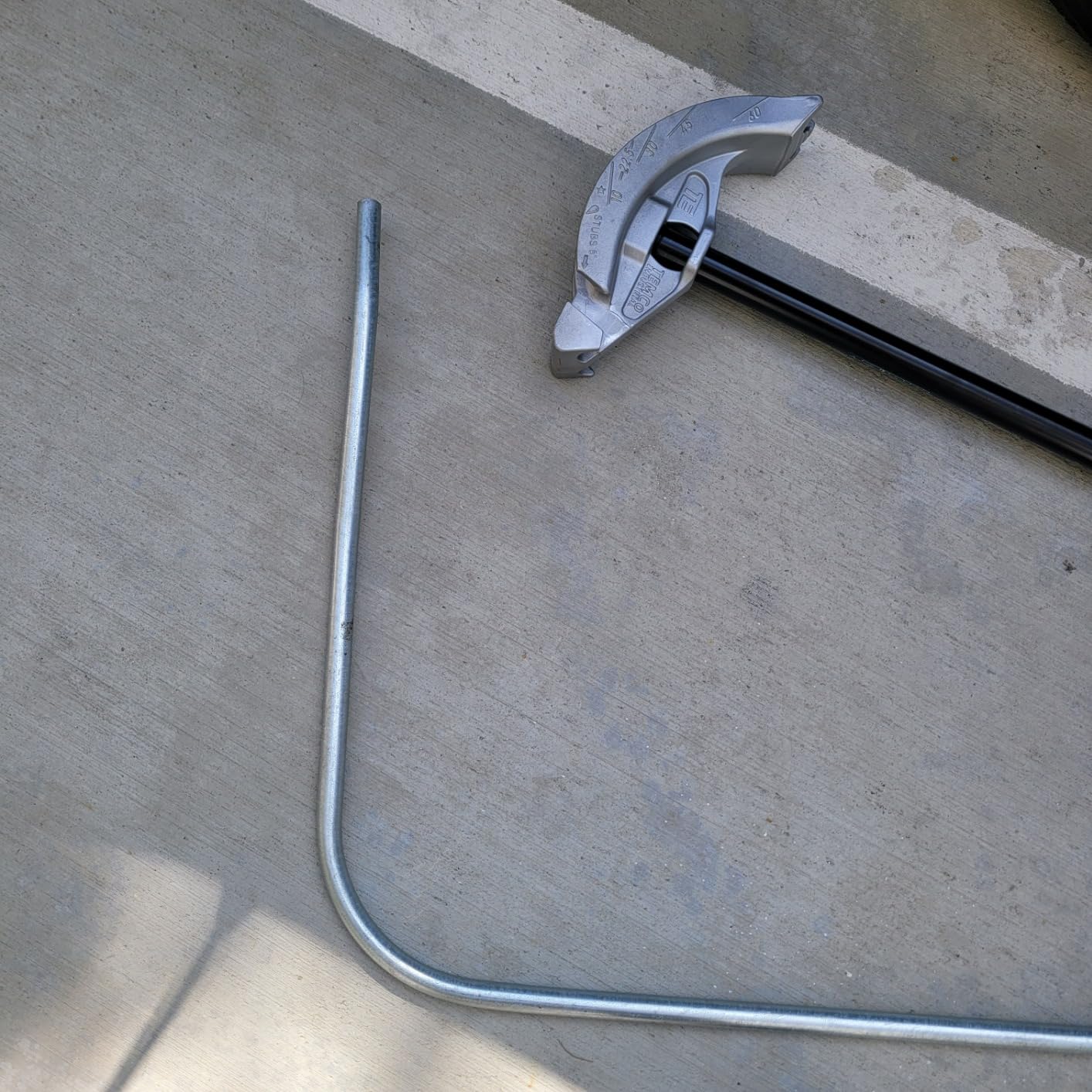
The trade-off for the dual-shoe design is weight. At 7 pounds, this bender is heavier than single-purpose aluminum models. That extra weight is noticeable after a full day of bending, but the convenience of carrying one tool instead of two makes up for it for most electricians.
The 5-year limited warranty is one of the best in this category. Most benders come with no warranty or a basic 1-year coverage. TEMCo stands behind this tool with a 5-year limited warranty plus a 1-year no-questions-asked return policy.
Durability of the Dual Shoe Design
The dual shoe design uses the same bend radius as a standard single-size bender. This means your bends meet code requirements just like they would with a dedicated tool. The aluminum construction holds up well to daily use, though the extra material makes it bulkier.
With a 75 percent five-star rate, this bender gets solid marks. The slightly lower rating compared to the Klein models reflects the weight issue and the fact that dual-purpose tools always involve some compromise.
Is the Dual Shoe Right for Your Work
This bender is ideal for electricians who work on varied jobsites where they never know which conduit size they will need. Service electricians, maintenance workers, and anyone who wants to travel light will appreciate having both sizes in one tool.
If you specialize in one size exclusively, a dedicated single-size bender will be lighter and more refined. But for generalists, the TEMCo dual shoe offers the best value on this list.
4. IDEAL Electrical Aluminum Conduit Bender 74-047 – 3/4-Inch EMT
- Lightweight aluminum construction
- Heat-treated head for strength
- Raised markings on both sides
- Serrated step prevents slippage
- Grooved internal hook grips conduit
- No warranty provided
- Limited stock availability
The IDEAL 74-047 has been on my radar for years because it is a proven workhorse. Electricians on Reddit consistently praise IDEAL benders for their weight and balance, and after using this one, I understand why. The 5.84-pound aluminum build feels solid without being heavy.
The heat-treated bender head is the key to this tool’s longevity. Heat treating strengthens the aluminum at the stress points where cheaper benders crack or wear out. IDEAL reinforces the head specifically where the most force concentrates during bends.
Raised markings cast into both sides of the head are a feature I wish every bender had. Whether you are right-handed or left-handed, you can read the degree marks without tilting the tool. The deeply serrated step and grooved internal hook prevent the conduit from slipping mid-bend, which is a common cause of ruined bends.
With 88 percent five-star reviews and a 4.8 rating across 178 reviews, this bender has earned its reputation. The main drawback is that IDEAL does not include a warranty, and stock can be tight at times.
How the Serrated Step Improves Bending
The serrated foot step gives your boot something to grip when you apply downward pressure. On smooth steps, your foot can slide off, especially in wet conditions or when wearing worn boots. The serrations bite into your sole and keep your foot planted.
This seems like a small detail until you are bending conduit on a slick concrete floor. The difference in control is immediately noticeable.
IDEAL vs Klein for 3/4-Inch EMT
Both IDEAL and Klein make excellent 3/4-inch aluminum benders. The Klein 51607 has the Angle Setter advantage, while the IDEAL 74-047 has the heat-treated head and serrated step. If you value precision angle stops, go with Klein. If you want maximum grip and durability, IDEAL is the stronger choice.
Price-wise, they are close enough that the decision comes down to which features matter more for your specific work style.
5. IDEAL Electrical Ductile Iron Bender 74-027 – 3/4-Inch EMT
- Ductile iron stronger than aluminum or malleable iron
- Compatible with 3/4 EMT and 1/2 rigid
- Built for heavy daily use
- Raised markings on both sides
- Serrated step prevents slippage
- Higher price point
- No warranty provided
When electricians on forums talk about wanting the strongest bender, ductile iron is the answer. The IDEAL 74-027 is built from ductile iron that provides more strength than malleable iron or aluminum. This is the bender you want if you work in fleet maintenance, industrial settings, or any environment where tools take a beating.
I noticed right away that the ductile iron head feels different from aluminum. There is no flex when you apply pressure, and the bend comes out crisp. The material is designed for a lifetime of heavy daily use, which is why many commercial electricians prefer iron over aluminum.
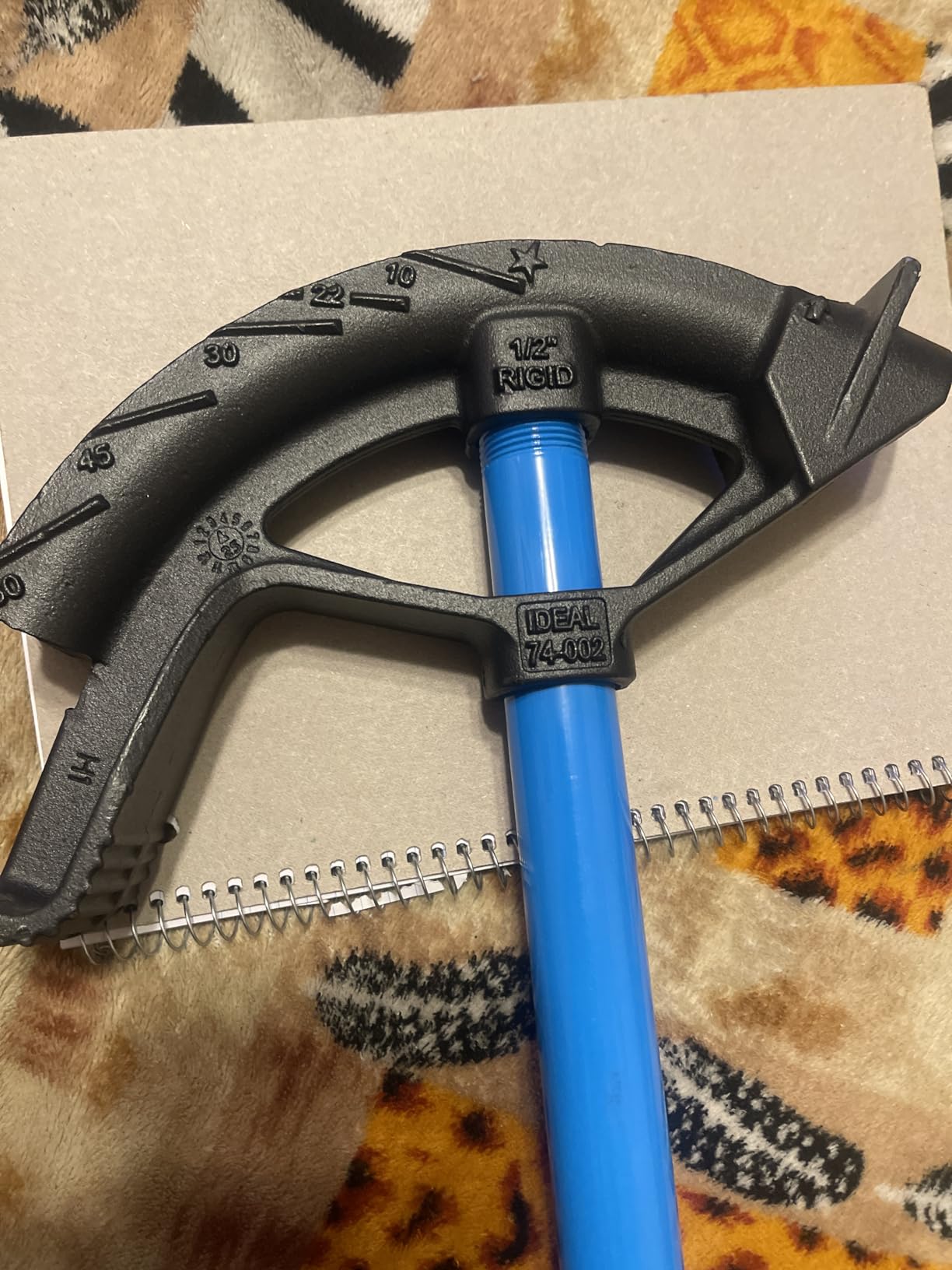
The raised markings on both sides match what IDEAL offers on their aluminum models. The serrated step and internal hook surface prevent the slippage that ruins bends and wastes conduit. Everything about this bender is designed for repeated, accurate use.
With a 91 percent five-star rating across 88 reviews, this iron bender clearly satisfies the electricians who buy it. The trade-offs are the higher price and the fact that IDEAL does not include a warranty.
When to Choose Ductile Iron Over Aluminum
Ductile iron makes sense for commercial electricians, industrial maintenance teams, and anyone bending conduit daily in demanding environments. The iron head will not wear or deform the way aluminum can over years of heavy use.
For residential work or occasional bending, aluminum is lighter and easier to handle. Iron is an investment for professionals who need maximum durability.
Rigid and IMC Compatibility
Beyond 3/4-inch EMT, this bender handles 1/2-inch rigid and IMC conduit. That versatility means you can use it for heavier wall conduit types that aluminum benders may struggle with.
This compatibility makes the higher price more justifiable, since you are getting a tool that works across multiple conduit types and will last for years.
6. Klein Tools 80148 ACCU-BEND Conduit Bending Set – 3/4-Inch EMT
- Complete 2-piece kit with bender and magnetic level
- Patented magnet track keeps magnets secure
- High visibility level with 4 angle readings
- Top-view vial windows
- Aluminum head with Angle Setter
- Limited stock availability
The Klein 80148 is not just a bender. It is a complete conduit bending system. The kit pairs the ACCU-BEND 3/4-inch aluminum bender with a magnetic level tool, giving you everything you need for precise bends in one package. For electricians who want to ditch the separate torpedo level, this set is a smart buy.
The magnetic level uses a patented magnet track that keeps the rare-earth magnets securely in place. Cheaper magnetic levels have magnets that fall out after a few months of use. Klein solved this problem with a track design that holds the magnets permanently.

I really like the high-visibility level vials. The large vials are easy to read at level, 90, 45, and 30 degrees. The top-view vial windows mean you can check your angle from above without craning your neck to the side. When you are bending conduit on the floor or overhead, this visibility makes a real difference.
The bender itself includes the same Angle Setter technology as the Klein 51607, so you get the same precise degree stops for 10, 22.5, 30, and 45 degrees. With 81 percent five-star reviews, this kit earns strong marks from working electricians.
How the Magnetic Level Improves Accuracy
The magnetic level attaches to the conduit using a thumb screw. Once attached, you can read your bend angle in real time as you apply pressure. This eliminates the guesswork of checking angles after the bend is already made.
For saddle bends and back-to-back bends where accuracy is critical, having the level right on the conduit during the bend is a significant advantage. It is the closest thing to real-time angle feedback you can get with a hand tool.
Is the 2-Piece Kit Worth It
If you already own a good torpedo level, the bender alone may be enough. But if you need both a bender and a level, buying them as a set saves money compared to purchasing separately. The quality of the Klein magnetic level justifies the kit price.
This set is ideal for electricians who want a matched system where the bender and level are designed to work together from the start.
7. IDEAL Electrical Conduit Iron Bender 74-034 – 1.25-Inch EMT
- Handles large 1.25-inch EMT and 1-inch rigid
- Ductile iron for maximum strength
- Lifetime daily use durability
- Raised dual-side markings
- 89 percent 5-star reviews
- 1-year manufacturer warranty
- Higher price point for large size
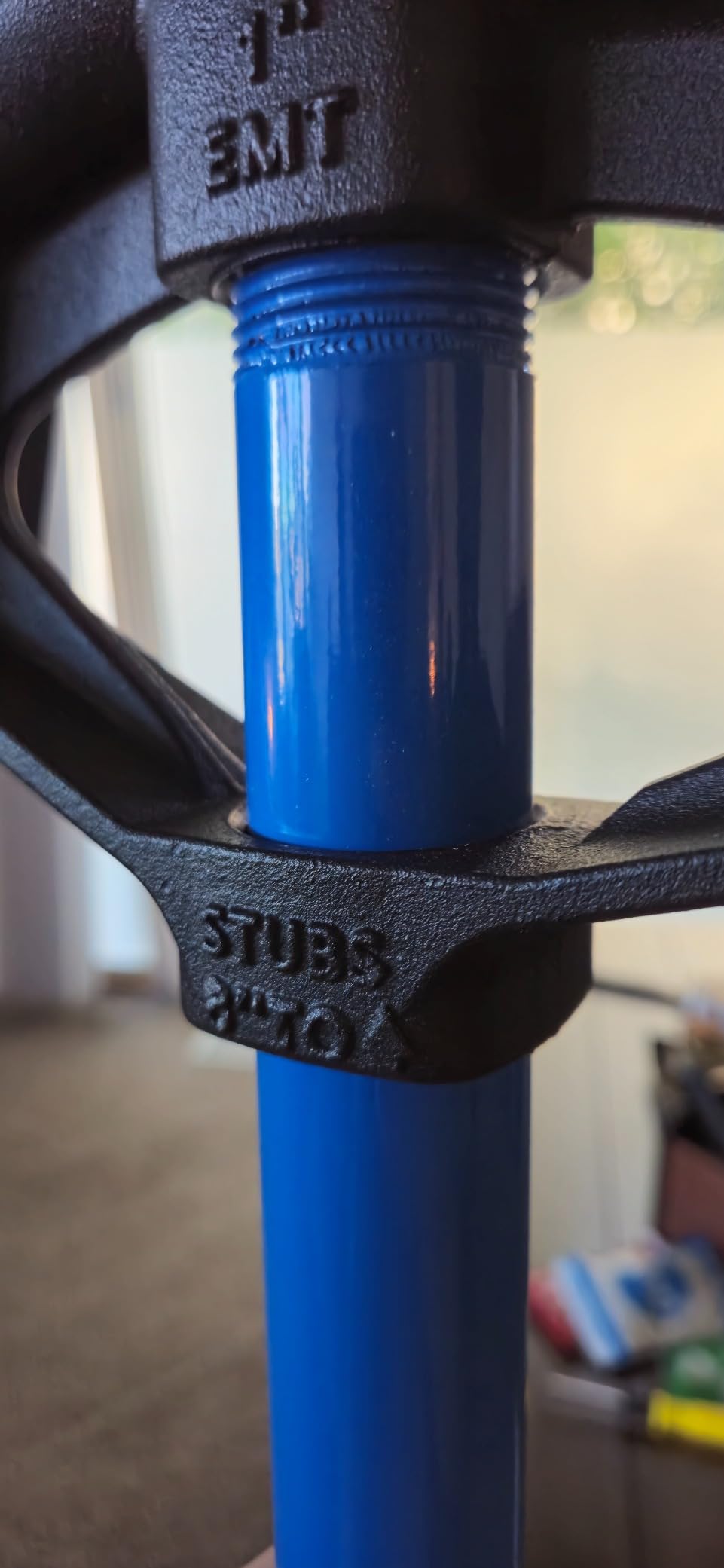
When you need to bend large conduit, the IDEAL 74-034 is the tool for the job. This ductile iron bender handles 1-1/4-inch EMT and 1-inch rigid and IMC conduit. That is the kind of heavy pipe you encounter in commercial feeder runs and industrial installations.
Bending 1.25-inch conduit requires serious leverage and a bender head that will not flex under pressure. The ductile iron construction on this tool delivers that rigidity. I found that even at the larger pipe sizes, the bends come out clean and consistent.

The raised markings on both sides follow the same IDEAL design philosophy as their smaller benders. The serrated step and internal hook surface prevent slippage, which becomes even more important when you are putting significant force into bending large conduit.
With 89 percent five-star reviews across 283 ratings, this is one of the most reviewed large benders available. It also includes a 1-year manufacturer warranty, which is better than what IDEAL offers on their aluminum models. This is a professional-grade tool built for daily trade use.
What Jobs Require a 1.25-Inch Bender
Large conduit runs are common in commercial buildings, industrial facilities, and service entrances. If you are running feeder circuits, pulling large wire, or working on motor controls, you will encounter 1-inch rigid and 1.25-inch EMT regularly.
Most residential electricians will never need this size. But for commercial and industrial work, having a bender that can handle large conduit saves the hassle of renting equipment or pre-fabricating bends offsite.
Ductile Iron for Large Conduit
When you are bending 1.25-inch conduit, the forces involved are significant. Aluminum benders are not rated for this size because the material can flex or crack under the pressure. Ductile iron provides the strength needed to bend large pipe without deforming the tool.
The IDEAL 74-034 is purpose-built for this work. If large conduit is part of your job, this is the bender you need.
8. Greenlee 1810 Little Kicker Offset Hand Bender – 1/2-Inch EMT
Greenlee 1810 Little Kicker Offset Hand Bender for 1/2″ EMT Conduit, Silver/Green
- Creates consistent offset bends in single step
- Matches box knockouts perfectly
- High-tensile steel construction
- Ideal for wall-mounted boxes
- Simple insert-depress-release operation
- Limited to 1/2-inch EMT only
- Higher price for a specialized tool
The Greenlee 1810 Little Kicker is a different kind of bender. Instead of making stub-ups and 90-degree bends, this tool specializes in one thing: box offsets. If you do exposed conduit work where the pipe needs to sit flush against a wall before entering a box, this tool creates the perfect offset every time.
The operation is simple. Insert the conduit, depress the handle, release, and remove. You get a consistent offset with a maximum depth of 0.56 inches (9/16 inches) that matches standard box knockouts. No measuring, no marking, no guessing.
I have seen electricians rave about the Little Kicker on forums because it solves a specific problem that standard benders handle poorly. Making a clean box offset with a traditional bender requires skill and practice. The Little Kicker makes it foolproof.
The high-tensile steel construction means this tool will last a career. With 81 percent five-star reviews across 236 ratings, the satisfaction level is strong. The main drawback is that it only works on 1/2-inch EMT and serves one specific purpose.
What the Little Kicker Does That Standard Benders Cannot
A standard bender can make offsets, but getting them perfectly consistent and matching the knockout spacing is difficult. The Little Kicker uses a mechanical compression process that creates identical offsets every single time.
For exposed conduit work where appearance matters, this consistency is the difference between a professional-looking installation and a sloppy one.
Is a Specialized Offset Bender Worth It
If you only occasionally run exposed conduit, a standard bender is probably enough. But if box offsets are a regular part of your work, the time savings and consistency of the Little Kicker pay for the tool quickly.
Many electricians keep this tool alongside their main bender as a specialty instrument for finish work. It is not a replacement for your primary bender, but a complement that handles one specific job better than anything else.
How to Choose the Right Conduit Bender?
Choosing among the best conduit benders for electricians comes down to four decisions: material, size, features, and the type of work you do. Here is how I break it down.
Aluminum vs Iron: Which Material Is Better
This is the most common question electricians ask, and the answer depends on your work. Aluminum benders are lighter, easier to carry, and resist corrosion. They are the standard choice for residential and light commercial work. The Klein and IDEAL aluminum models on this list handle daily use without issue.
Iron benders, specifically ductile iron, are stronger and more rigid. They do not flex under pressure, which produces crisper bends, especially in larger conduit sizes. Commercial and industrial electricians often prefer iron because it holds up to the demands of heavy daily use.
The downside of iron is weight and fatigue. If you are bending conduit all day on a residential job, an iron bender will wear you out faster. Aluminum is the better choice for all-day carrying, while iron is the better choice for durability and precision in heavy applications.
What Size Conduit Bender Do You Need
The most common sizes for electricians are 1/2-inch and 3/4-inch EMT. If you do residential work, start with a 1/2-inch bender since most branch circuit runs use that size. For commercial work, a 3/4-inch bender is essential.
Many electricians carry both sizes. The TEMCo dual shoe reviewed above gives you both in one tool if you want to travel light. For large commercial feeders, you will need a 1-inch or 1.25-inch bender like the IDEAL 74-034.
Remember that bender sizes refer to EMT capacity. Most benders also handle one size smaller in rigid conduit. A 3/4-inch EMT bender typically also bends 1/2-inch rigid.
Key Features That Actually Matter
Based on forum discussions and real-world use, these are the features that separate good benders from great ones:
Degree markings on both sides of the head let you read angles regardless of which hand you bend with. Wide foot pedals provide better leverage and reduce foot fatigue. Serrated steps prevent your boot from slipping during bends. Interior hooks that grip the conduit prevent rolling and twisting.
Advanced features like the Klein Angle Setter and the Greenlee peg system take accuracy to another level. If you are willing to pay for these features, they reduce wasted conduit and speed up your work.
Common Bend Types Every Electrician Should Know
Every bender on this list can produce the four essential bend types: stub-up (90-degree), offset, saddle, and back-to-back. The key marks on the bender head that make these bends possible are the arrow, star point, rim notch, and center marks.
For stub-ups, you use the arrow mark. For offsets, you use the star point and degree marks. For saddles, you combine multiple bends using the center marks. For back-to-back bends, the star point is your reference. Understanding these marks is what separates skilled conduit bending from trial and error.
Frequently Asked Questions
What is the tool called that electricians use to bend conduit?
The tool is called a conduit bender or hand bender. It consists of a bending shoe that shapes the conduit, a foot pedal for leverage, and a handle for applying force. Electricians use hand benders to create precise angles in EMT, rigid, and IMC conduit for electrical installations.
Which tubing bender is considered the best?
The Klein Tools 51607 Aluminum Conduit Bender is widely considered the best conduit bender for electricians. It earns the top spot thanks to its Angle Setter technology for precise degree bends, wide foot pedal for leverage, bold cast markings, and reinforced aluminum head. It holds a 4.8-star rating with 594 reviews.
Which is better for bending conduit, an aluminum or iron bender?
Aluminum benders are lighter, easier to carry all day, and resistant to corrosion, making them ideal for residential and light commercial work. Iron benders, specifically ductile iron, are stronger and more rigid, producing crisper bends and lasting longer under heavy daily use. For commercial and industrial work, iron is preferred. For all-day residential bending, aluminum is the better choice.
What bender is the strongest?
Ductile iron benders are the strongest option available. The IDEAL 74-027 (3/4-inch EMT) and IDEAL 74-034 (1.25-inch EMT) both use ductile iron construction that provides more strength than malleable iron or aluminum. These benders are designed for a lifetime of heavy daily use in commercial and industrial settings.
Final Thoughts on the Best Conduit Benders for Electricians
After reviewing all eight benders, the Klein Tools 51607 stands out as the best conduit bender for electricians in 2026. The Angle Setter technology, wide foot pedal, and reinforced aluminum head make it the most accurate and user-friendly option for daily work. For value, the TEMCo dual shoe gives you two sizes in one tool. For maximum durability, the IDEAL ductile iron models are built to last a career.
The right bender for you depends on your trade. Residential electricians will love the lightweight aluminum models from Klein and IDEAL. Commercial electricians should look at ductile iron for daily durability. And if box offsets are a regular part of your work, the Greenlee Little Kicker is a specialized tool that earns its place in your kit.
Pick the size and material that matches your work, and you will get clean, professional bends on every job.