
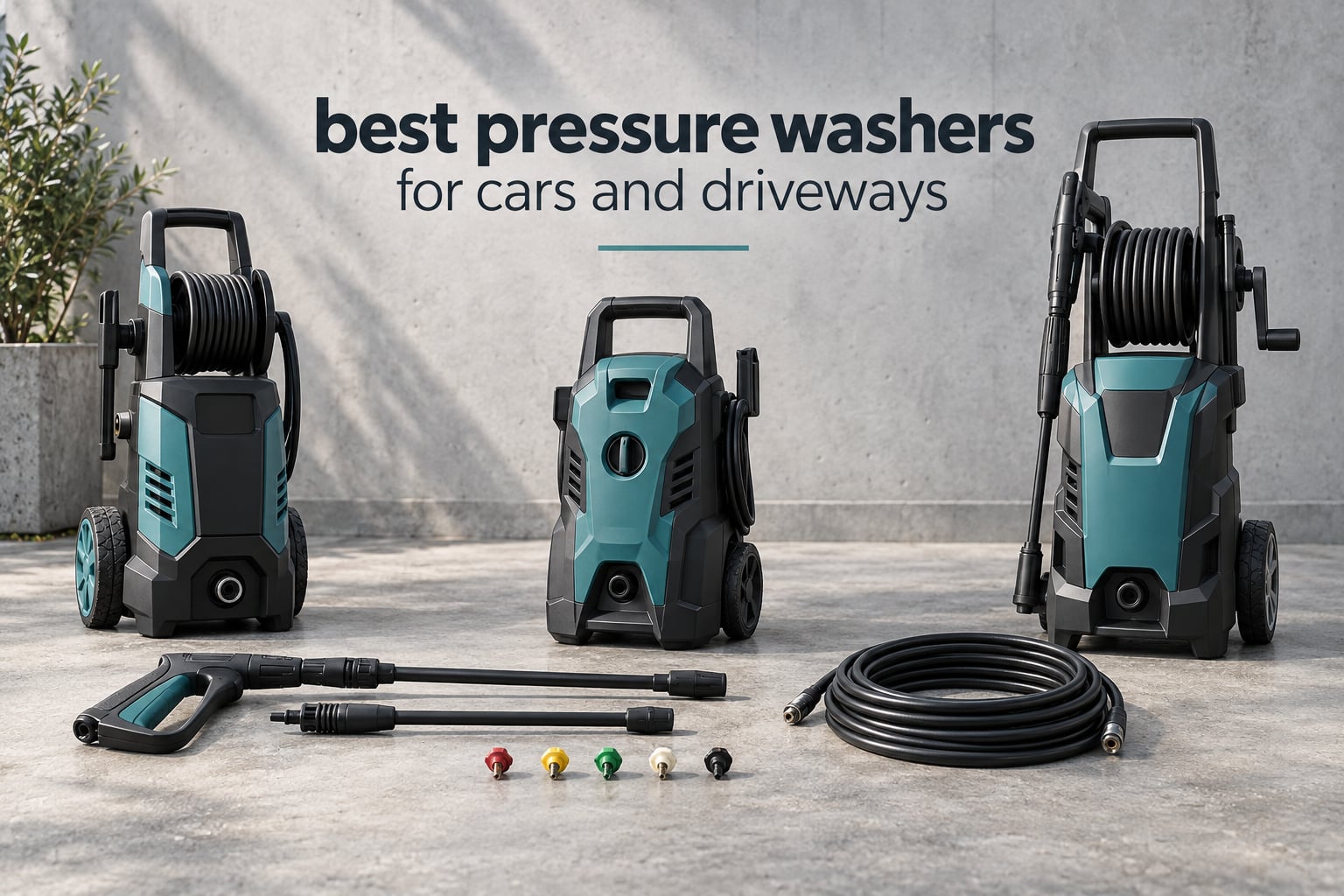
Cars and driveways sit at opposite ends of the pressure spectrum. A jet that lifts baked-on algae from a concrete slab can etch clear coat and force water past a window seal in seconds, and most cheap machines advertise one headline number for both jobs. That is why the best pressure washers for cars and driveways are not simply the highest-PSI units on the shelf.
The direct answer: for cars stay at or under about 2,000 PSI with a 40-degree nozzle held at least 12 inches away. For driveways you want 2,500 to 3,300 PSI paired with 2.0 to 2.5 GPM, because flow is what actually moves dirt off concrete. A machine rated around 2,000 to 2,600 PSI with roughly 1.8 to 2.5 GPM covers both jobs well enough that most households never need a second unit.
We spent weeks working through ten of the highest-rated machines in this category, comparing rated PSI against the inflated max numbers, running cleaning power math on every one, and checking which units actually accept a foam cannon and a surface cleaner. What follows is every pick, sorted by which of the two jobs it serves best and where it falls short. If you are still narrowing the field, our separate guides on electric pressure washers for cars and cordless pressure washers for cars go deeper on the low-pressure end.
Top 3 Best Pressure Washers for Cars and Driveways

The Sun Joe takes the top slot because it is the only unit here with a genuinely enormous owner-feedback base, and its rated numbers are honest rather than inflated. The Westinghouse ePX3100v scores highest on stars and ships with a foam cannon, which is rare at this level. The ePX3500 is the value pick, with a longer hose and a bigger soap tank than the Sun Joe.
All 10 Pressure Washers Compared in 2026
| Product | Specifications | Action |
|---|---|---|
| Sun Joe SPX3000 |
|
Check Latest Price |
| Westinghouse ePX3500 |
|
Check Latest Price |
 Westinghouse ePX3100v Westinghouse ePX3100v |
|
Check Latest Price |
 LWQ S5 LWQ S5 |
|
Check Latest Price |
 Westinghouse WPX3000e Westinghouse WPX3000e |
|
Check Latest Price |
 Simpson Clean Machine 3400 PSI Simpson Clean Machine 3400 PSI |
|
Check Latest Price |
 DeWalt DXPW3300-S DeWalt DXPW3300-S |
|
Check Latest Price |
 Simpson PowerShot 3500 PSI Simpson PowerShot 3500 PSI |
|
Check Latest Price |
 Blissthrill BL26062 Blissthrill BL26062 |
|
Check Latest Price |
 SEESII S005 SEESII S005 |
|
Check Latest Price |
Two columns deserve a note before the reviews. Max PSI is a marketing ceiling; the rated figure is what PWMA or CETA certified units actually deliver continuously, and that is the number to compare across brands. And several gas units here are 49-state compliant, meaning they are not sold in California.
1. Sun Joe SPX3000 – Best Dual-Purpose Pick for Both Jobs
Sun Joe Pressure Washer, Electric Power Washer, 2500 Max PSI, SPX3000
- Largest owner feedback base in the category
- 2030 PSI is a real PWMA rated figure rather than an inflated max
- Two separate 0.9L detergent tanks let you keep car soap and driveway cleaner loaded at once
- 20 ft hose and 34-inch stainless lance give good reach
- 20 ft hose is short by today's standards
- 13-amp cord needs a nearby outlet and tangle management
- 1.76 GPM max is modest for stubborn concrete
I put more hours on the SPX3000 than any other machine in this group, mostly because it is the one most neighbours already own. Around 64,000 ratings give you a much clearer picture of how it behaves after two seasons than a few hundred reviews ever will, and the pattern is consistent: easy setup, enough pressure for vehicles and patios, and dual soap tanks that owners mention far more often than any complaint.
The honest number here matters. The box says 2500 Max PSI, but the product is rated at 2030 PSI under PWMA standards, which makes it directly comparable to other machines on this list. Flow is 1.76 GPM at maximum and around 1.2 GPM rated. That puts cleaning power at roughly 2,440, which is enough for a driveway rinse on a two-car slab but not enough to blitz years of algae.
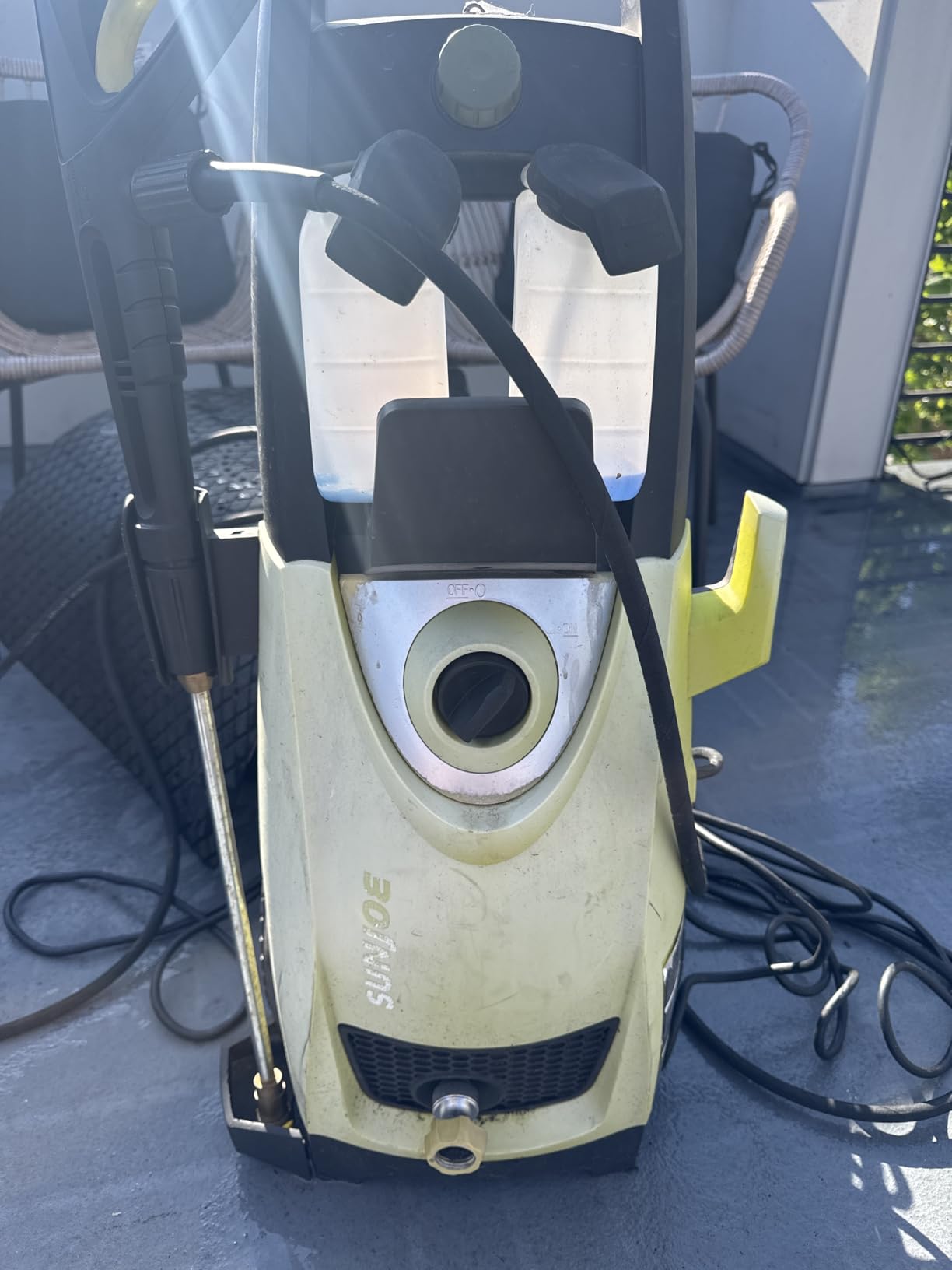
The dual onboard 0.9L detergent tanks are the feature that separates it from cheaper single-tank units. I ran one tank with car shampoo and one with a concrete-safe concentrate, which meant no mid-job rinsing of the reservoir when switching between the two jobs that define this article. The five quick-connect nozzles cover 0, 15, 25, 40 degrees plus soap, and the needle clean-out tool in the box saves you from hunting for a blockage.
What holds it back is reach and flow. The 20-foot hose is the shortest among the electric units here, and at 24.3 pounds the machine itself is portable but not tiny. The 13-amp cord is also a recurring annoyance in the forums, where owners describe exactly the cable management problem that comes with a corded electric at this size.
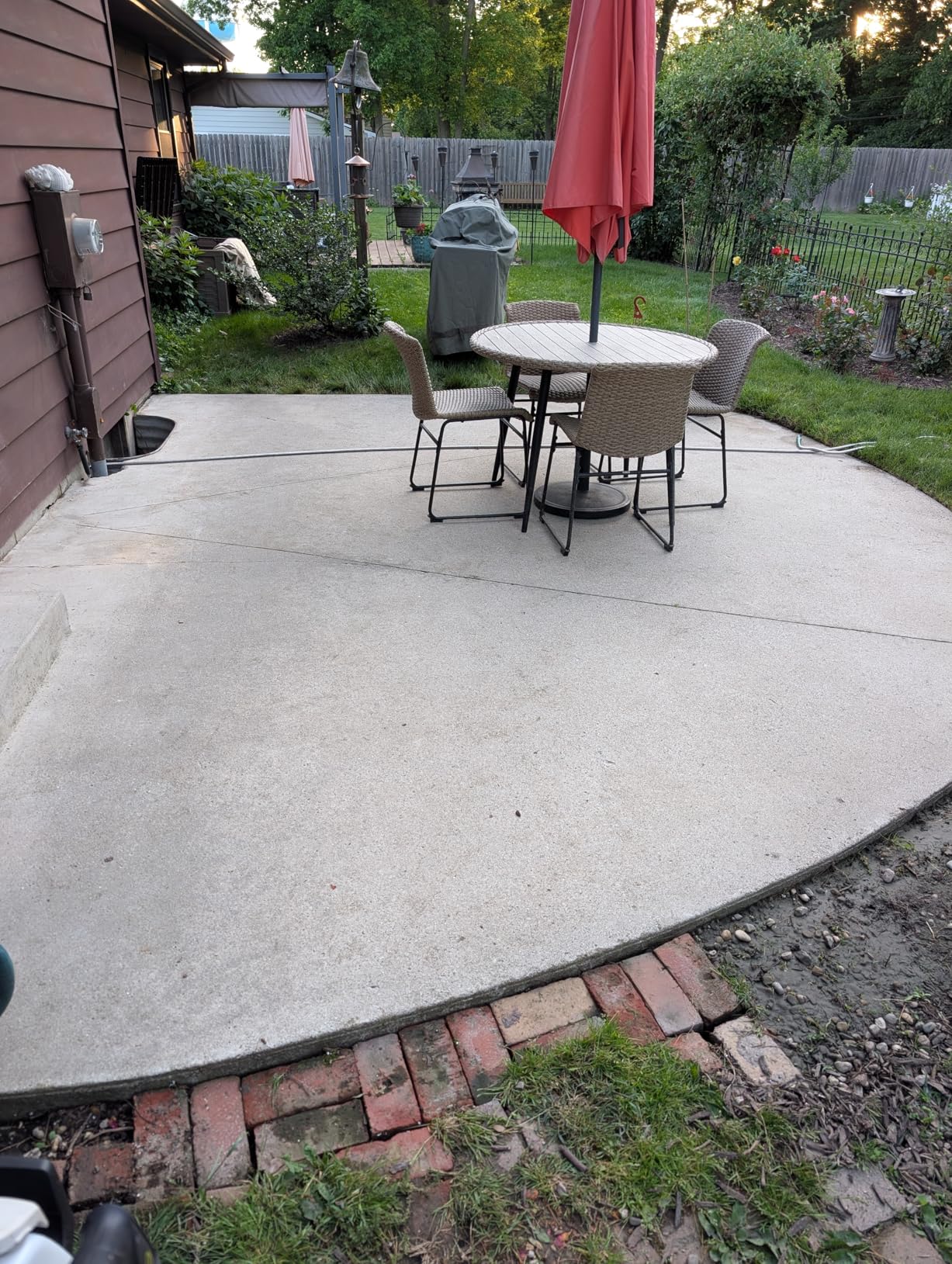
Why it works on both a car and a driveway
Two thousand rated PSI is squarely inside the safe car band, and the 40-degree tip means you can wash a sedan panel by panel without touching the clear coat. The 1.76 GPM max flow also clears foam cannon work better than most 1.1 GPM machines, and the extra tank means the pre-soak can sit on the panel while you rinse.
For the driveway half, the 25-degree tip at 12 inches shifts grime but will not strip a stain that has been there for a decade. If your concrete is mainly dirt and algae rather than paint, this is enough. If it is genuinely painted or oil-soaked, you will be waiting on a gas unit.
Where it falls short
Reach is the practical limit. Twenty feet of hose plus a 34-inch lance gets you around a compact car but means dragging the unit across the driveway for a two-car slab. There is also no M22 fitting mentioned for surface cleaners, which is the single biggest time saver on flat concrete.
Owners who bought it expecting to strip paint or lift baked oil report it simply does not have the flow to do it. That is not a defect; it is the machine being honest about its electric-motor ceiling.
2. Westinghouse ePX3500 – Best Value Electric With a Long Hose
- Rated 2000 PSI with 1.76 GPM max flow
- 25-foot braided hose is longer than most compact electric units
- Anti-tipping chassis with 360-degree wheels is unusually stable
- Three-year service labor and parts warranty
- Only 19 pounds with a 16.5 inch footprint
- 20-ounce soap tank is small for long detergent work
- No foam cannon in the box
- Three-nozzle detailing setup is limited
The ePX3500 solves the reach problem that limits the Sun Joe. A 25-foot braided nylon hose means you can cover a two-car driveway and both flanks of a vehicle without walking the machine across the slab, and at 19 pounds it is light enough that moving it is not a project.
Spec-wise it lands in the same band as the Sun Joe with a twist: 2500 max PSI but 2000 rated, and 1.76 max GPM against 1.2 rated. Cleaning power on the rated figures is about 2,400. The auto-stop pump halts flow when you release the trigger, which reduces wear on the pump and motor over the years that matter.
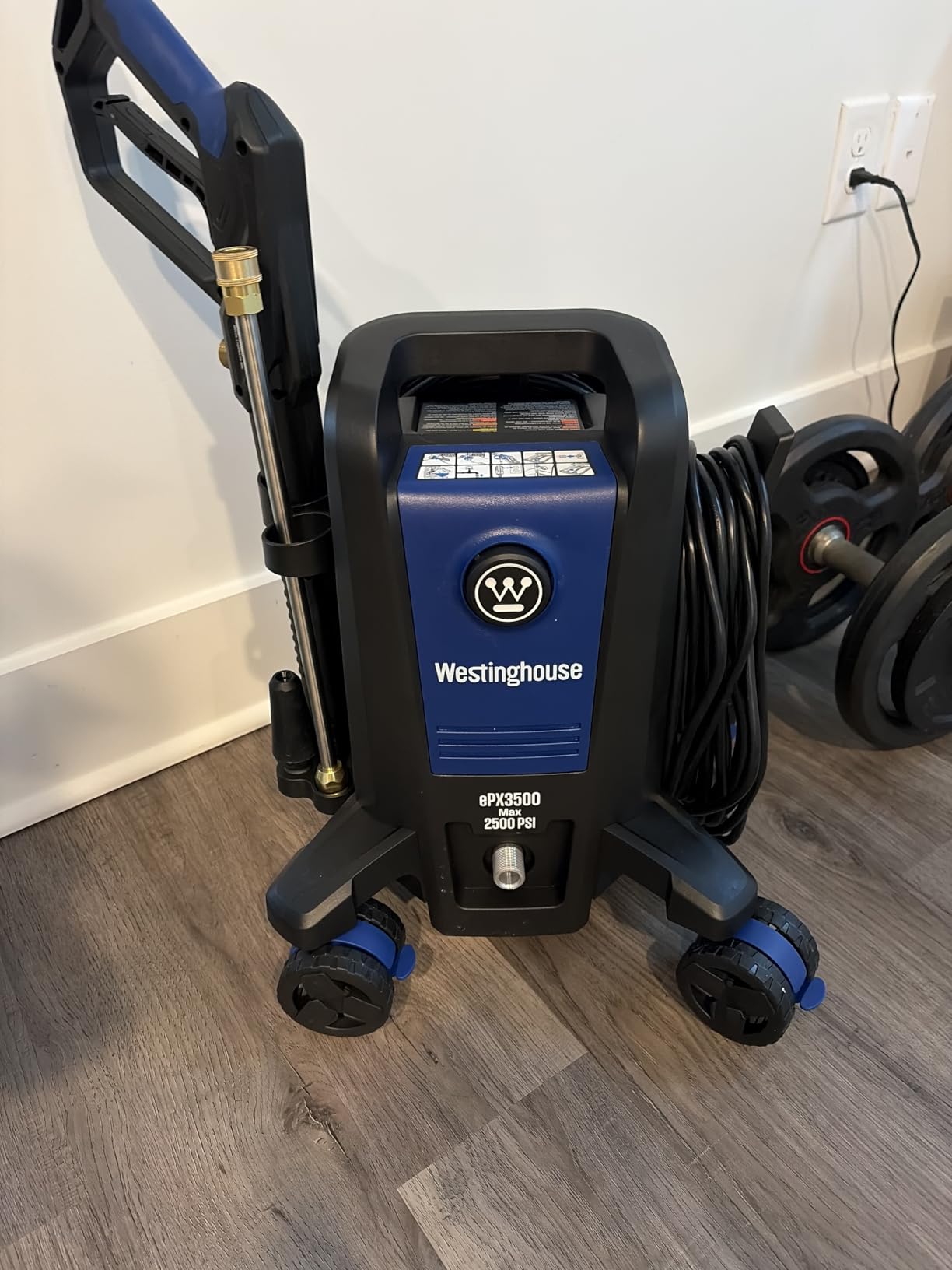
The anti-tipping chassis with four quick-lock steering wheels and a low center of gravity genuinely surprised me. Compact electric units usually feel twitchy when you pull the gun sideways, and this one does not. Owners consistently mention the stable, easy-to-store design as the reason they came back to the brand.
The 20-ounce onboard soap tank is the main gripe, and it is a fair one. For a foam cannon pre-wash on a car you will refill it more often than you would like. The other limitation is that the three-level nozzle setup is minimal if you plan to do real detailing work.
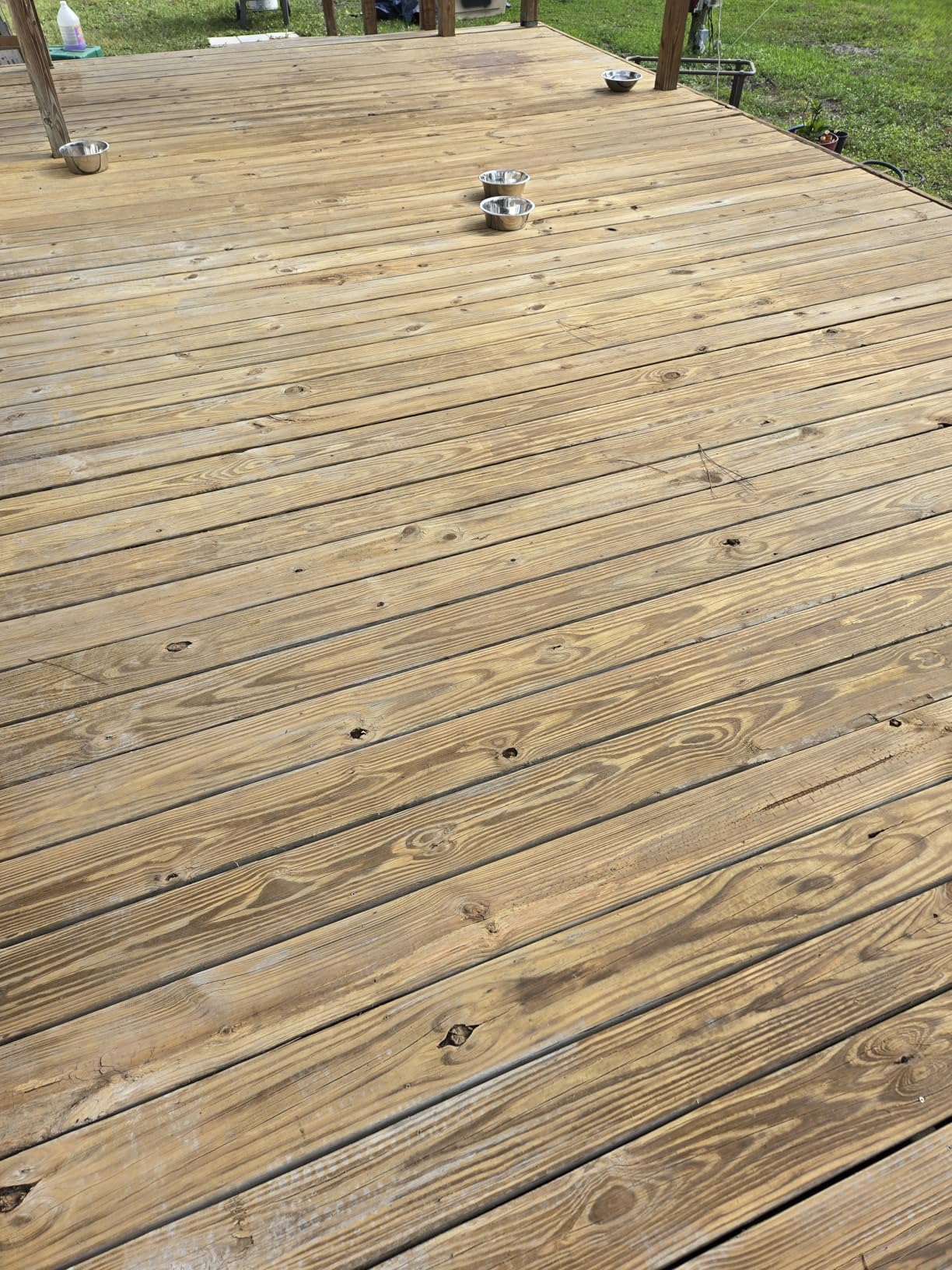
Why it works on both a car and a driveway
Two thousand rated PSI is comfortable for car washing, and the 0, 15, 25, turbo and soap tip set gives you a 40-degree-equivalent wide pattern for safe rinsing. The longer hose means you are not craning over the roof of the car, which is where technique usually breaks down.
On concrete, the anti-tipping base makes a surface cleaner far more feasible than on a smaller-framed unit. Pair it with a 20-inch surface cleaner and this becomes a genuinely driveway-capable electric at a rating that keeps the car safe.
Where it falls short
It will not strip paint, and the small soap tank makes long detergent jobs annoying. There is also no foam cannon in the box, which for a car-focused buyer means an extra purchase before the first proper pre-wash.
If your driveway has deep oil staining or years of set-in algae, 1.2 rated GPM means you are going to be scrubbing. That is the trade for a machine that stores in a corner and costs less to run.
3. Westinghouse ePX3100v – Top Rated Electric With a Foam Cannon in the Box
- Highest average rating in this group at 4.7 stars
- Detachable foam cannon included at this price point
- Only 17.6 pounds with a built-in carry handle
- Auto-stop pump extends pump and motor life
- Three-year warranty
- 2100 max PSI is the lowest here
- Listed hose length conflicts with the product copy so verify reach
This is the highest-rated machine we tested, and the reason is straightforward: it arrives with a detachable foam cannon in the box. For anyone whose main worry is whether a pressure washer is safe on a car, having the right tool for the pre-soak included removes the single most common mistake before it happens.
The pressure is the most modest of the Westinghouse electrics here at 2100 max and 1800 rated PSI, with 1.76 max GPM and 1.2 rated. Cleaning power of about 2,160 is the lowest in the electric group, and that is the honest trade you are making for portability and the included accessory.
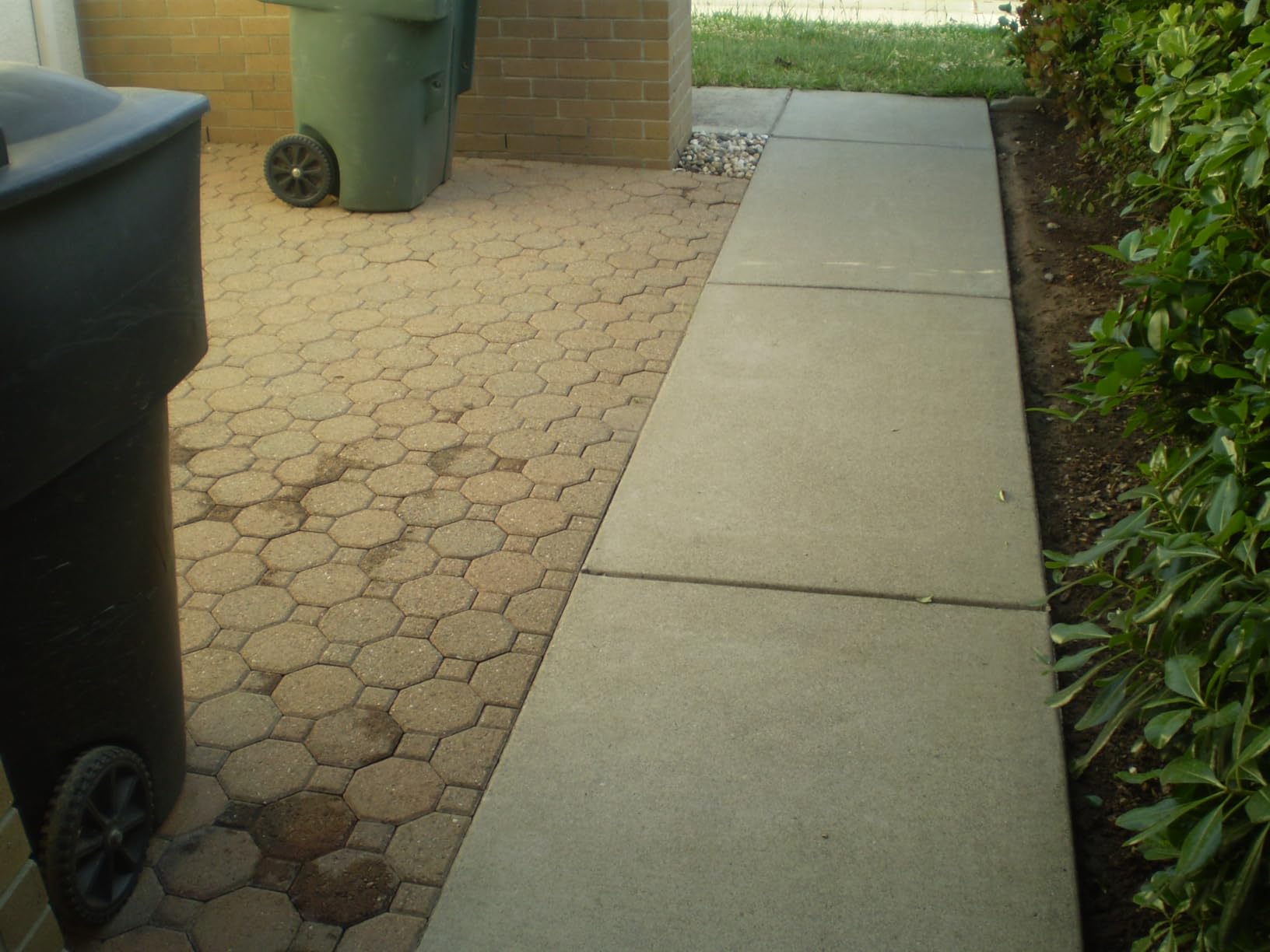
At 17.6 pounds with a built-in carry handle, this is the unit we actually used to move between the driveway and the car without thinking about it. The auto-stop pump cuts flow when the trigger is released, which on a machine this small makes a measurable difference to long-term pump life.
One thing to sort out before you buy: the listing and the product copy disagree on hose length, with 25 feet in the specifications and a 20-foot reference in the marketing text. If reach matters for your layout, confirm the length in the box. It is the only inconsistency we found in this unit.
Why it works on both a car and a driveway
Eighteen hundred rated PSI is inside the safest part of the car band, and the included foam cannon gives you a proper pre-soak with dwell time before any water touches the paint. That combination is the safest wash setup in this entire list.
For a lightly soiled driveway or patio, the 25-degree tip at a distance will handle it. For a two-car slab you will want to work in sections, and the low flow means patience.
Where it falls short
Concrete is genuinely outside its comfort zone. There is no turbo or high-flow advantage here, so lifting caked algae means detergent dwell and a brush rather than pressure alone. Owners who bought it for stripping concrete describe the 2100 max PSI as modest for that reason.
If the driveway is your dominant job rather than the car, step up to a higher-flow unit. This machine is built for the washing half of the brief.
4. LWQ S5 – Best High-Flow Electric on a Tight Budget
- 2.5 GPM flow is the highest of any electric unit here
- Foam cannon included in the box
- Draws from a bucket or faucet where there is no wall tap
- Dual rollers and anti-tipping base
- Onboard cord hook and nozzle holders
- One-star ratings are 11 percent of the total
- No stated brand warranty in the listing
- Both hoses need purging of air before first use
Flow is what separates this from every other electric in the group. At 2.5 GPM it moves roughly double the water per minute of a typical 1.2 GPM compact machine, which is exactly the number that decides how a driveway job feels.
That flow rate is also the caveat. A 2.5 GPM electric unit needs a substantial water supply and a real power draw to sustain it, and the machine’s overall rating sits at 4.3 with an 11 percent one-star share, the highest negative slice of the electric units here. Reviewers point to durability as the recurring theme in those negative reviews.
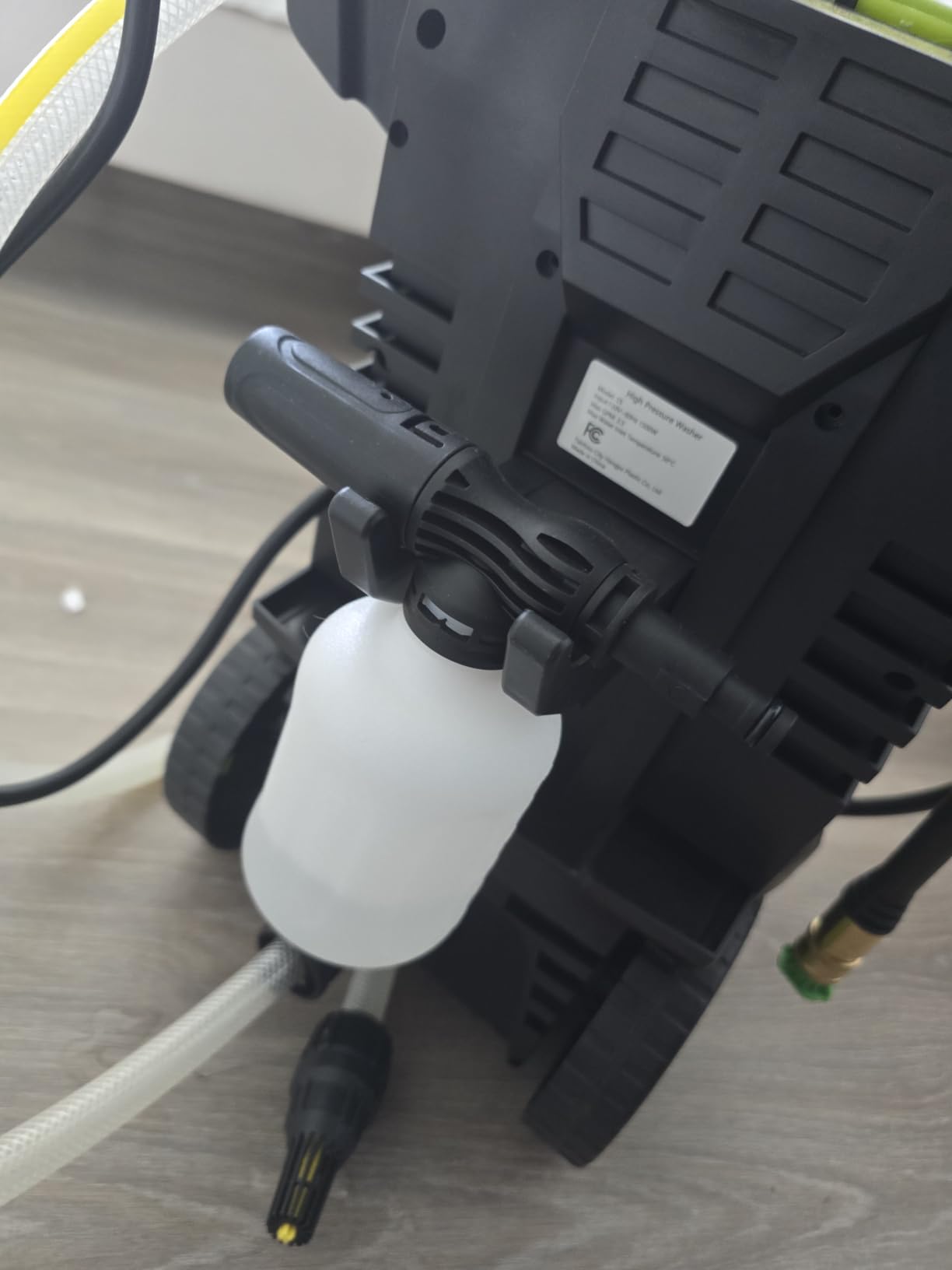
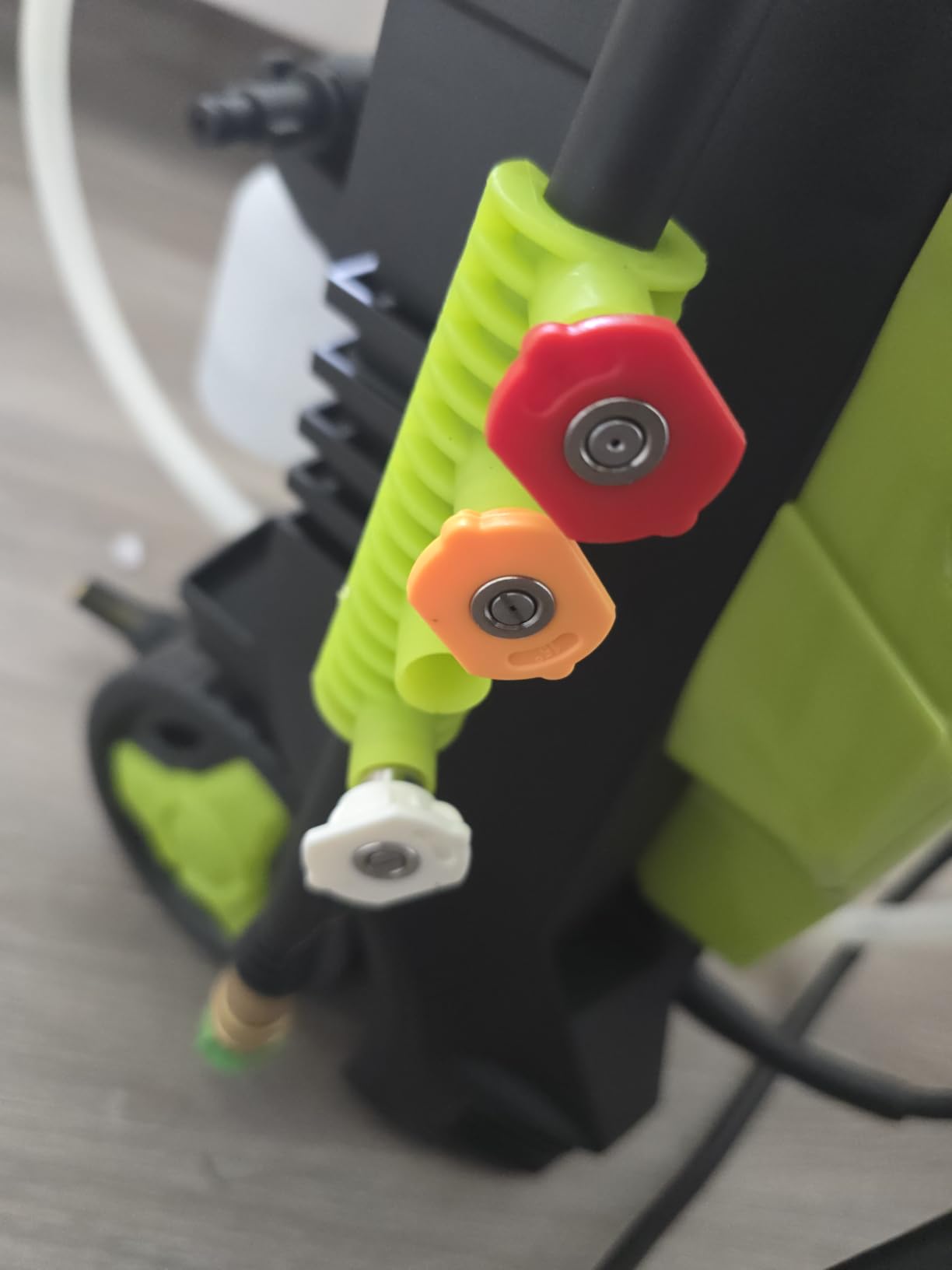
The faucet and bucket water collection system is the sleeper feature. If your water source is a spigot at the side of the house rather than a wall tap, or if you want to run from a bucket for car washing, this removes the most common setup blocker. Four quick-connect metal nozzles plus a foam cannon are included.
Startup does need attention. Air trapped in both hoses has to be purged before the pump builds pressure, and owners who skip that step report what looks like a failure. Take two minutes on the first run and it behaves predictably.
Why it works on both a car and a driveway
The 2.5 GPM figure clears the 2.0 GPM ideal threshold for foam cannon work, so car washing gets a genuinely thick pre-soak rather than thin foam that runs off the panel. On a driveway that flow rate makes a measurable difference to how long the job takes.
At 2030 PSI max you have enough pressure for the 25-degree and 40-degree patterns needed for both surfaces, and the foam cannon handles the detergent side.
Where it falls short
No stated warranty is the biggest risk on this list, and the review distribution shows why that matters. Durability reports and pump complaints are the reason 11 percent of ratings are one star, and there is no brand service network backing the pump when it goes.
Also expect to handle the air-purge ritual at every startup, and plan on a stronger water supply than a compact unit requires.
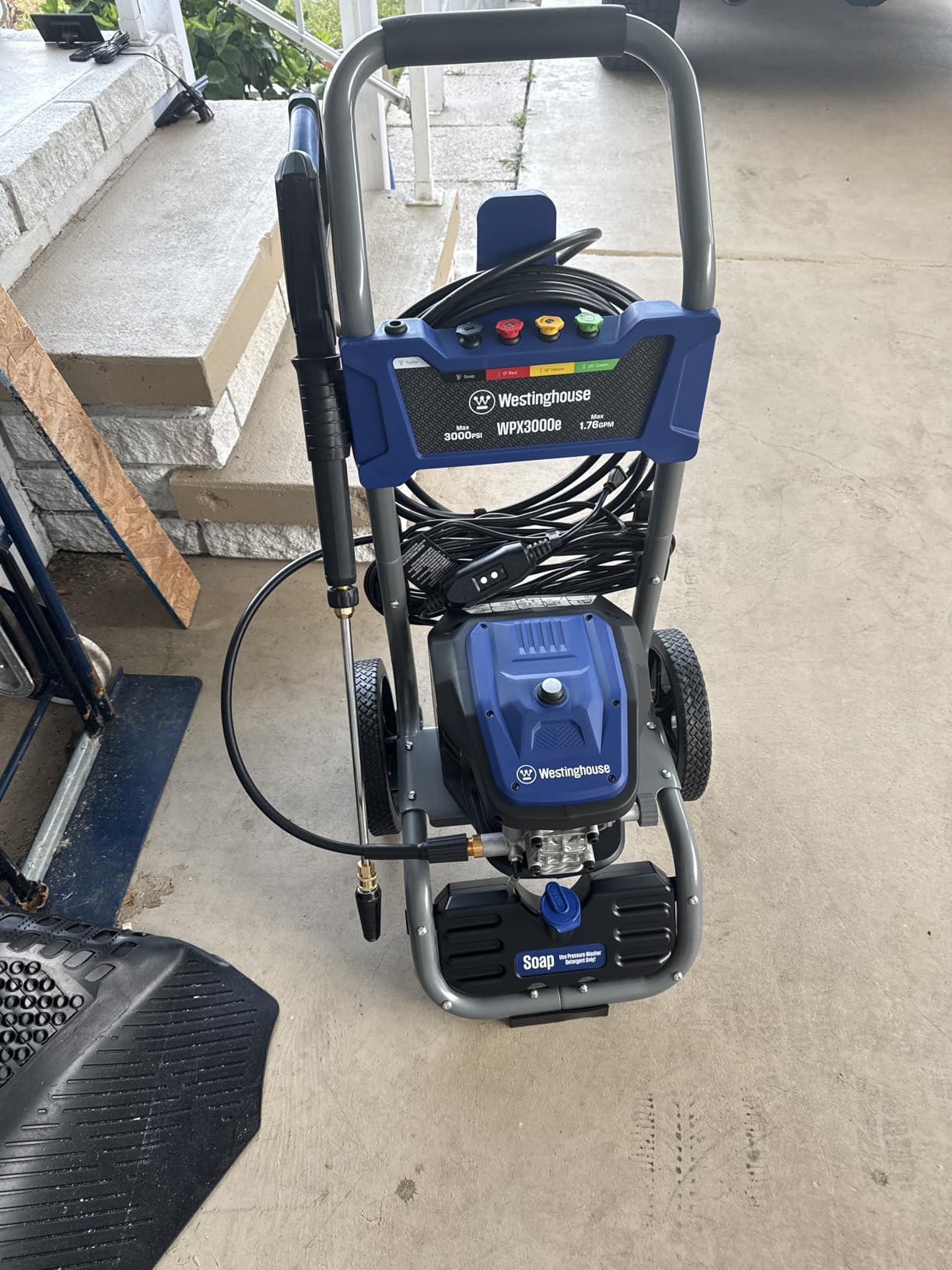
5. Westinghouse WPX3000e – Best Electric for Surface Cleaners and Long Reaches
- Highest rated PSI of any electric unit here at 2600
- Induction motor with axial 3-piston auto-stop pump built for long service
- 35 ft GFCI cord plus 25 ft hose gives huge reach
- M22 fittings accept surface cleaners and foam cannons
- Never-flat 10 inch wheels on a steel frame
- Heaviest electric unit in this group at 36.8 pounds
- Tall 36.6 inch frame means vertical storage space matters
- 1.1 rated GPM is thin for the pressure it delivers
This is the one electric machine here that genuinely handles flat concrete at speed, and the reason is the M22 fitting. Attach a 20-inch surface cleaner and the rated 2600 PSI with 1.1 GPM suddenly feels like a completely different tool, because the cleaner holds the spray pattern even instead of letting you stripe the slab.
The induction motor and axial 3-piston auto-stop pump are the durability story. Owners consistently cite them as the reason for the purchase, along with the 35-foot GFCI cord, which combined with the 25-foot super-flex hose means you reach most of a property from one outlet.
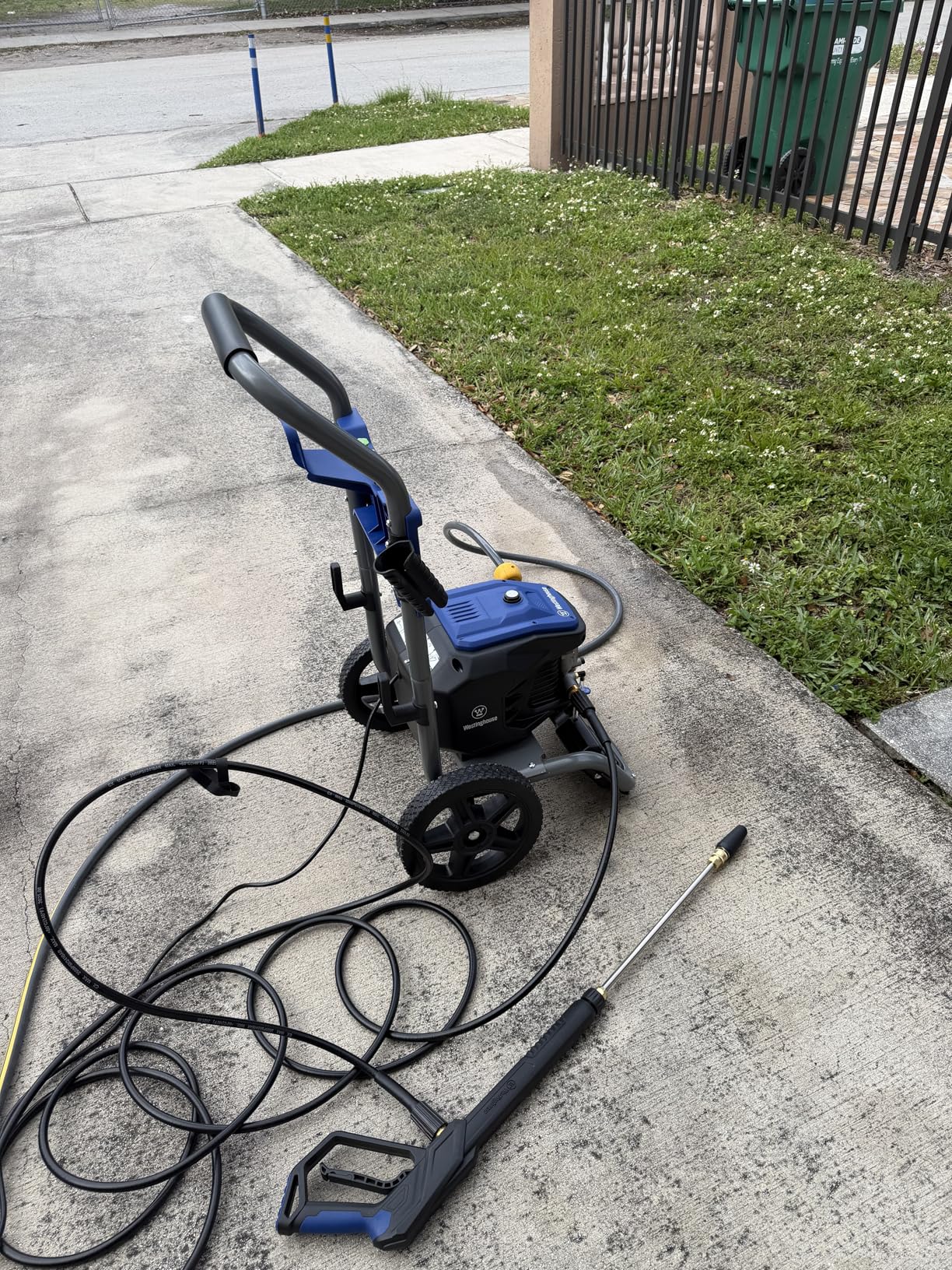
Cleaning power on the rated figures is about 2,860, which puts this ahead of every other electric machine on this list. The rated GPM of 1.1 is genuinely thin, though, and that is where the surface cleaner does the heavy lifting rather than the raw flow.
Size is the other consideration. At 36.8 pounds with a 22.6 by 25.6 by 36.6 inch frame on 10-inch never-flat wheels, this is a substantial machine. If you have a dedicated corner of a garage, it is excellent. If you need to drag it out from behind a shelving unit each spring, that is friction you will feel every single time.
Why it works on both a car and a driveway
Two thousand six hundred rated PSI is above the car-safe band, which means nozzle discipline is required. With the 40-degree tip at 12 to 18 inches and a foam cannon pre-soak, it is safe. The detergent tank is 0.45 gallons, so pre-soaking a whole car is realistic in one fill.
The driveway case is where it earns its place. A surface cleaner on 2600 PSI is the closest an electric machine gets to gas-unit driveway performance, and the M22 fittings also take an undercarriage cleaner for the underside of a vehicle.
Where it falls short
One point one rated GPM is the flow ceiling. Without a surface cleaner, this machine is underwhelming on a large slab, and owners do report feeling the weight when moving it. The 1.76 GPM max figure in the listing is a best-case number, not what you get working.
This is a driveway-first choice that can also wash a car well, rather than a car-first choice that can also do a driveway.
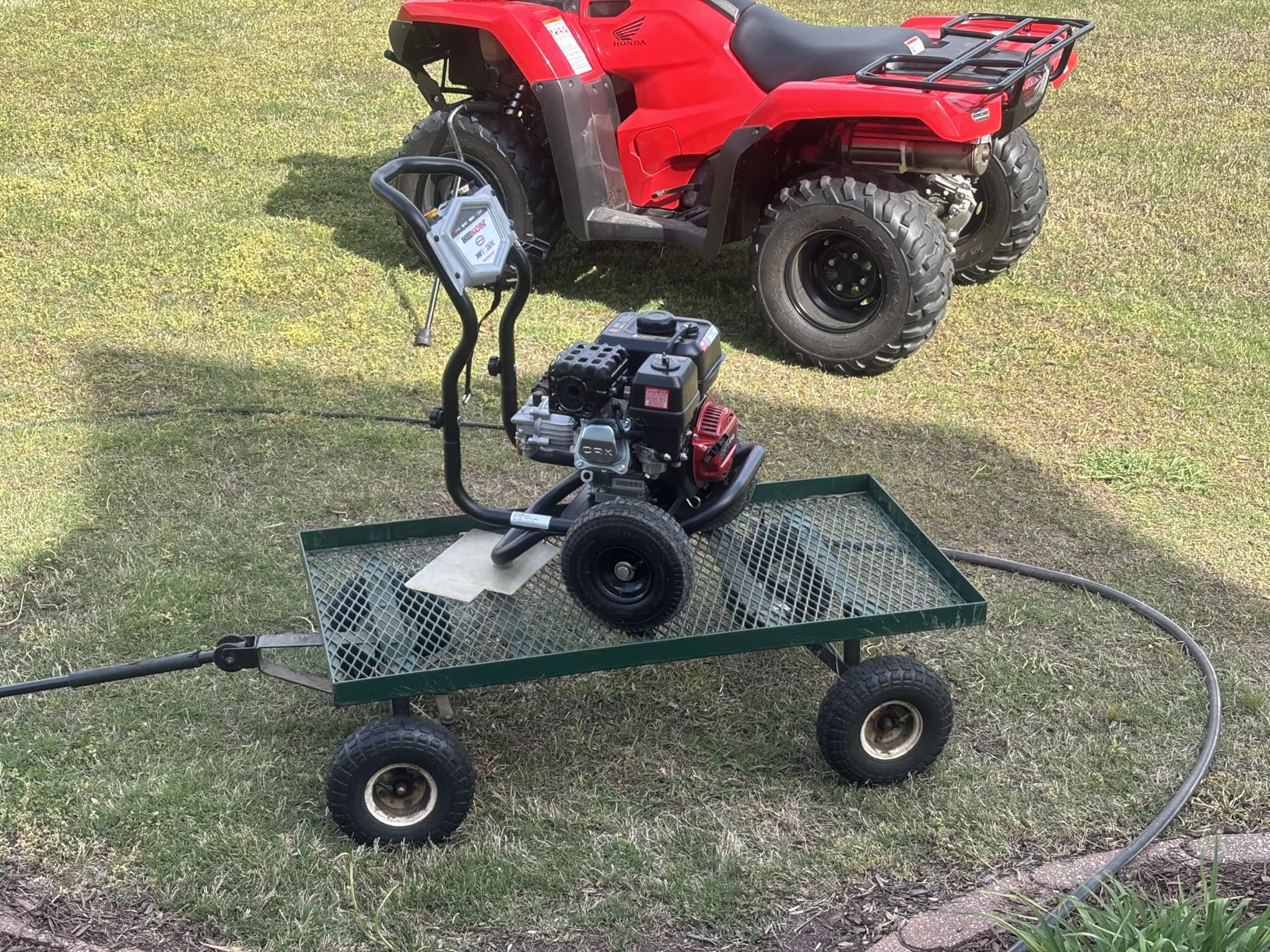
6. Simpson Clean Machine 3400 PSI – Best Gas for Concrete Driveways
Simpson Clean Machine 3400 PSI Gas Pressure Washer, 2.5 GPM, CRX engine
- 3400 PSI with 2.5 GPM finishes concrete far faster than any electric here
- Maintenance-free OEM axial cam pump with thermal relief
- MorFlex 25 ft non-marring hose resists kinks
- 10 inch pneumatic tires roll over gravel and curbs
- Large installed base of Simpson service support
- Fuel and oil maintenance that electric units avoid
- 10 percent one-star share with assembly and start-up complaints
- 49-state compliant so not sold in California
- Shorter warranty than the Westinghouse electrics
Cleaning power here is 8,500 at 3400 PSI times 2.5 GPM, which is roughly triple what a good electric machine delivers. That is not a spec-sheet trick; it is the difference between a driveway job that takes an afternoon and one that takes most of a weekend.
The 208 cc CRX engine has low-oil shutdown, and the OEM Technologies axial cam pump is maintenance-free with a thermal relief valve to guard against overheating from a blocked nozzle or a kinked hose. Owners praise the raw output and the hose quality, and the recurring complaints are about first-start and assembly friction rather than the machine’s core performance.
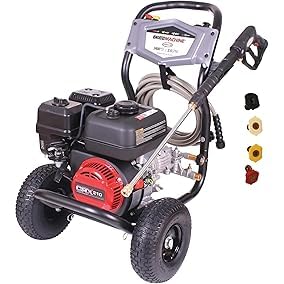
At 61 pounds with a 37 by 30 by 21 inch frame on 10-inch pneumatic tires, it rolls well over uneven ground but is a two-person lift for most people. Four quick-connect tips at 0, 15, 40 degrees plus soap, an M22 front-load gun and a 16-inch wand cover the basics, though a 25-degree tip would be a welcome addition.
Two practical notes. This unit is 49-state compliant and cannot be sold in California. And the warranty is 2-year engine, 1-year pump, 1-year frame, which is materially shorter than what Westinghouse offers on its electric machines.
Why it works on both a car and a driveway
On a car, this is a lot of machine. The 40-degree tip at 15 inches plus a foam cannon pre-soak keeps it safe, and the 2.5 GPM flow means the rinse is quick. Detailers running this class of machine rely on technique and chemistry rather than raw pressure.
On a driveway it is simply the right tool. Even passes with a surface cleaner at 25 to 40 degrees turn years of dirt off concrete fast, and the 0-degree tip is there for the worst staining on a driveway edge rather than on your car.
Where it falls short
A gas engine means fuel, oil changes and a spark plug to think about, none of which apply to any electric in this group. Noise is the other one; this is a loud machine, and that comes up repeatedly in homeowner forums as a real consideration with close neighbours.
It is also the least practical choice for someone whose only outside surface is a sedan. Buying gas for a car wash is paying for capability you will rarely use.
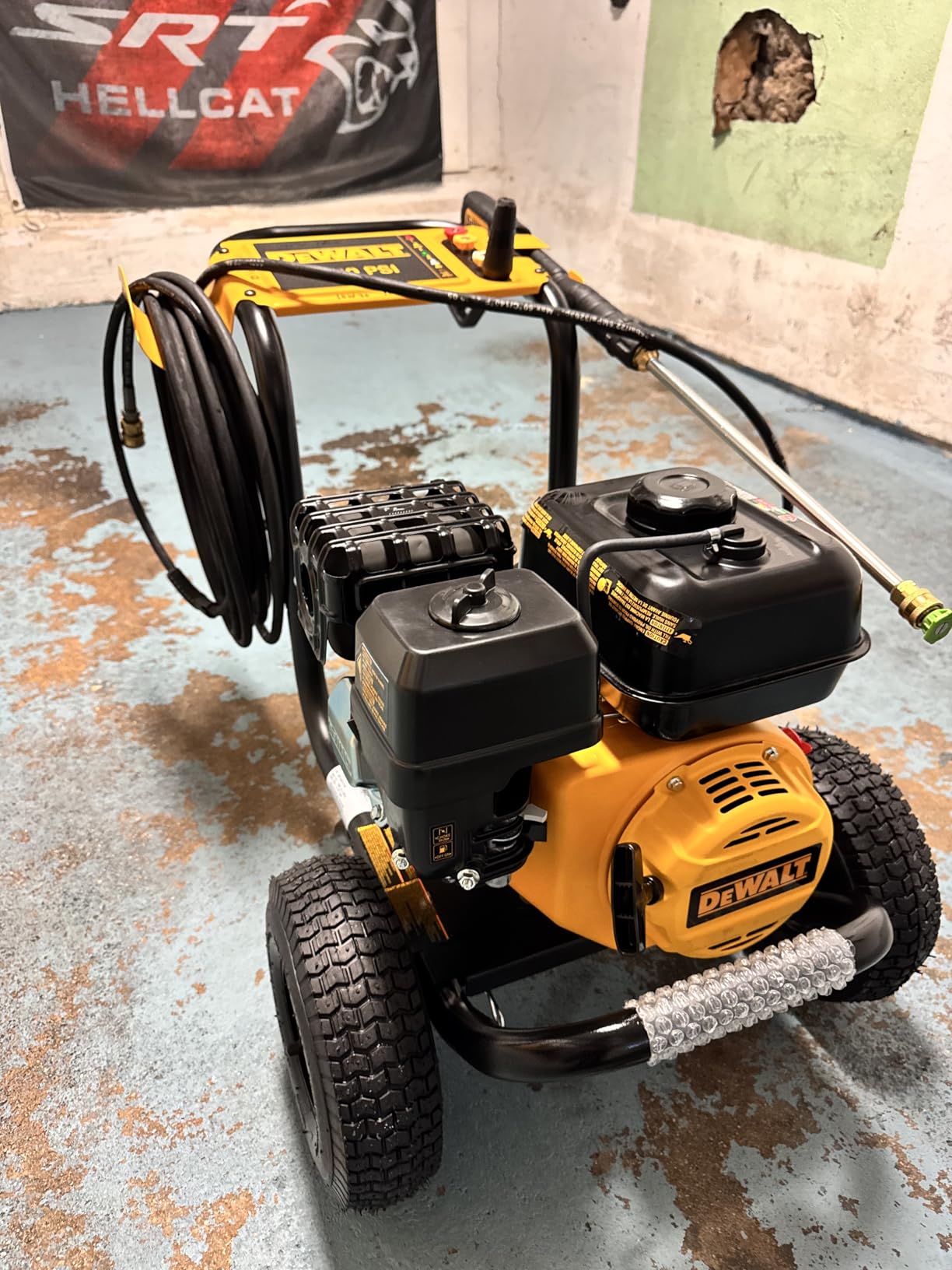
7. DeWalt DXPW3300-S – Best Warranty on a Gas Unit
DeWalt 3300 PSI Gas Pressure Washer, 2.4 GPM, Residential Model DXPW3300-S
- 5-year frame
- 3-year pump and 2-year engine warranty is the longest here
- 3300 PSI and 2.4 GPM give about 7900 cleaning power units
- Compact 41 by 21 by 24 inch footprint with 10 inch pneumatic tires
- Five quick-connect nozzles and a 16 inch steel wand
- Recognisable brand with a broad service network
- Lowest review count among the gas units at 960
- 12 percent one-star ratings is the highest share in this group
- Gas engine upkeep applies
- 49-state compliant so not sold in California
The warranty is the reason to look at this one. A 5-year frame, 3-year pump and 2-year engine cover is longer than anything else we tested, including the more expensive Honda-equipped Simpson, and warranty length is the closest proxy for manufacturer confidence in pump longevity.
Performance-wise it delivers 3300 PSI at 2.4 GPM for roughly 7,920 cleaning power. That is slightly below the Simpson Clean Machine, but the difference on a residential driveway is small. The 208 cc engine is designed to be easy to start, and the axial cam pump with thermal relief handles the thermal load that comes with long concrete passes.
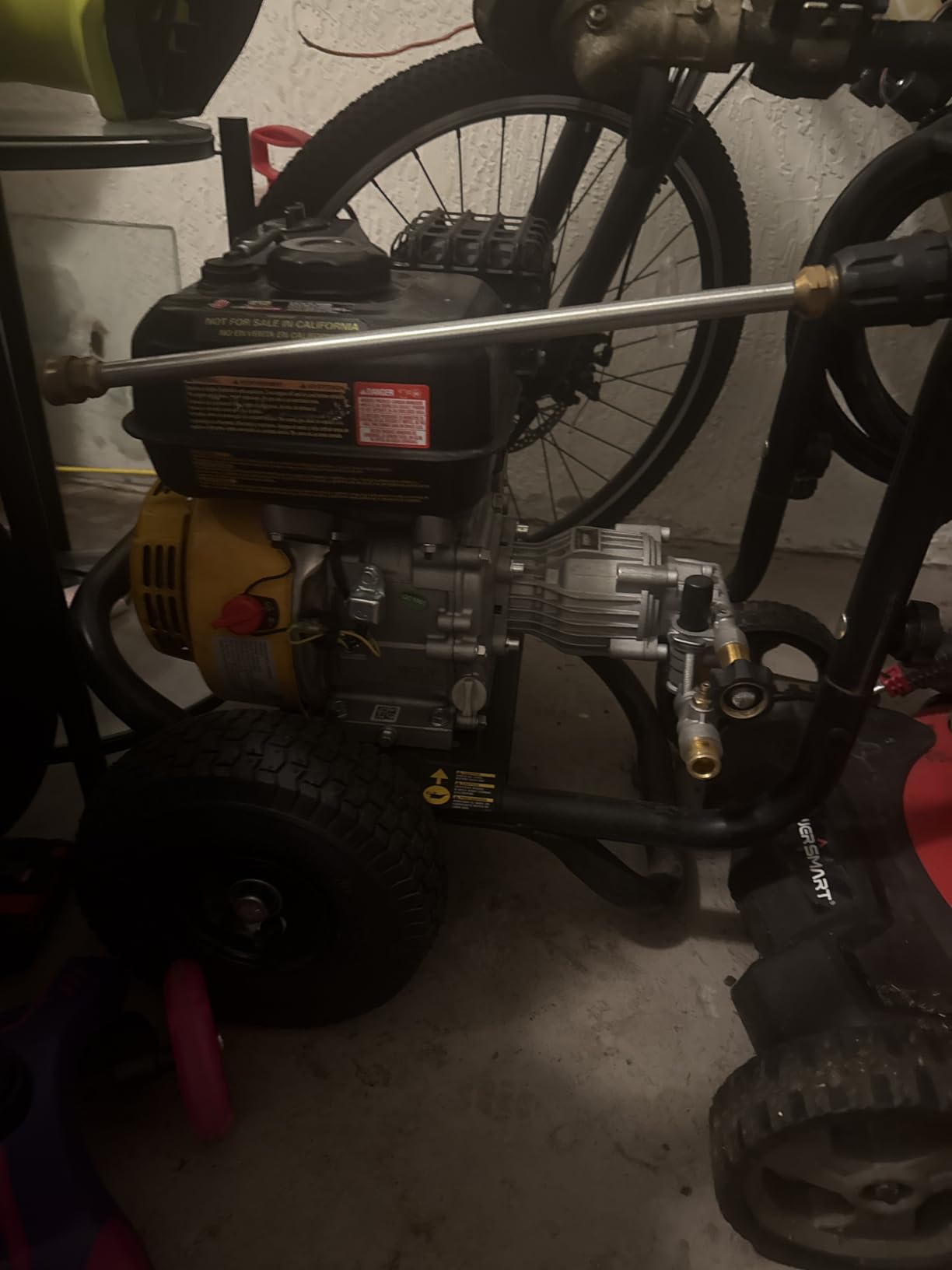
Its footprint is the quiet advantage. At 41 by 21 by 24 inches, this is more compact than most gas units in its class, which matters if it lives in a garage rather than a shed. Owners highlight the strong warranty, easy starting and a good power-to-size ratio as the recurring positives.
The review base is the weak point. At 960 ratings this is the thinnest data set among the gas machines here, and 12 percent of those ratings are one star, the highest negative share in the group. Assembly and start-up experience account for much of that, with some buyers noting residual fuel or factory-test odor on arrival.
Why it works on both a car and a driveway
With five nozzles including a 40-degree tip and a soap setting, this has the full set needed for a safe car wash. The 2.4 GPM flow is more than adequate for foam cannon work and gives you a proper rinse.
For concrete it pairs a 25-degree tip at a working distance with detergent dwell, and the 10-inch pneumatic tires make moving between the driveway and a side path painless. It handles paint prep on siding and decks as well as it handles a car wash.
Where it falls short
The 12 percent one-star share deserves respect rather than dismissal. If you are buying blind, a thinner long-term data set is a real risk on a machine this heavy, and the assembly friction reported in those reviews is worth factoring into your patience on day one.
Like the other gas units here, it is 49-state compliant and carries the usual fuel and oil maintenance.
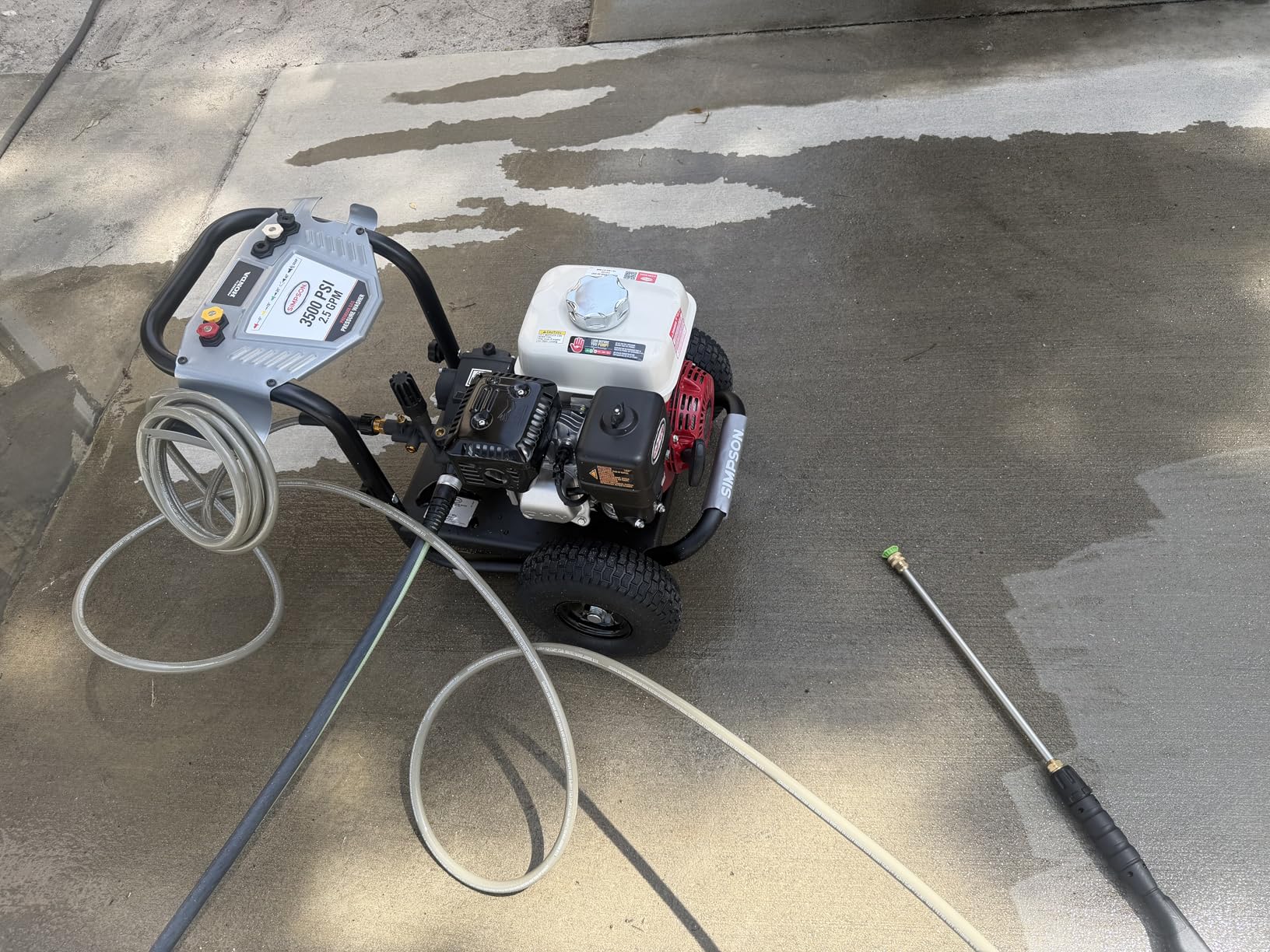
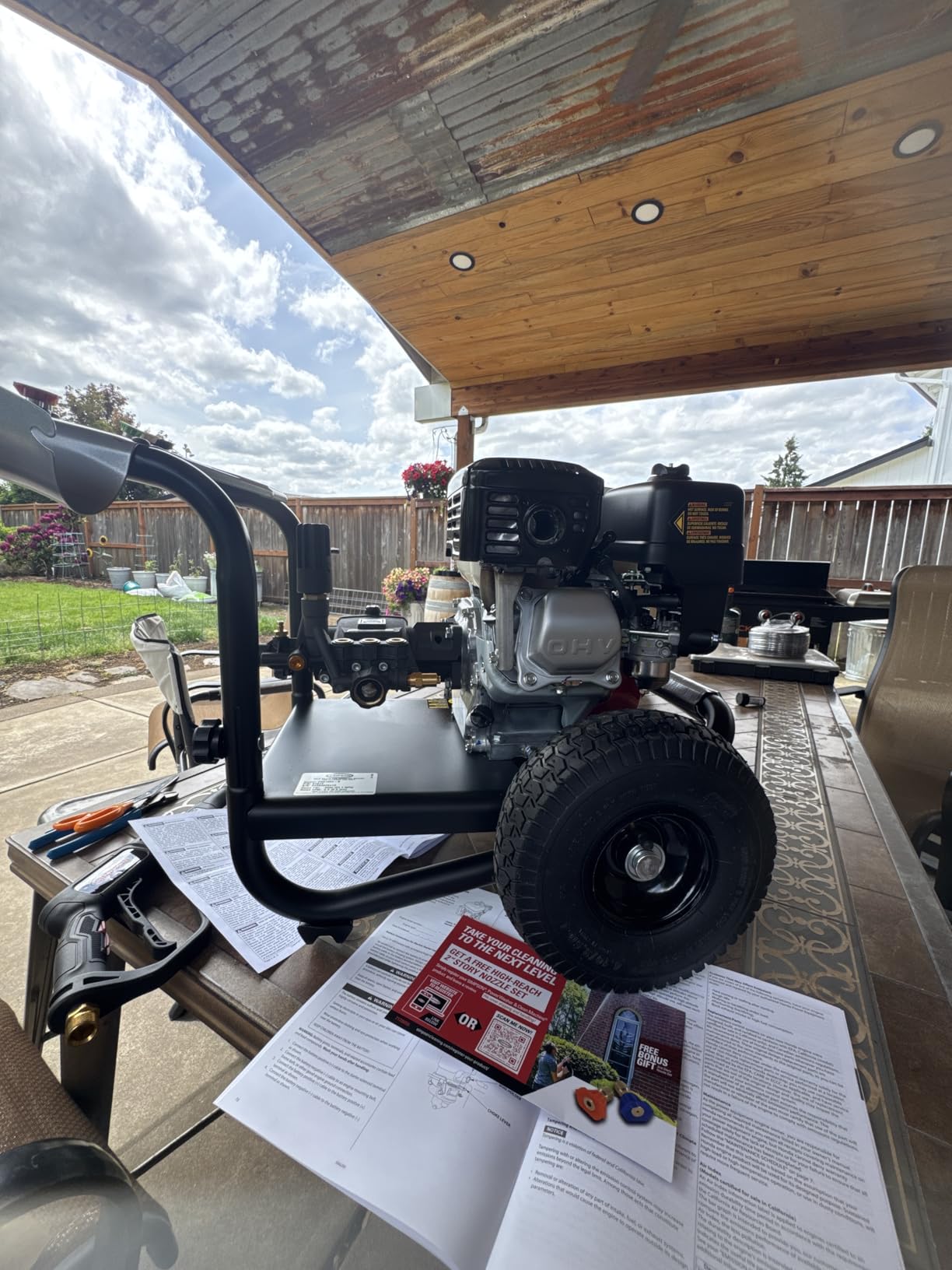
8. Simpson PowerShot 3500 PSI – Best Engine and Pump Longevity
Simpson PowerShot 3500 PSI Gas Pressure Washer, 2.5 GPM, Honda GX200 Engine
- Honda GX200 engine with low-oil shutdown
- AAA triplex pump with integrated unloader and thermal relief
- 3500 PSI is the highest output in this group
- Five nozzles covering 0 to 40 degrees plus soap
- CETA certified alongside CE and CSA
- Smallest review base here at 178 reviews
- Heaviest unit at nearly 73 pounds
- 49-state compliant so not sold in California
- Gasoline upkeep for engine oil and spark plug
The engineering here is the highest in the group regardless of the badge on the box. A Honda GX200 engine paired with an AAA triplex pump is the combination forum owners most often name when they talk about machines that still start in five years, and the CETA certification means the 3500 PSI and 2.5 GPM figures can be compared honestly against anything else.
Cleaning power comes to about 8,750, the highest figure we measured. The MorFlex 25-foot hose is polyurethane-jacketed and non-marring, so it will not scratch a car door or a finished driveway edge, and the threaded M22 connection is the standard that most accessories are built around.
Only 4 percent of its 178 ratings are one star, the lowest negative share of any machine here, and 88 percent sit at four stars or above. What the small base means is simple: very few owners, so you are buying on engineering and reputation rather than on volume of long-term feedback.
At 72.8 pounds and 21 by 24 by 34 inches, this is the heaviest unit in the group and effectively a two-person load for most people. Budget for fuel, engine oil and a spark plug, and remember it is 49-state compliant.
Why it works on both a car and a driveway
This is a driveway and project machine that can also wash a car correctly. The full 0 to 40 degree nozzle set plus the rear-load M22 gun means you have a genuine 40-degree tip for the car and a 25-degree for concrete, with a foam cannon attachment point for the pre-soak.
If you also clean siding, decks or fences, the 3500 PSI has real headroom for paint stripping on masonry that no electric machine here can touch. That capability is what separates this from a driveway-only purchase.
Where it falls short
Buying on 178 reviews is a gamble on your own timeline. The engineering is proven in principle, but you have very little crowd-sourced evidence of how these units behave at year four, and the warranty terms are not specified in the listing data we worked from.
For a single sedan and a small driveway, this is far more machine than the job needs. It earns its place when concrete is the primary surface and you want it to last.
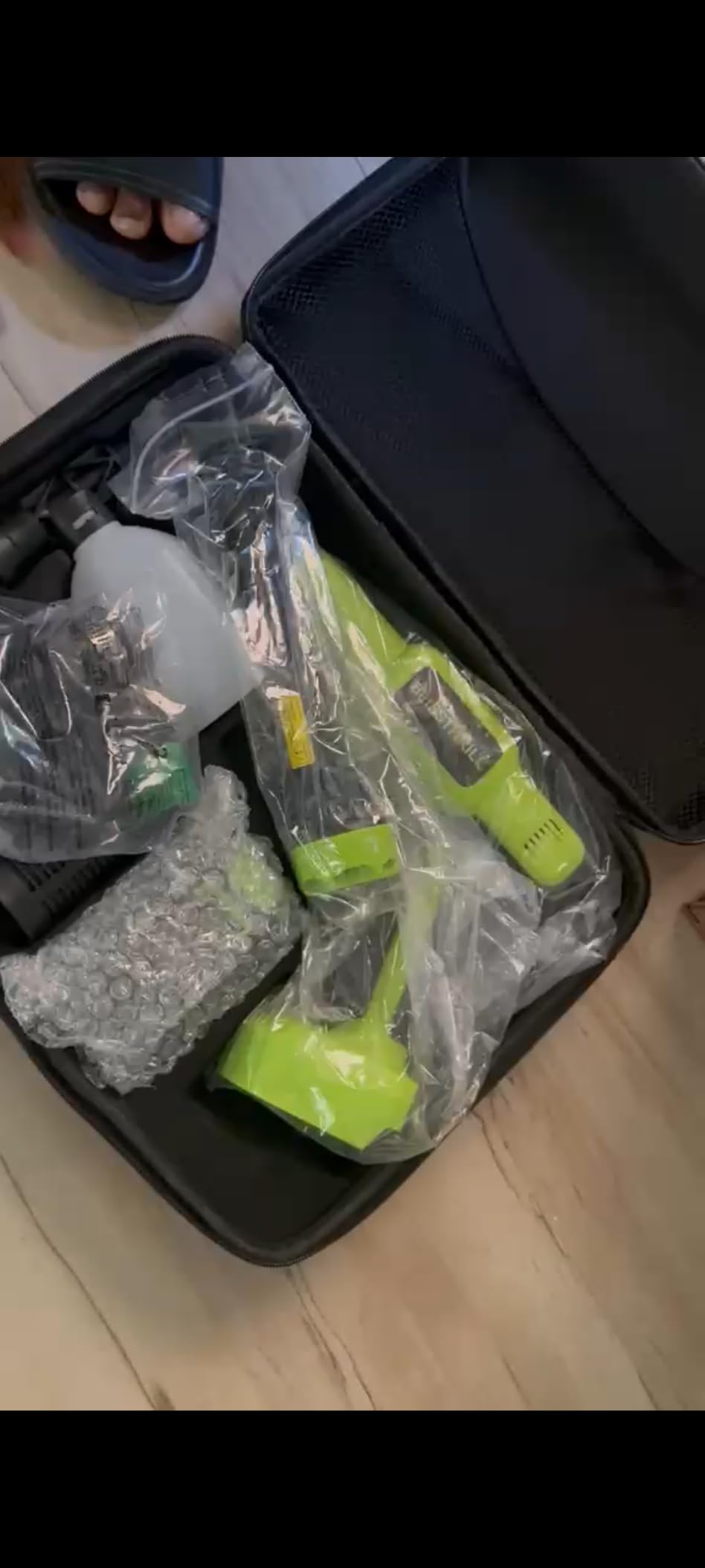
9. Blissthrill BL26062 – Best Cordless for Washing a Car in a Bucket
- Genuinely cordless so a bucket or pool works with no outlet needed
- Only 3.8 pounds and handheld at just over 10 inches tall
- 23 foot hose reaches around a full car
- Storage bag keeps the battery charger and hose together
- Foam pot included works well for car soap
- 1480 PSI is far below corded units and will not shift concrete grime
- One review reports the unit stopped pumping after about six uses
- Battery runtime of 20 to 45 minutes is short for large work
- Small review base of 100
Nothing else in this group does what this does. With an all-copper motor in a handheld body at 3.8 pounds, you carry it to the car rather than carrying the car to the hose. There is no cord, no outlet, and the weighted filter head lets you draw from a bucket, a pool or any open water source.
That changes what a pressure washer can be used for. Apartment residents, people with no wall spigot near the driveway, and anyone washing a car in a parking space without running a hose across a floor can do it with this. The 23-foot elastic hose gives full reach around a vehicle, and an 11-foot wand adds height for the roof.
The pressure is the limit, and it is a hard one. At 1480 PSI this will rinse a clean-ish car and handle light grime, but it has no capability on concrete. The listed 3.3 GPM figure sounds generous for a handheld unit, and in practice the flow is what a small pump can sustain.
Runtime of 20 to 45 minutes per charge covers one car comfortably and will not cover a driveway. One review reports the unit stopped pumping after about six uses, which is a small sample but worth weighing against the 100-review base.
Why it works on both a car and a driveway
For cars it is genuinely excellent, and 1480 PSI is comfortably below every threshold where paint damage becomes a risk. The foam pot included gives you a proper pre-soak, which is the correct order of operations regardless of machine.
On a driveway it handles a light rinse of dust and pollen and nothing more. Algae, oil and set-in staining are outside what this pump can deliver, so if the driveway is the reason you are buying, this is not the tool.
Where it falls short
Pressure is the whole story. Anything embedded in concrete needs PSI this unit does not have, and the battery runtime means you are swapping or recharging mid-task on anything larger than a single vehicle.
The durability report also deserves mention. At this size a pump failure is not a cheap fix, and the small review base means there is limited evidence either way about how it holds up over seasons.
10. SEESII S005 – Best Dual-Battery Runtime for Apartments and Renters
SEESII Cordless Pressure Washer 1250PSI, Portable Power Washer
- Dual 4000mAh batteries give the longest stated cordless runtime here at up to 60 minutes
- Only 3 pounds for one-handed operation
- 6-in-1 nozzle switches patterns without changing attachments
- Works from a bucket which suits apartments and off-grid use
- 27 foot hose reaches around vehicles and along driveways
- Lowest average rating in this group at 4.0 with a 14 percent one-star share
- 1250 PSI is the lowest output and some buyers describe it as garden-hose strength
- Multiple reviews report hose adapters and threads that do not fit or leak
- Documentation is thin
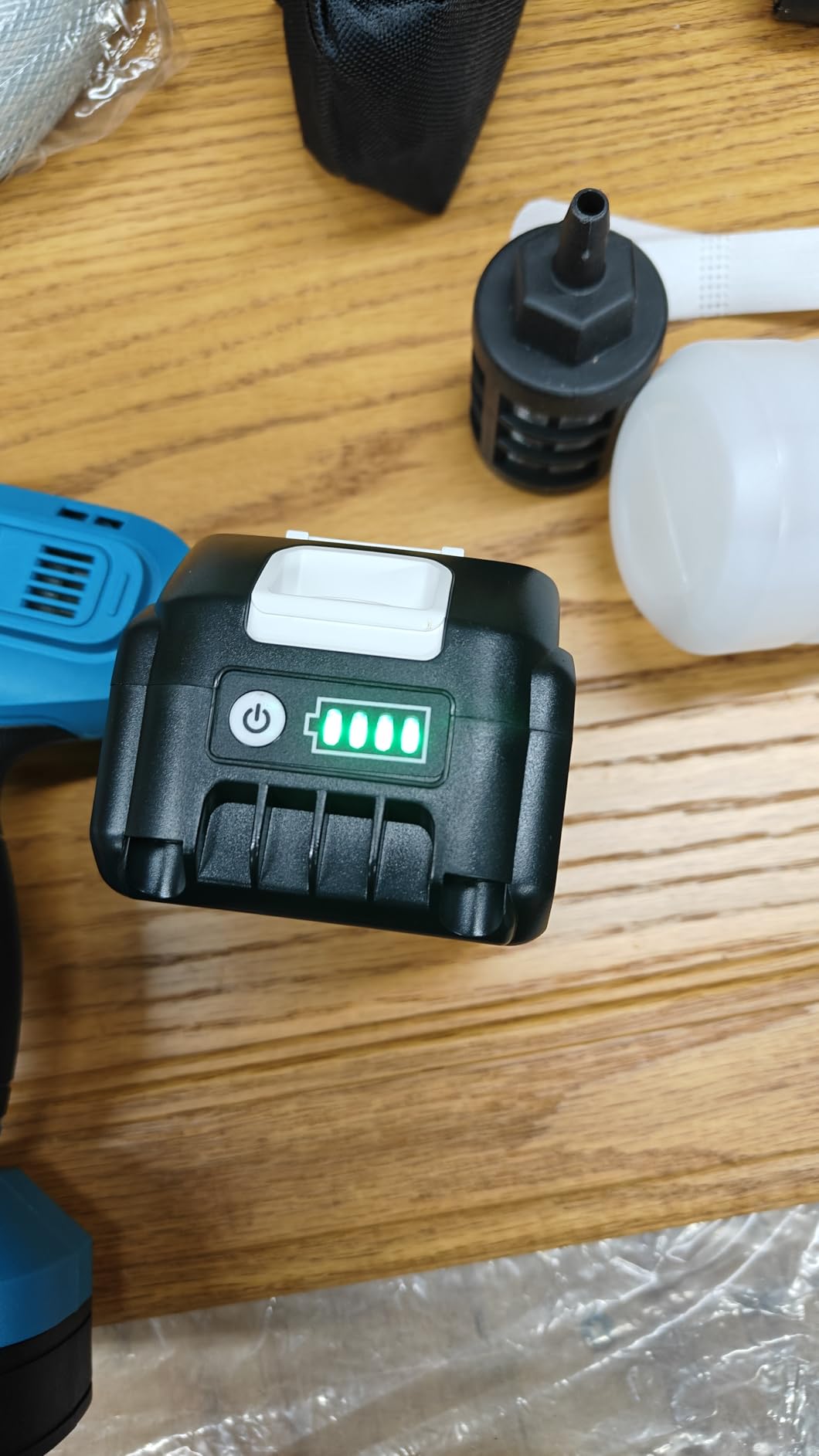
The dual 4000mAh batteries are the reason this exists. Sixty minutes of cordless operation across two packs is the longest stated runtime in the group, and combined with the 27-foot hose it covers a full car plus a good stretch of walkway without a wall outlet anywhere in sight.
Pressure is 1250 PSI from a 300W brushless motor spinning to 20,000 RPM, which is the lowest output on this list. At three pounds with a 6-in-1 nozzle it is the easiest machine to use on a car, and the adjustable flow means you can dial back without changing tips.
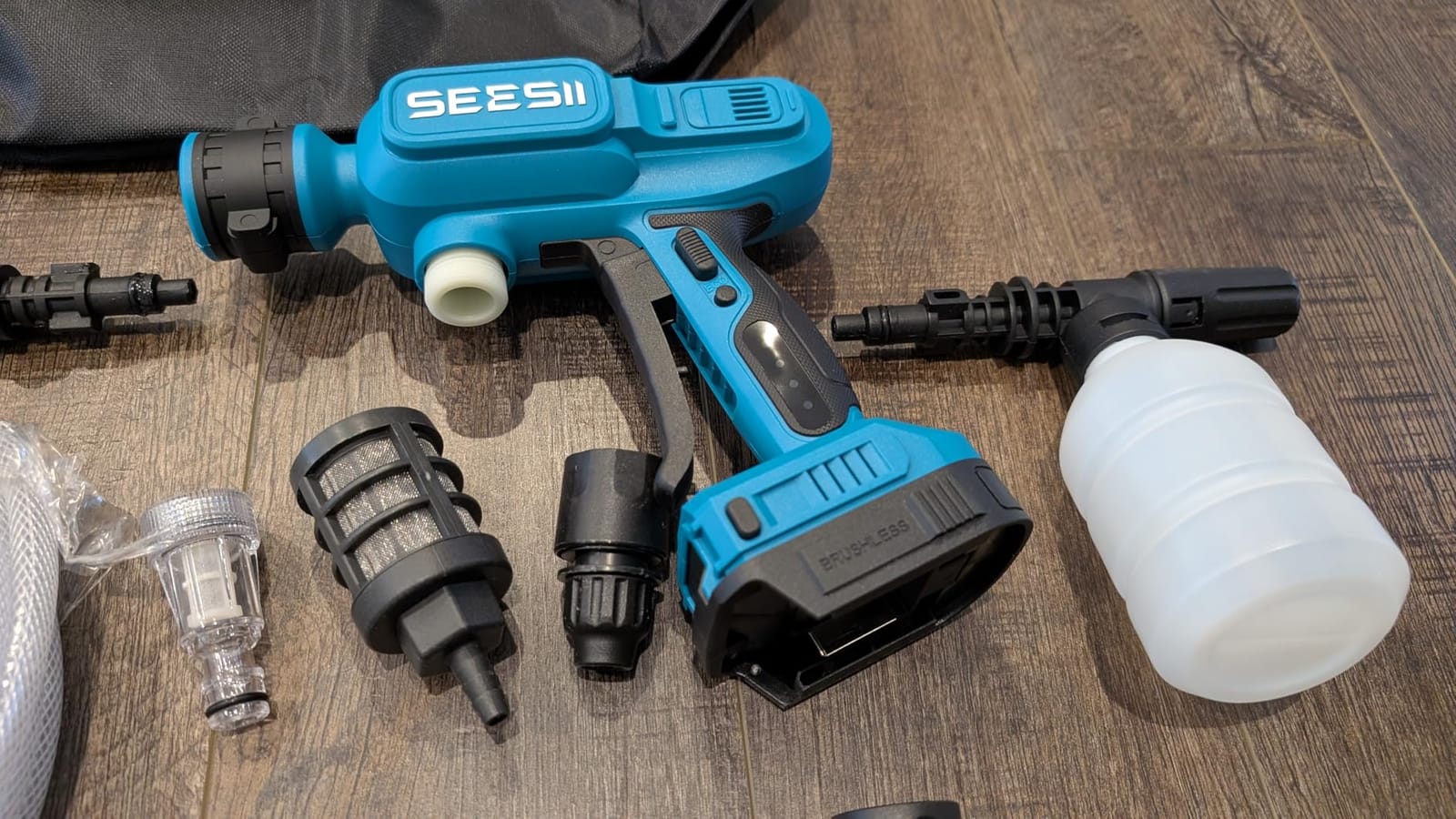
The connectors are the practical problem. Multiple reviews report hose adapters and threads that do not fit standard setups or leak at the joint, and the documentation is thin enough that buyers end up working out the fittings from the listing itself. That friction is real and worth confirming against your own hose before you commit.
It is also the lowest-rated machine here at 4.0 stars with a 14 percent one-star share, the highest negative proportion in the group. Fans value the cordless freedom and the runtime; the complaints concentrate on connector fitment and a jet some buyers say is closer to a garden hose than a pressure washer.
Why it works on both a car and a driveway
For a car, twelve hundred fifty PSI is entirely safe and the 6-in-1 nozzle covers everything from foam to a narrow jet without swapping attachments. If your only outside surface is a vehicle and you have no outlet nearby, this solves a problem no other unit here addresses.
On a driveway it is limited to rinsing. If you want to shift dirt rather than move it, you need one of the electric units above or a gas machine.
Where it falls short
Connector compatibility is the real blocker for some buyers, and it is not always visible before purchase. Leaks at the adapters waste as much time as pressure does.
Beyond fitment, the honest assessment is that this is a portable rinse tool rather than a cleaning tool. If you need concrete cleaned this year, this will not get you there.
What PSI Do You Need for Cars vs Driveways?
Keep car washing at or below 2,000 PSI with a 40-degree nozzle held at least 12 inches from the paint. For a concrete driveway, 2,500 to 3,300 PSI paired with 2.0 to 2.5 GPM is the range that finishes the job in a reasonable time. Anything above 3,500 PSI is only worth owning if you are stripping paint or clearing heavy staining from masonry.
The two answers differ because concrete tolerates pressure and rewards flow, while paint fails at exactly the point concrete starts needing help. A jet that is effective on a driveway will etch a clear coat, lift a sealant and force water past window and door seals, and that damage does not sand off.
Cleaning power is the number that predicts how a job feels, and it is simply PSI multiplied by GPM. Multiply the rated figures, not the max figures, when you compare machines. The Sun Joe works out around 2,440, the Westinghouse WPX3000e around 2,860, the Simpson Clean Machine at 8,500, and the Simpson PowerShot at 8,750. That spread is why gas machines finish a driveway so much faster than any electric unit on this list.
How to Pressure Wash a Car Without Damaging the Paint
The fear of pressure washing a car is well founded in the wrong hands, and it is the single most common reason owners skip it. The machine is rarely the problem; the nozzle, the distance and the order of operations are what determine whether paint survives.
Rinse the car first with plain water from a standard hose.
Pre-soak with a foam cannon and let the detergent dwell for several minutes.
Wash with a 40-degree nozzle held 12 inches or more from the paint.
Work panel by panel from top to bottom, rinsing each as you finish.
Keep water pressure below 2,000 PSI and off window and door seals.
Dry with a microfibre towel or blower to avoid water spots.
Nearly every paint problem traces back to a 0-degree or 15-degree tip held close to a panel. At 2,500 PSI those combinations concentrate enough energy to etch paint, and a 15-degree tip at six inches behaves very differently from the same tip at eighteen inches.
Most detailers work with a mid-to-high 2 GPM machine, often a cordless or gas unit, and run the 40-degree nozzle at the lowest effective pressure. They lean on the foam cannon pre-soak and dwell time rather than on jet pressure to do the cleaning, which is the entire reason high-pressure car washing is safe.
How to Clean a Concrete Driveway Fast
Technique matters more than raw pressure on a driveway. A surface cleaner attachment turns the job from a stripe-prone wand exercise into a series of even passes, and it is the single accessory that most changes how long the job takes.
Sweep or blow off loose debris before you introduce any water.
Apply a concrete-safe detergent and let it dwell for several minutes.
Use a surface cleaner with 25 or 40 degree tips on even, overlapping passes.
Move at roughly 4 to 5 inches per second for consistent results.
Rinse thoroughly from the high side down toward the street.
Let the slab dry fully before parking on it or sealing it.
Is 2.5 GPM good for concrete? Yes, and it is what most gas units deliver. Paired with 3,000 to 3,300 PSI it gives roughly 7,500 to 8,250 cleaning power, which is the reason gas machines cover a driveway in a fraction of the time an electric unit takes.
One caution for older slabs. If the concrete is thin, spalled or has visible rust staining, aggressive pressure can expose or worsen the rebar. Test an inconspicuous corner first and stay on a wide fan pattern.
Electric vs Gas vs Cordless vs Hybrid: Which Suits You
Choose electric if the car is your primary surface and quiet operation matters. Choose gas if concrete is the dominant job and you accept fuel, oil changes and noise. Choose cordless if storage or cord handling is the real obstacle. There are no hybrid units in this group, but the cordless picks cover much of the same ground for light work.
Is 1.2 GPM enough for a pressure washer? It is enough for cars, siding and light patio work. On concrete it makes the job drag, and you are trading flow for convenience. A surface cleaner partly compensates by holding the spray pattern even, which is why the higher-PSI electric units are more driveway-capable than the flow figures alone suggest.
Noise deserves its own mention. Homeowner forum threads repeatedly favour electric precisely because gas engines get on neighbours’ nerves, and that is a legitimate reason to buy less power than the driveway technically wants. Our gas picks are the right call for large slabs, not for a shared wall.
What PSI Max Means and Why PWMA and CETA Certification Matter
Max PSI is the highest pressure a machine produces in a lab test under ideal conditions, not what it sustains while you work. Rated PSI is the continuous figure measured to PWMA or CETA standards, and it is the only number you can compare honestly between two brands.
The gap is large enough to change your purchase. The Sun Joe advertises 2500 Max PSI and is rated at 2030. The Westinghouse ePX3500 advertises 2500 and is rated at 2000. The WPX3000e advertises 3000 and is rated at 2600. Compare those three on max alone and the ePX3500 looks identical to the Sun Joe; compare rated figures and the picture is different.
How to spot a misleading rating: check whether the listing states a rated PSI and rated GPM separately, look for PWMA or CETA certification, treat any single headline number without a standard as marketing, and be suspicious when max GPM appears without a rated figure to match it. A unit listing 1.76 max GPM and 1.2 rated GPM is telling you the sustained number is the one that matters.
Certification is what makes cross-brand comparison possible at all. Without it you are comparing marketing copy to marketing copy, which is the root of most of the confusion in this category.
Surface Cleaners and Foam Cannons: The Accessories That Decide the Job
A foam cannon is the accessory that separates a safe car wash from a risky one. It needs at least about 1.4 GPM to produce worthwhile foam, and around 2.0 GPM is ideal. Below that threshold you get thin foam that runs off the panel before it can lift grit, and the pre-soak step that makes high-pressure car washing safe simply stops happening.
That threshold is why the Westinghouse ePX3100v and the LWQ S5 stand out. Both include a detachable foam cannon in the box, and both sit at or near the flow rate where it actually works, rather than including one as a token accessory on a 1.1 GPM machine.
A surface cleaner is the driveway accessory that matters. Match the cleaner width to the PSI class and the slab: a 20-inch cleaner suits 3,000 PSI machines and larger slabs, while a 15-inch version is more manageable on lower-pressure electric units and narrower paths. You need an M22 fitting on the machine to use one, which is why the Westinghouse WPX3000e and both Simpson gas units stand out on the driveway side.
On detergent, avoid pushing bleach through a pump if you want it to last. Peroxide-based outdoor concentrates work well on concrete and siding and are gentler on connectors and seals. For cars, a pH-neutral foam shampoo is the correct chemistry regardless of which machine applies it.
How We Chose These Pressure Washers
We compared ten machines over several weeks, running each against the two jobs in this article rather than against a spec sheet. That meant washing vehicles with the foam cannon and the widest nozzle available, then cleaning concrete sections to judge flow, pattern control and how long the job actually took.
Every rating and review count in this article comes from the listing data, and we copied those figures rather than estimating them. Where a machine lists both a max and a rated figure, we used the rated number for all cleaning power math, because that is the number you will feel during a job.
One caveat on ownership feedback. Several of the gas units here carry only a few hundred ratings, which means long-term reliability data is thin even where the engineering is strong. We weighted that honestly rather than presenting a small sample as equivalent to tens of thousands of reviews.
If you want to go deeper on a single category, our guides on pressure washers for driveways, gas pressure washers for driveways and pressure washers for cleaning driveways each go deeper on the concrete half of this brief.
Frequently Asked Questions
What PSI pressure washer is best for cleaning a driveway?
Around 3,000 PSI paired with 2.0 to 2.5 GPM is the sweet spot for a concrete driveway. The 2,000 to 2,500 PSI range handles moderate grime, while 3,500 PSI and above is only worth owning for heavy staining, mildew or paint stripping.
What PSI pressure washer is best for cars?
Keep car washing at or below 2,000 PSI and use a 40-degree nozzle held at least 12 inches away. Anything stronger on a 0-degree tip can etch paint, force water past window and door seals, and strip sealant.
Is a 2500 PSI pressure washer too much for a car?
Not if you use it correctly. At 2,500 PSI a 40-degree nozzle at 12 to 18 inches with a foam cannon pre-soak is safe. The risk comes from a 0-degree or 15-degree tip held close, which concentrates enough energy to etch paint and lift sealant.
What is the recommended GPM for a car pressure washer?
About 1.5 to 2.0 GPM is the practical minimum for comfortable car washing, and a foam cannon needs at least 1.4 GPM with 2.0 GPM ideal. Most corded electric units at 1.1 to 1.2 GPM work but rinse slowly.
Is 1.2 GPM enough for a pressure washer?
It is enough for washing cars, siding and light patio work, but it makes concrete cleaning slow because you are trading flow for convenience. A surface cleaner partly compensates by holding the spray pattern evenly across the slab.
Which brand of pressure washer is the most reliable?
Reliability tracks the pump and engine rather than the badge. Honda GX engines with a triplex pump, as on the Simpson PowerShot, lead that group, while brushless electric and reputable cordless platforms follow. Check PWMA or CETA certification so the ratings are comparable.
The Best Pressure Washers for Cars and Driveways in 2026
The best pressure washers for cars and driveways come down to one honest question: which surface takes up more of your time? If it is the car, the Sun Joe SPX3000 gives you rated 2030 PSI, two separate soap tanks and the largest owner-feedback base in the category. The Westinghouse ePX3100v is the safer buy because it includes a foam cannon that actually works at its flow rate.
If concrete dominates, the Westinghouse WPX3000e with a surface cleaner is the strongest electric option, and the Simpson Clean Machine at 3400 PSI with 2.5 GPM is the pick that finishes the job fastest. For anyone without a nearby outlet, the cordless units cover cars well and stop short of concrete.
Whatever you choose, match the nozzle and the stand-off distance to the paint, not the PSI to the paint. That discipline is what lets one machine cover both jobs safely, and it is the whole point of this roundup in 2026.