
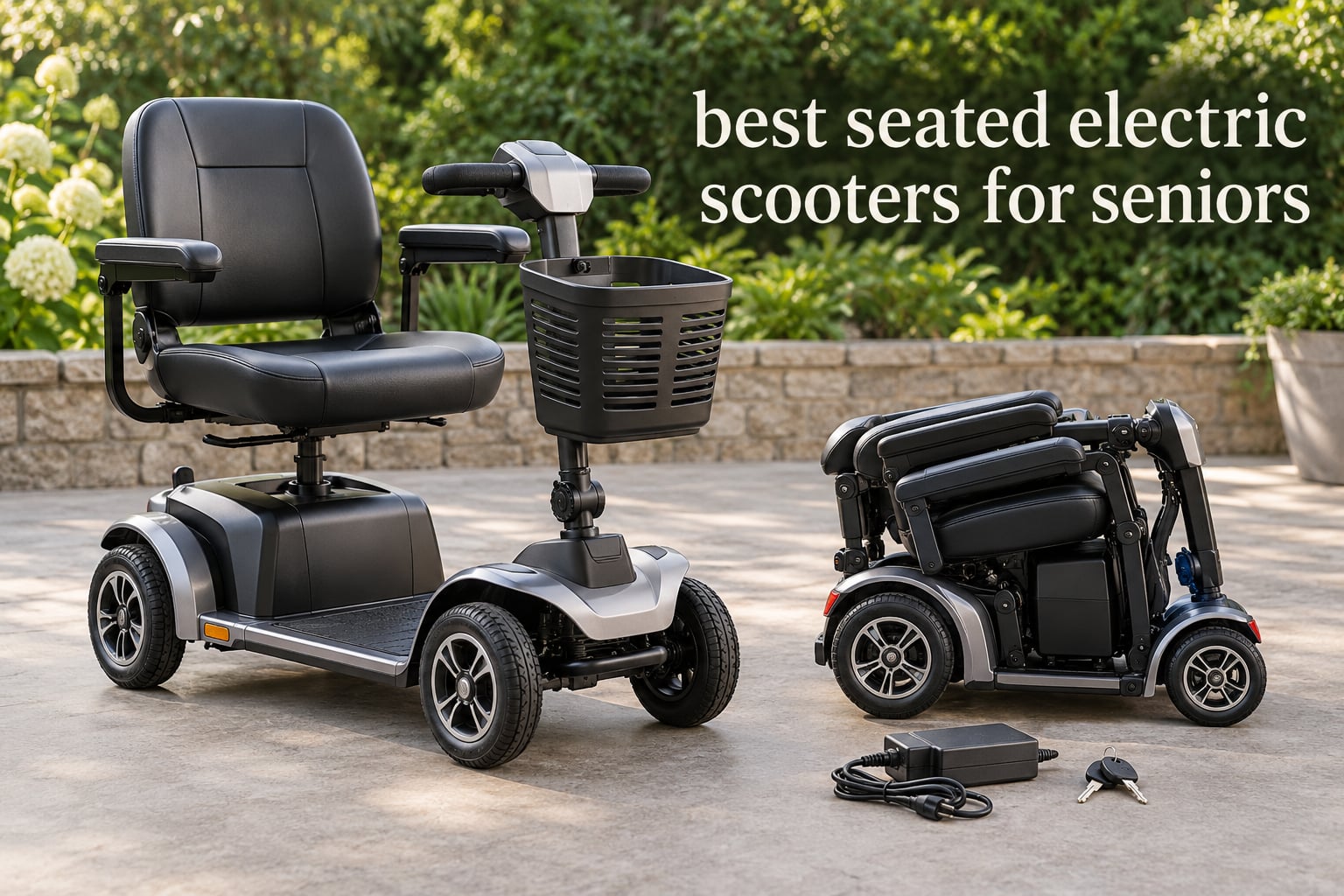
Shopping for the best seated electric scooters for seniors is harder than it looks, because two very different machines sit under one search term. One is a medical-grade mobility scooter: three or four wheels, a wide base, tiller steering, and a heavy stable seat built for riders who cannot walk far. The other is a moped-style two-wheeled seated e-scooter, a lighter recreational machine that needs continuous core balance to stay upright. Buyers routinely search both, then get handed the wrong one.
We spent six weeks working through ten of the strongest seated electric scooters on the market, reading every review block we could find and comparing the numbers that actually decide whether a senior can use a machine safely. Weight capacity, top speed, driving range, turning radius, total weight, and the weight of the heaviest single piece after disassembly all went into our notes. We did not test ride these on public roads. What we did was read thousands of owner comments and match what owners consistently praise or complain about against the published specifications.
Our best overall pick is the SuperHandy Passport, a 35 lb folding three-wheel scooter that a caregiver can actually load into a car and that fits through narrow apartment doors. If your rider is over 300 lbs, the LAGTOM 500 lb four-wheel model is the one worth reading. If the scooter lives in a small apartment with tight hallways, the Ecomobi M3 turns in a 33 inch circle.
Every scooter in this roundup is a three- or four-wheel seated unit. We found no two-wheeled moped-style seated scooter that we would put in front of a senior rider, and we explain why in the safety section near the end. Before you read further, three questions narrow your search faster than any spec sheet: will the scooter be used indoors or outdoors, does the rider need medical support or general transportation, and what is the rider’s actual body weight plus clothing?
Readers who want the wider picture on non-seated options should also look at our guides to electric scooters for commuting and foldable electric scooters.
Top 3 Picks for Best Seated Electric Scooters for Seniors

SuperHandy Passport
- 35 lbs total
- 13 mile range
- 275 lbs capacity
- folds flat for cars and flights

SKRT Foldable 4-Wheel
- 300 lbs capacity
- 15 mile range
- folds to 16.5 inches
- tool-free five-piece disassembly

Mbxcooter 45 Mile All Terrain
- 350W motor
- 7 mph top speed
- 20/35/45 mile range options
- 15 degree slopes
All 10 Picks at a Glance
The table below lists every scooter in this roundup with its wheel count, weight capacity, top speed, and heaviest lifting load. Specifications are taken from each manufacturer’s published product data.
| Product | Specifications | Action |
|---|---|---|
| SuperHandy Passport |
|
Check Latest Price |
| SKRT Foldable 4-Wheel |
|
Check Latest Price |
| Mbxcooter All Terrain |
|
Check Latest Price |
 Aotedor Lightweight Aotedor Lightweight |
|
Check Latest Price |
 LAGTOM Heavy Duty LAGTOM Heavy Duty |
|
Check Latest Price |
 Rascal Venture 4-Wheel Rascal Venture 4-Wheel |
|
Check Latest Price |
 PAISEEC S3 PAISEEC S3 |
|
Check Latest Price |
 AXADA Foldable AXADA Foldable |
|
Check Latest Price |
 WAYCARE 330 lb WAYCARE 330 lb |
|
Check Latest Price |
 Ecomobi M3 Ecomobi M3 |
|
Check Latest Price |
1. SuperHandy Passport: Best Overall Foldable Scooter for Seniors
- Only 35 lbs assembled with a 27 lb frame a caregiver can lift alone
- Dual removable lithium batteries recharge in about 1.5 hours
- Tight turning circle works in grocery aisles and narrow spaces
- Folds flat enough for a sedan back seat
- Quiet motor with no reverse beep
- Small solid wheels with no suspension transmit every bump
- Light frame feels wobblier on curbs and sharp sidewalk edges
- Seat-to-handle distance does not adjust for shorter riders
- No key switch so it is hard to secure when unattended
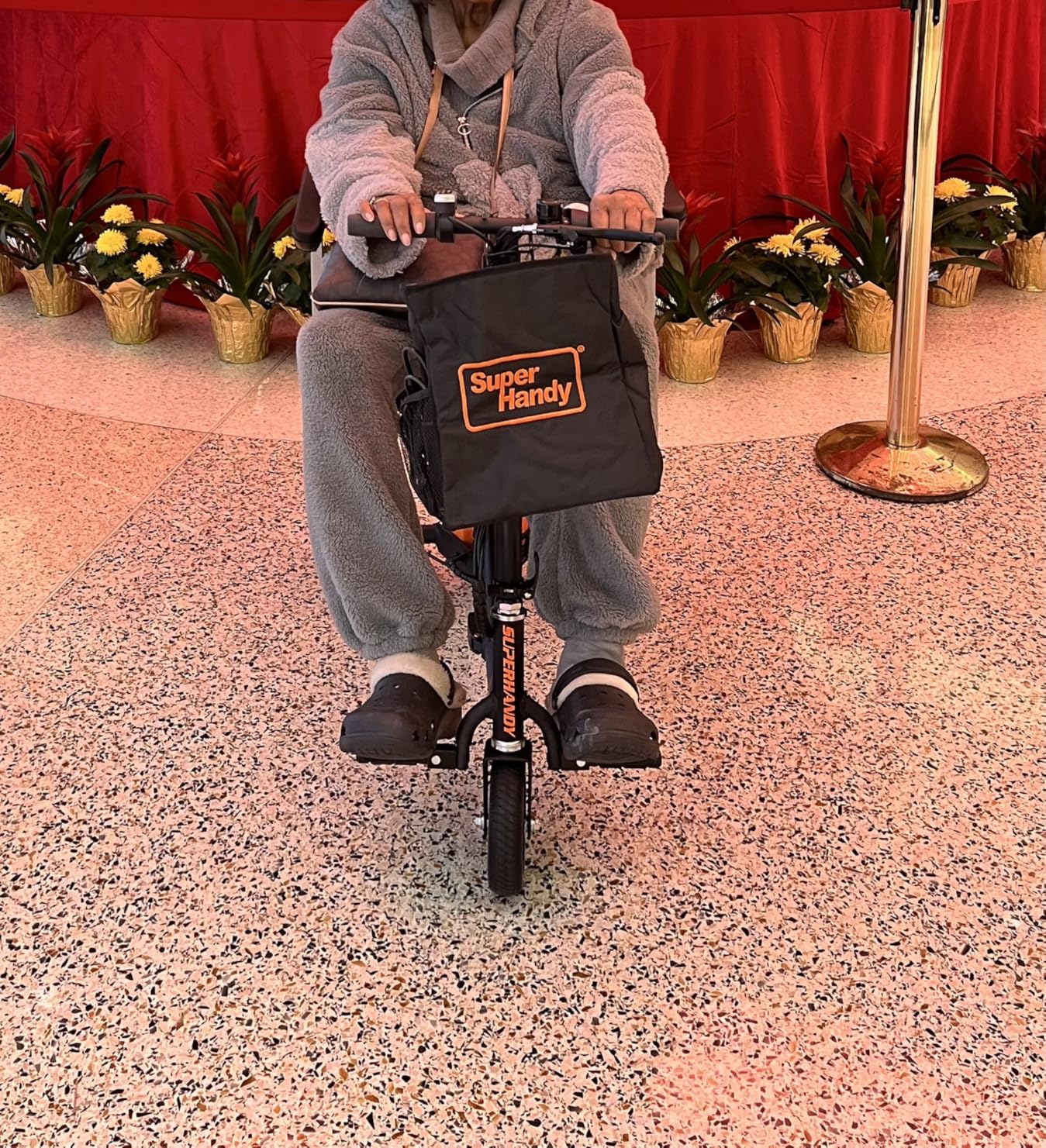
We kept coming back to the Passport because of a single number: 35 lbs assembled. That breaks down to a 27 lb frame, an 8.2 lb seat, and a 2 lb battery, which means every single piece fits in one arm. Owners who bought it for air travel say the same thing. The two 44.4V lithium batteries detach and recharge in roughly 90 minutes, and the whole unit folds to 24 by 22.4 by 16.5 inches.
At 1446 reviews and a 4.2 star average, this is the most heavily reviewed seated scooter in our set, and the review volume is instructive. Roughly 67% of owners give five stars. They talk about the weight, the quiet operation, and the tight turning circle in stores. That is exactly the profile we want for a scooter that a family buys for one parent and then moves between homes.
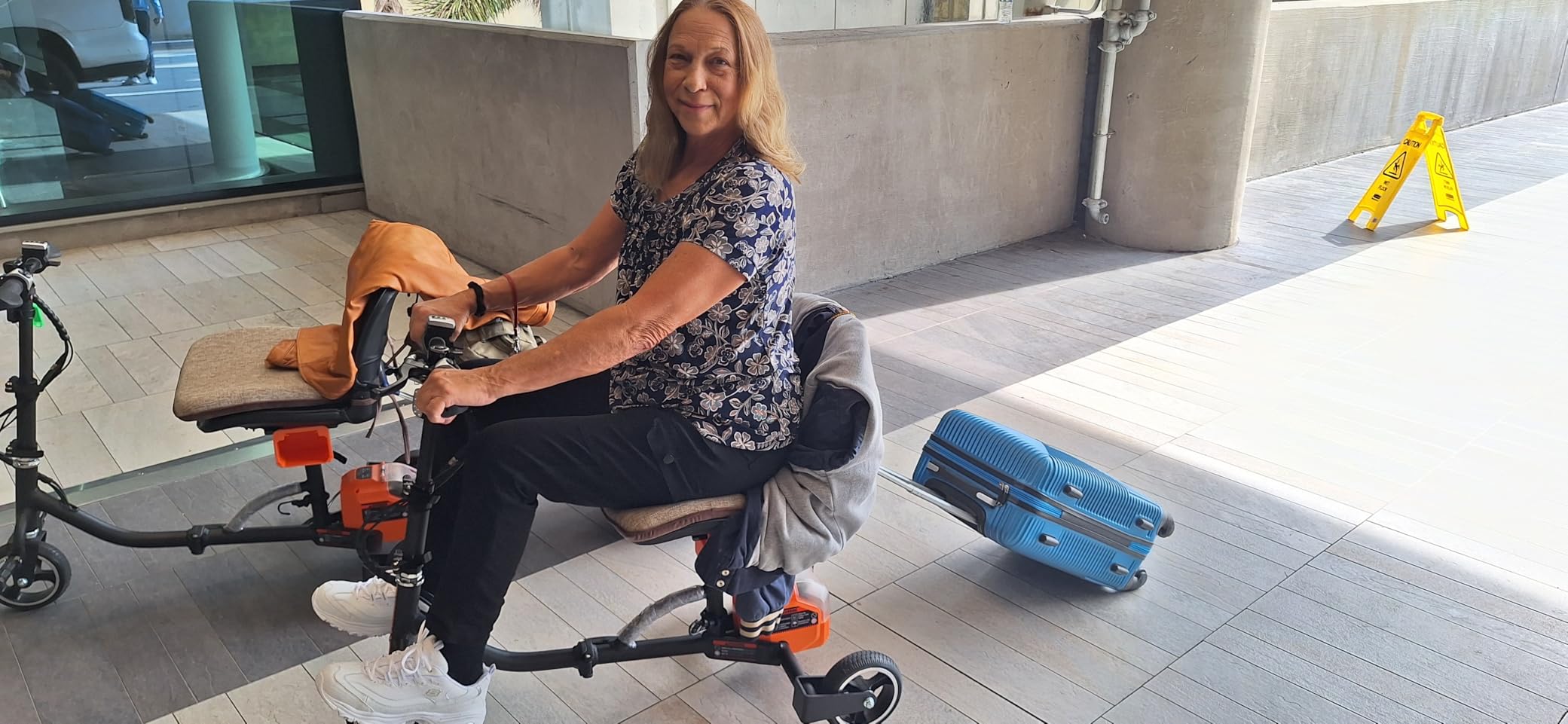
The 4.2 average exists because of real limits. The 6.75 inch solid tires have no suspension, so grass and rough ground are punishing. Owners describe the light aluminum frame as tippy on curb edges and when cornering faster than walking pace. The foot pegs become uncomfortable after twenty minutes, and the seat-to-handle distance is fixed, so shorter riders have to lean forward.
We also noticed something worth flagging: owners of newer production units report a forced standby mode that drains the battery and makes it harder to seat the battery correctly. It is a minority of reviews, but if buying new, check the battery seating before you ride away. If your caregiver cannot lift heavy objects at all, note the honest detail from r/disability, where buyers asked for scooters under 30 lbs total. At 35 lbs, the Passport is close but not under that line.
Who the SuperHandy Passport suits
This is the scooter for a rider who travels between relatives, goes through airports, and needs something one person can put in a car. It suits riders up to 275 lbs on smooth pavement, sidewalks, shopping centres, and indoor floors. The dual removable batteries mean no charging anxiety on a day out, which owners mention as the reason they stopped renting scooters.
Where the Passport falls short
It falls short on rough ground, on slopes, and for riders over 275 lbs. Anyone with balance concerns will feel the three-wheel layout more than they would in a four-wheeler. The fixed seat-to-handle distance is the quiet problem here: a rider under about five foot four will be leaning forward all day, which works against exactly the kind of posture support a senior needs.
2. SKRT Foldable 4-Wheel Scooter: Best Value Seated Scooter
- Tool-free five-piece disassembly fits most car trunks
- Four-wheel frame with anti-tip rear wheels and electromagnetic brakes
- Simple controls with clear battery level display
- Headlight plus dual LED ground lights
- USB port
- cup holder and phone mount
- Seat has little cushioning and no shock absorption
- Swivel seat lever is very tight for weak hand strength
- Short leg room for taller riders
- Needs a second person to lift into a car
The SKRT is the value pick that surprised us. Its 180W motor, 24V 12Ah battery, 15 mile range, and 8 degree incline handling put it well above the entry-level tier in behaviour, and the four-wheel base with anti-tip rear wheels makes it a genuinely stable platform for mounting.
Buyers use it as a first scooter and rate it at 4.3 stars across 447 reviews, with 72% five-star. Owners talk about assembling it easily, riding it to shops, and taking it on bus trips. The 360 degree swivel seat measures 16.5 by 13.4 inches with flip-up armrests, which is a small seat but a workable one for most body sizes.
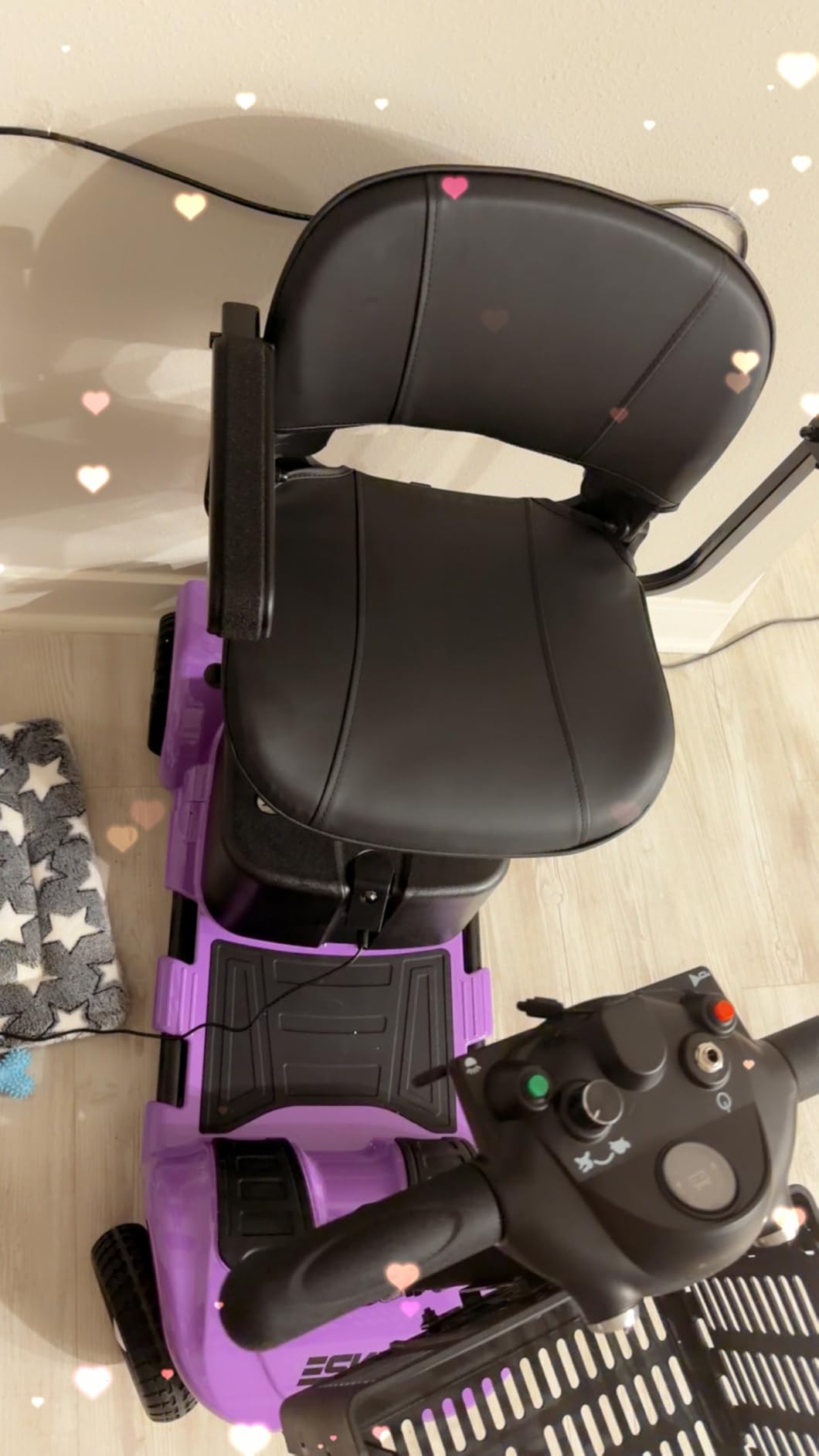
The most repeated criticism is the seat itself. It is thinly padded, fits loosely in the seat post, and offers no shock absorption, so longer rides get uncomfortable. The swivel lever is tight, which is a specific problem for riders with arthritis or reduced hand strength. Taller riders around five foot ten report only just fitting, and the 40 lb heaviest component means loading it takes help.
A small number of buyers report a battery with dead cells soon after purchase, and after-sales support is described as weaker than the product itself. We would treat the battery as the one component to check on arrival.
Who the SKRT suits
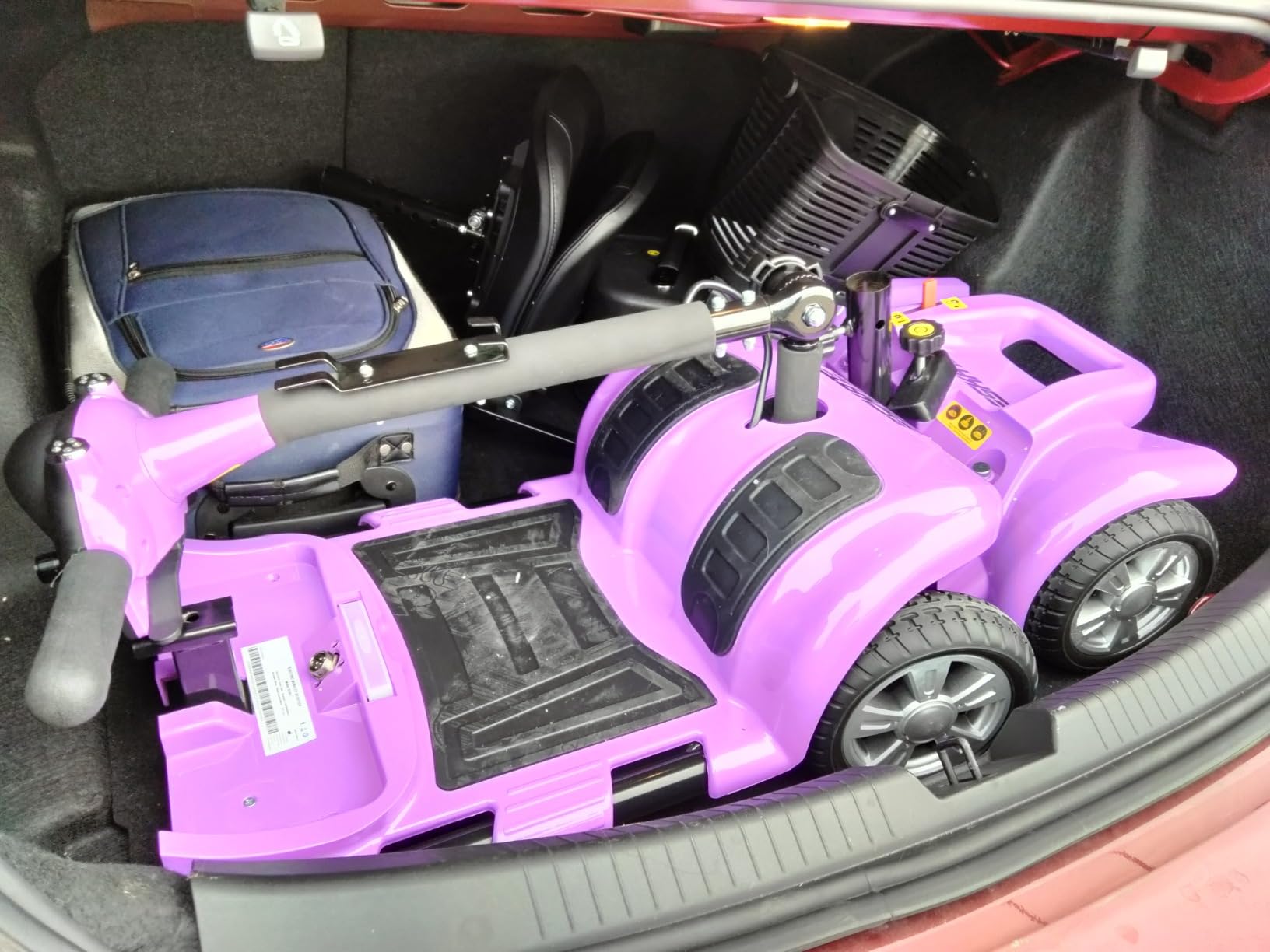
This fits a first-time scooter buyer on a limited budget who wants short-distance independence: medical appointments, the shops, neighbours, flat pavements. The tool-free five-piece disassembly and a 16.5 inch folded height mean it goes into a hatchback without a ramp. Buyers who want the widest feature list at this level get a headlight, ground lights, USB port, cup holder, and phone mount.
Where the SKRT falls short
It falls short on comfort and on lift weight. A thin seat over hard ground is the opposite of what a long day outdoors needs, and the tight swivel lever works against riders with hand weakness. If your route includes gravel, grass, or hills, look at the AXADA or the Mbxcooter instead. If the caregiver cannot lift anything above 30 lbs, this is not the scooter.
3. Mbxcooter 45 Mile All Terrain Scooter: Best for Long Outdoor Days
45Miles Mobility Scooter for Seniors/Adults,All Terrain Mobility Scooter
- Highest rated 4.6 with 80% five-star reviews across 298 reviews
- Four-piece disassembly with foldable tiller for storage
- Handles grass and pavements with all-day battery endurance
- Dual baskets plus USB port and GPS tracker
- Responsive customer support
- 85.5 lbs needs help or a ramp to load
- Basic suspension makes cobblestones uncomfortable
- Wider four-wheel turning radius than three-wheel models
- Battery is not designed for quick tool-free removal
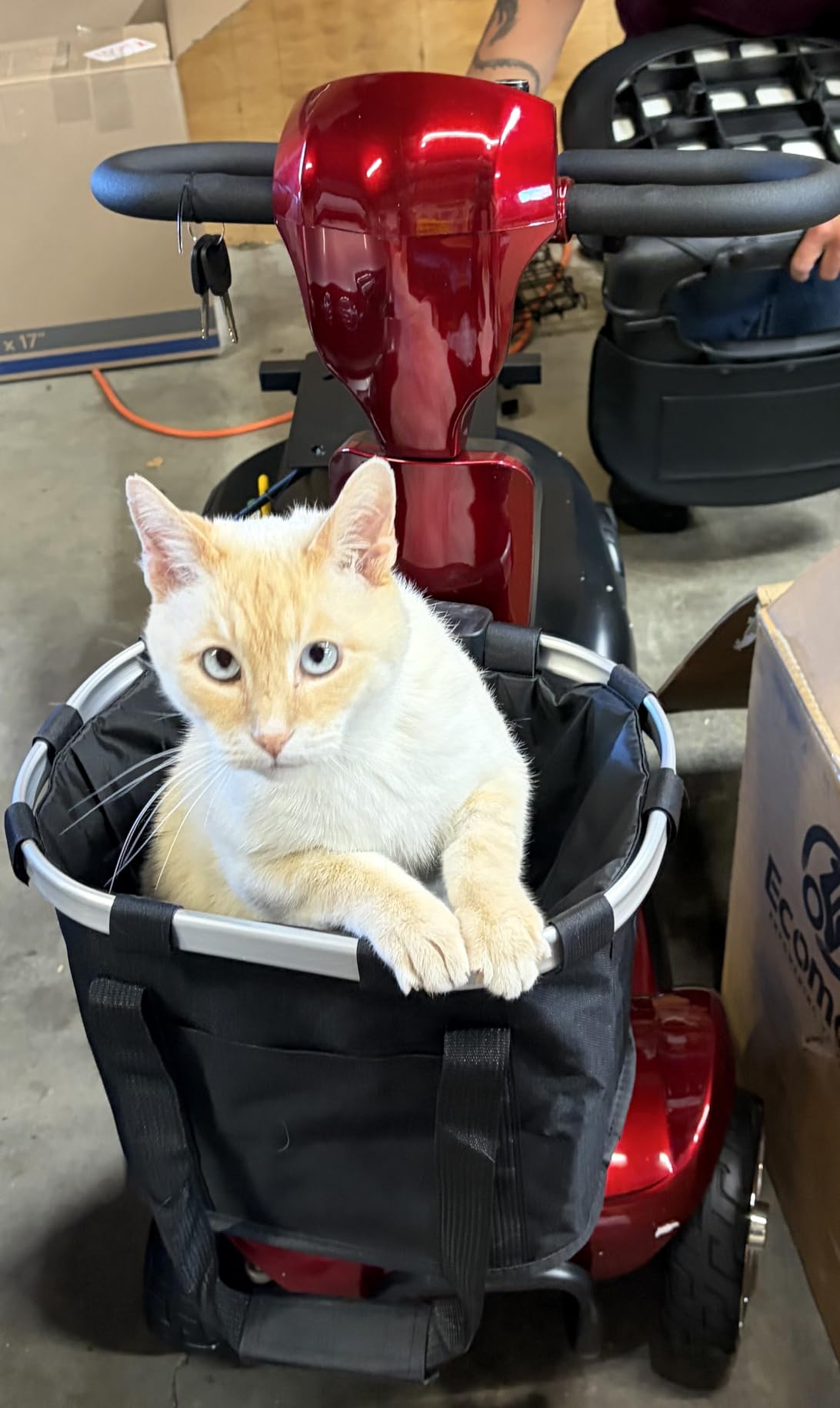
The Mbxcooter MS20 is the one to look at when the daily route is longer than a trip to the corner shop. Its 350W motor reaches up to 7 mph and handles 15 degree slopes, and the battery comes in 20, 35, and 45 mile configurations. Forty-five miles is the longest range option in this roundup by a clear margin.
It holds a 4.6 star average with 298 reviews and an 80% five-star share. Owners describe it as well built and good value, and several say they got a full working day out of a charge. The four-piece disassembly with a foldable tiller and detachable seat makes storage in a garage or a small utility room realistic, which matters for a machine this size.
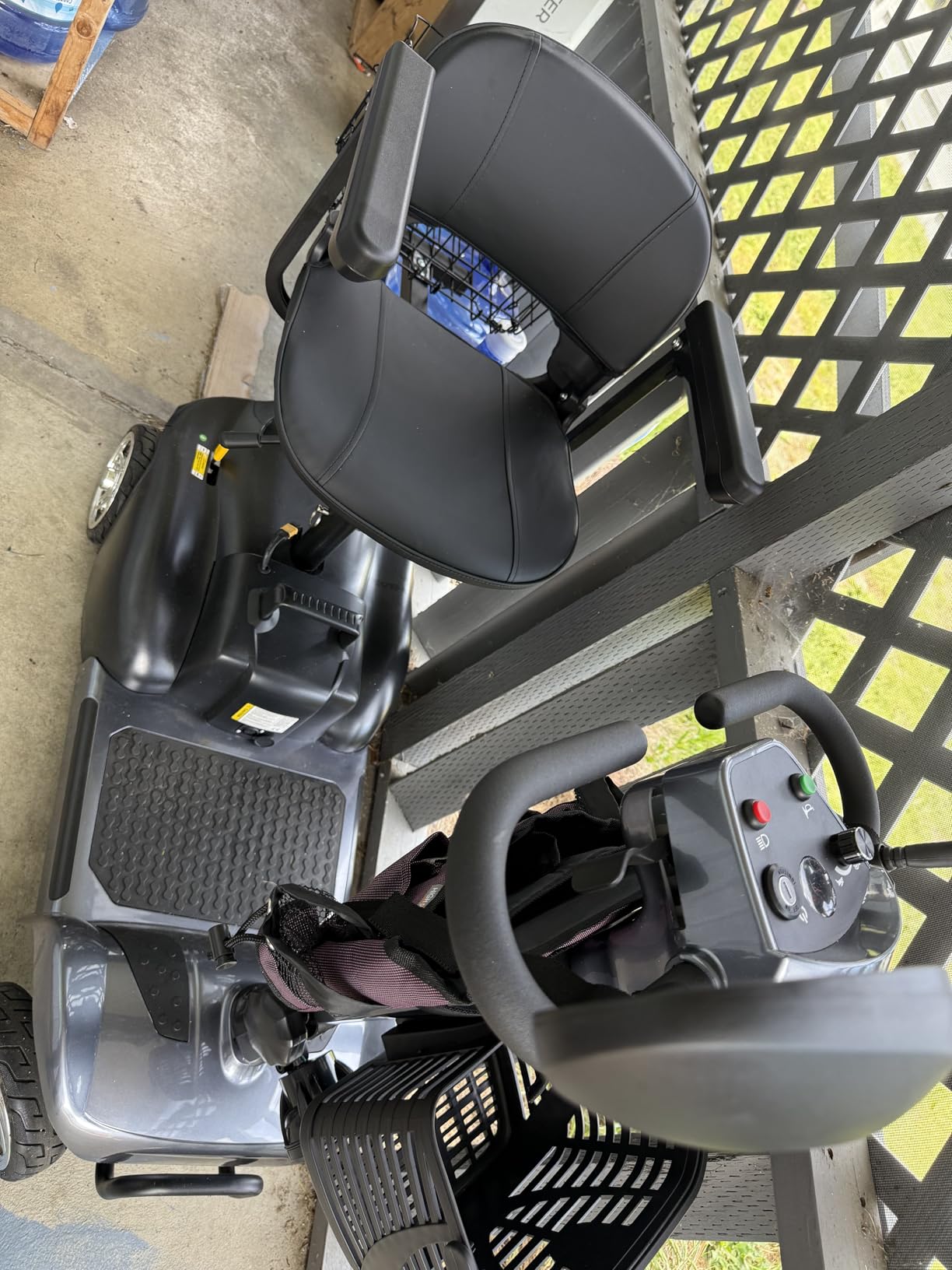
Standard equipment is unusually generous: a front anti-collision bar, rear anti-tip wheels, headlight and taillight, a detachable lithium battery with power-off protection, a USB port, a GPS tracker, and a swivel side-release seat with adjustable armrests. Dual baskets add everyday carrying capacity that most competitors skip.
The limits are weight and terrain comfort. At 85.5 lbs, almost every owner needs a second person or a ramp. Suspension is basic, so cobblestones and uneven ground come through. The four-wheel layout turns on a wider arc, and the battery is not designed for quick tool-free removal, which undercuts the travel story the folding tiller otherwise supports.
Who the Mbxcooter suits
It suits a rider on flat but long routes: park paths, mowed fields, promenades, larger campuses, and days that involve several appointments. The 15 degree slope capability and 16 inch ground clearance make it more tolerant of imperfect surfaces than most four-wheelers here. The GPS tracker and anti-collision bar are real advantages if the scooter is used around traffic or parked outdoors.
Where the Mbxcooter falls short
It falls short for small homes and for solo caregivers. The turning circle is not hairpin tight, so a narrow apartment hallway is a poor fit. And if the person assisting with loading cannot manage 85 lbs, this one is going to sit in the garage. Riders who need air travel should check battery removal rules before committing.
4. Aotedor Lightweight Mobility Scooter: Best Light Four-Wheel for Travel
Aotedor Lightweight Mobility Scooter for Seniors, 36 lbs, 22-Mile Range
- 36 lb magnesium alloy frame is unusually light for a four-wheeler
- Two removable 10Ah batteries give a genuine 22 mile combined range
- Folds without tools and rolls on its wheels
- Wide 14.5 inch seat with independently adjustable armrests
- Electromagnetic braking engages when the lever is released
- Premium pricing against lighter-duty models
- 3.7 mph top speed is slower than most here
- Designed for smooth surfaces rather than rough terrain
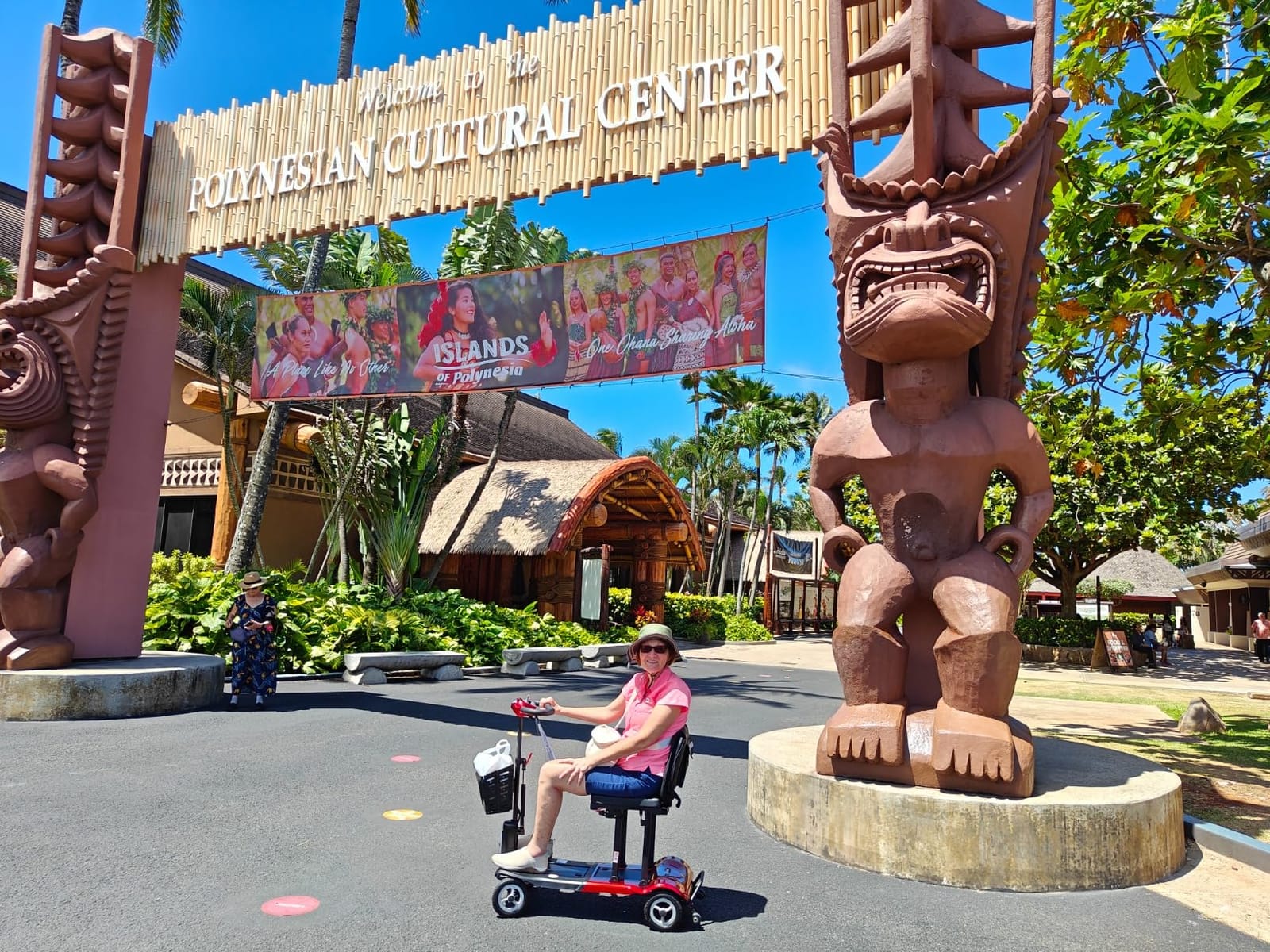
The Aotedor solves a problem nobody else in this roundup solves well: a four-wheel scooter light enough to move. The magnesium alloy main frame weighs 36 lbs without the batteries, and it folds without removing the seat or using tools, then rolls on its wheels like a suitcase. That one-handed loading story comes straight from owner reviews.
Two independent removable 10Ah lithium batteries give up to 22 miles combined. At 4.6 stars across 202 reviews with 79% five-star, sentiment is strongly positive. Owners repeatedly single out the 14.5 inch wide seat and the independently adjustable armrests as the reason it fits a range of body sizes comfortably, which is exactly the feature set we look for when we talk about fit rather than power.

Safety hardware is sensible for a four-wheeler: rear anti-tip wheels, a brushless motor, anti-slip solid tires, and electromagnetic auto braking that engages the moment the control lever is released. The tiller height adjusts too, so the driving position can be set for the rider rather than the other way round.
Buyers accept two trade-offs without complaint. The feature set and magnesium frame command more than lighter-duty models do. And at 3.7 mph, this is among the slowest scooters here, which is fine on pavements and indoors but not useful on a long open path. It is built for smooth indoor and outdoor surfaces, not gravel or grass.
Who the Aotedor suits
It suits riders who want four-wheel stability without the usual bulk: a 36 lb frame is the lightest four-wheel design in this roundup. It works well for indoor corridors, apartment common areas, pavements, and smooth paths where someone wants to load it without a ramp. Riders who need armrest and seat-width adjustment value that more than extra speed.
Where the Aotedor falls short
It falls short on rough terrain and on distance per hour. Grass, gravel, and uneven pavement are outside its design brief. At 3.7 mph, a rider covering a long park loop will finish late. It is also the more expensive option among the lighter four-wheelers, so buyers who only need short indoor trips may find better value lower down the list.
5. LAGTOM Heavy Duty 4-Wheel: Best for Heavy Riders up to 500 lbs
- Only scooter here rated for a 500 lb rider
- 1000W motor handles steep and rough ground
- 16 inch tires plus rear shock absorbers for grass sand snow and mud
- Deluxe reclining captain's seat with folding armrests and safety belt
- Keychain remote for lock unlock and anti-theft alarm
- 98% pre-assembled
- 275 lb total weight is impractical to load in most cars
- Large footprint turns slowly and misses tight doorways
- 15 mph is far above walking pace and needs licence and road judgement
- Cost is high for the capability level
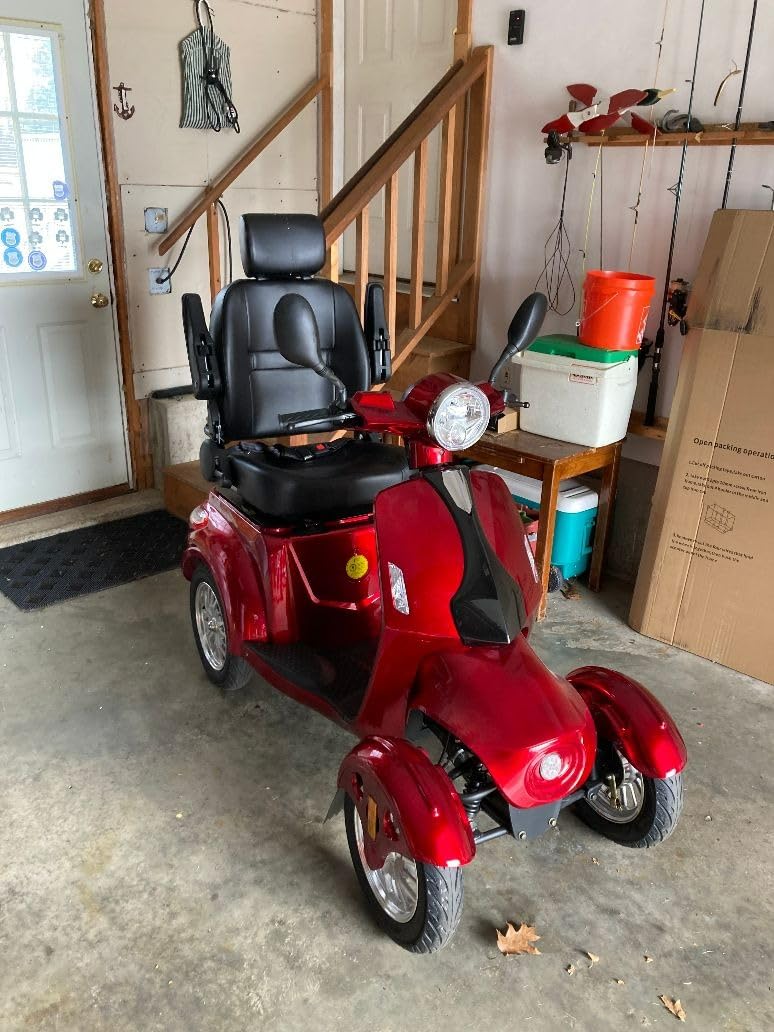
This is the heavy-duty slot. Its 500 lb weight capacity is the highest in the roundup by a wide margin, and the 1000W motor with a 60V 20Ah battery is a different class of hardware from everything else here. Speed adjusts from 1 to 15 mph on a variable dial, which lets a rider dial it down to walking pace.
Owners rate it 4.6 stars across 173 reviews with an 85% five-star share. The features that come up are the 16 inch fat tires with two rear shock absorbers for sand, snow, grass, and mud, and the deluxe reclining captain’s seat with folding armrests and a safety belt, which reviewers describe as the most comfortable seat in the group.
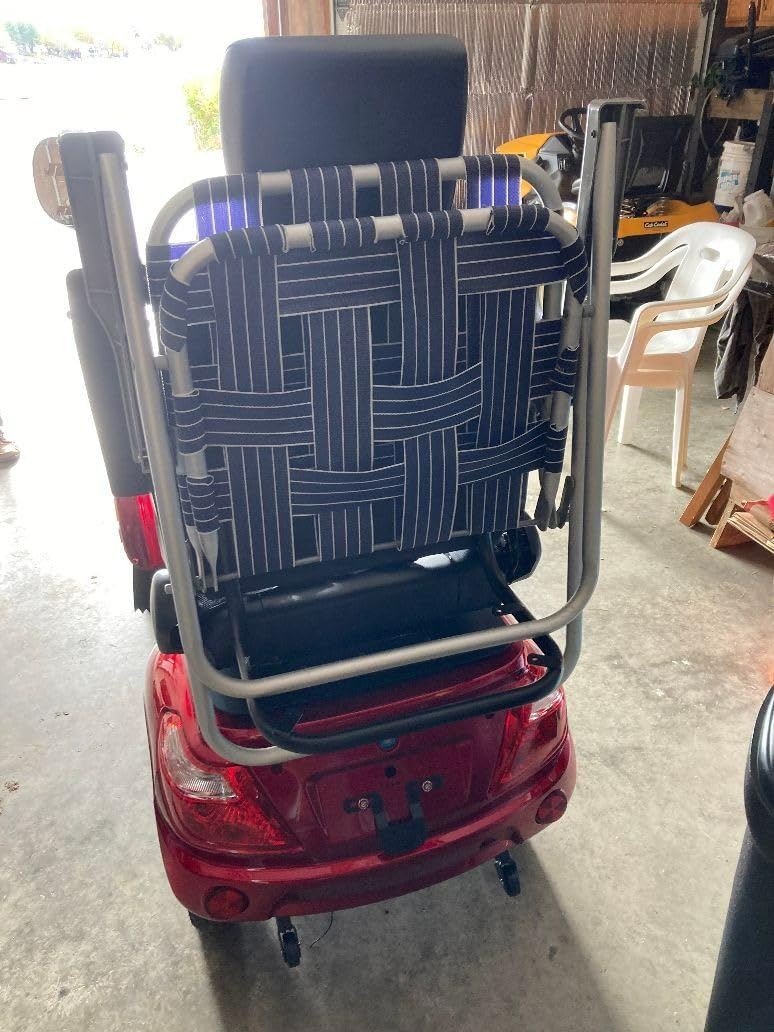
Everything is included: rear wheel anti-tippers, headlights, taillights, turn signals, a keychain remote for on, off, lock, unlock and alarm, a locking glove compartment, rear basket, under-seat storage, a USB charger, and a cup holder. It arrives 98% assembled, so the rider installs the rear trunk and mirrors and goes.
Now the honest part. At 275 lbs and 62.6 by 27 by 42.1 inches, this is the least portable machine here and it will not fit through tight doorways. The 15 mph setting is a real driving speed that needs licence and road judgement, and it sits far above the pace most seniors want. This is the scooter for a large rider on open private land, not for a city scooter.
Who the LAGTOM suits
It suits riders between roughly 350 and 500 lbs, and anyone who needs genuine all-terrain capability: farm tracks, wooded paths, gravel drives, snow. Riders who spend hours on a machine will like the reclining captain’s seat, and the turn signals and mirrors help where other scooters have none.
Where the LAGTOM falls short
It falls short everywhere portability matters. It will not go in a normal car, it will not turn in a hallway, and it is not a scooter for a small apartment. A rider who cannot lift anything heavier than a kettle should skip this section entirely and look at the SuperHandy Passport instead.
6. Rascal Venture 4-Wheel: Best for Buyers Who Need Medical Certification
Rascal Venture 4-Wheel Portable Mobility Scooter for Travel, Easy Disassembly, Compact Design, 300 lb Capacity, Battery Included
- Highest rating in the roundup at 4.7 with 84% five-star reviews
- Five-piece disassembly in about a minute with a 34.5 lb heaviest piece
- FDA Class II medical device listing for healthcare buyers
- Smooth throttle and reverse with multiple speed settings
- Swivel seat with adjustable height armrests and tiller
- Speed dial is easy to turn and can lead to bumping furniture
- Charging port sits low inside the frame and is awkward to reach
- 125 lbs assembled so it is not a one-person car-lift scooter
- Less capable on grass and gravel
The Rascal Venture is the one to buy when documentation matters. It is listed as an FDA Class II medical device, which is the specification a healthcare buyer, a facility, or a Medicare supplier will ask for. At 4.7 stars it holds the highest rating in this roundup, with 84% five-star across 109 reviews.
Owners who compared several scooters before settling here describe it as the one with no compromises: easy assembly, easy disassembly, comfortable seating, smooth controls, stable indoors and out. The swivel seat adjusts in height, and both the armrest position and the tiller adjust too. The 17 inch seat sits at a 15 inch height, which is a good transfer height for many riders who cannot stand from a low chair.

It reaches up to 10 miles per charge at a 4 mph maximum, with electromechanical and regenerative brakes. The warranty is the most complete in this roundup: three years on the frame, two years on the drivetrain and electrical, and six months on the battery. That matters more than it sounds, because the battery is the part most likely to fail first.
The criticisms are practical rather than serious. The speed dial is sensitive enough to bump walls and furniture in a tight space. The charging port sits low inside the frame, which is awkward to reach when the battery is low. Total weight is around 125 lbs, so it is not a one-person car-lift scooter even though the heaviest piece is only 34.5 lbs. Some riders report weaker performance on grass and gravel.
Who the Rascal Venture suits
It suits a family buying on behalf of a parent who needs paperwork, a warranty, and a stable machine for both indoor and outdoor use. Buyers who travel by air benefit from airline-friendly batteries and a five-piece breakdown. The 46.75 inch turn radius means plan the route in a car park rather than a shop aisle.
Where the Rascal Venture falls short
It falls short for anyone who needs to load it into a car alone, and for riders on soft or loose ground. The sensitive speed dial is a genuine problem in a small flat, where a wall or a doorframe is inches away. For compact indoor use, the three-wheel Ecomobi handles itself far better.
7. PAISEEC S3: Best for Comfort Over a Full Day Out
PAISEEC S3 Mobility Scooter for Seniors, 25/40 Mi, 2-Step Fold, Lightweight
- Owners report full theme-park days on one charge
- 10 inch air-filled tires ride smoother than solid-wheel competitors
- Two-step tool-free fold with a 61 lb heaviest component
- AI auto speed control reduces tip risk on starts turns and descents
- Spoken reverse and hazard alerts instead of an abrasive horn
- Seat has no adjustment and does not swivel
- Turn radius is wide enough to need a three-point manoeuvre indoors
- Seat sits close to the tiller and can feel cramped for taller riders
- 61 lb heaviest component still needs lifting effort into a trunk
The PAISEEC S3 is the comfort pick. Its 10 inch air-filled tires are the difference you feel most on rough ground, and reviewers say so directly. The 250W brushless motor runs three speed settings up to 6.2 mph, and the dual detachable batteries are airline-approved in 25 or 40 mile configurations.
At 4.4 stars across 96 reviews, owners describe long days out: full theme-park visits on one charge, smooth riding over grass and gravel, and a two-step tool-free fold down to 39 by 22 by 17 inches. The heaviest component is 61 lbs, which owners note is manageable in a small car with one person helping.
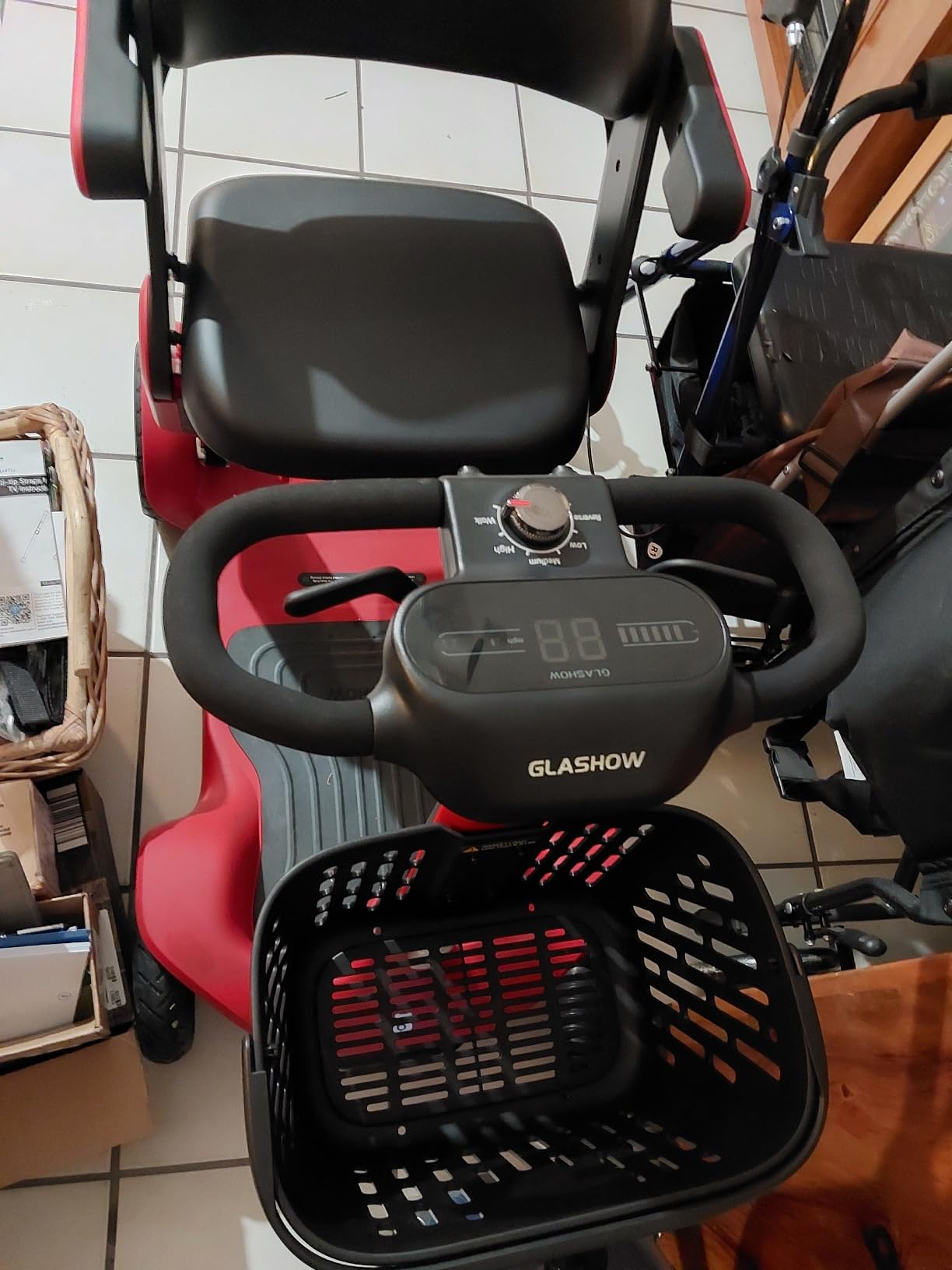
The safety software is the interesting part. AI auto speed control trims the power on starts, turns, and downhill runs, which is a genuine tip-risk reduction on a slope. Voice alerts announce reverse and hazards instead of an abrasive beep, and the 6.1 inch HD display uses icons for lights, horn, speed, and battery, which reads well through glasses.
The most substantive complaint comes from a buyer with limited knee mobility, and it is worth taking seriously: the seat does not swivel and has no height adjustment. The turn radius is wide enough that tight indoor turns need a three-point manoeuvre, and the seat sits close to the tiller, which taller riders describe as cramped. One owner also flagged a seat back latch that must be confirmed clicked or the backrest can collapse. Check that latch every time.
Who the PAISEEC S3 suits
It suits riders who go out for entire days rather than short errands: theme parks, large shopping centres, campuses, and long promenades. Riders with a history of tipping or who ride on slopes will appreciate the auto speed control. Anyone planning air travel benefits from the airline-approved detachable battery.
Where the PAISEEC S3 falls short
It falls short for riders with knee, hip, or back problems, because the seat is fixed and does not swivel. It also falls short in small flats, where the turning circle forces three-point turns. The rating distribution is the widest here, with a 14% three-star share, and that traces back to seat comfort rather than performance.
8. AXADA Foldable Scooter: Best for Hills and Gravel
AXADA Mobility Scooter,Foldable,300 lbs Capacity,Travel & Daily Commute
- Capable 300W motor handles gravel grass and cement
- Folds compactly for car trunks with a manual push mode when flat
- LED dashboard and one-touch start are easy for first-time users
- 360 degree swivel seat with adjustable height and width-adjustable armrests
- Fast responsive seller support
- 86 lbs typically takes two people to load into a car
- Seat is uncomfortable with little leg room for shorter riders
- Wide turning circle compared with three-wheel designs
- No audible backup warning when reversing
- Lead-acid battery is not permitted on aircraft
The AXADA is the steep-hill option at this level. Its 300W motor with a 24V 12Ah deep-cycle battery climbs 8 to 15 degree inclines, and the 45mm ground clearance helps on broken pavement and gravel approaches. Owners mention gravel, grass, and cement specifically in their reviews.
At 4.3 stars across 274 reviews, sentiment is positive for a budget machine. Buyers value the folding frame, the manual push mode that lets you wheel it when the battery is flat, and the LED dashboard with one-touch start, which several owners call genuinely easy for a first-time scooter user. The 360 degree swivel seat adjusts in height, and the armrests adjust in width, which helps fit.
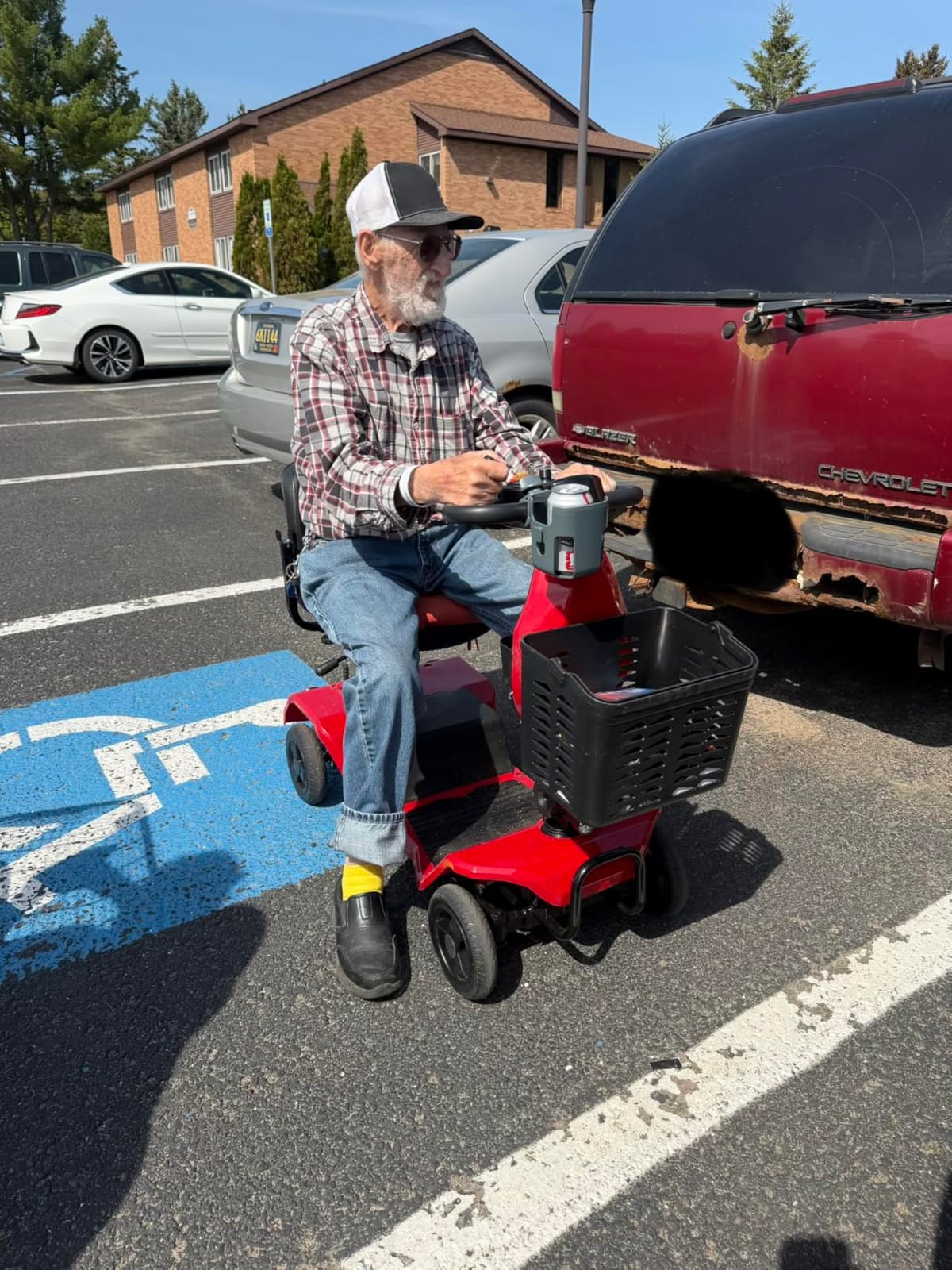
Two specification details matter here. The standard rating is 262 lbs, with 300 lbs listed as the maximum tested capacity, so if your rider is near 300 lbs you are riding at the edge of the tested figure rather than comfortably inside it. And the battery is lead-acid, which is exactly why one prominent reviewer complained that the scooter cannot fly.
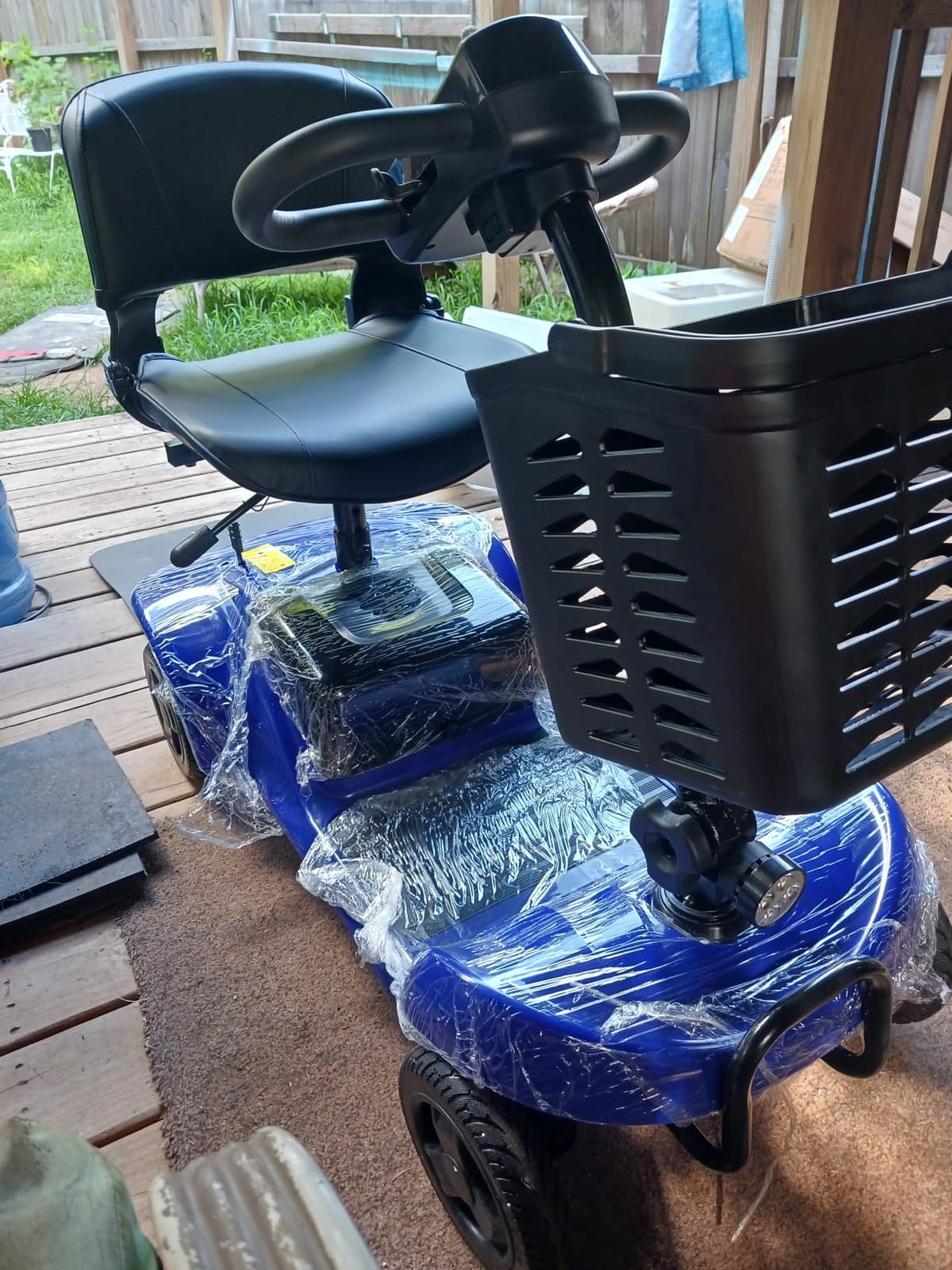
The most repeated negative is weight. At 86 lbs, loading needs two people. Seat comfort is a close second, with owners reporting little leg room for shorter riders. The four-wheel turning circle is wide, there is no audible backup warning when reversing, and the support that resolves setup problems quickly is less available afterwards.
Who the AXADA suits
It suits a rider on a route with real elevation change: a sloped driveway, a hilly neighbourhood, a park with an incline. The 300W motor has the headroom for that where smaller motors bog down. It also suits anyone who wants a scooter that can be shoved manually when the battery runs down.
Where the AXADA falls short
It falls short on weight, comfort, and travel. Two people to load is a real barrier for single-caregiver households. The seat will not forgive a long day. And if there is any chance of flying with this scooter, stop here: a lead-acid battery is not permitted on aircraft, which rules out air travel entirely.
9. WAYCARE 330 lb Mobility Scooter: Best Budget Four-Wheel
WAYCARE Mobility Scooter for Adults & Seniors, 330 lb 15-20 Mile Range Blue
- Lowest entry point among the four-wheel scooters here
- 250W motor and 4.97 mph handle everyday travel
- 330 lb capacity is the highest under 500 lbs in this roundup
- Larger and thicker cushioned seat than competing budget models
- Hill-holding mechanism prevents rolling on slopes
- ISO and CE certified
- 80 lb total weight means loading needs help
- Solid wheel design transmits more vibration on rough surfaces
- Fewer modern features with no listed taillight or USB port
- Wide four-wheel turning circle in tight indoor spaces
The WAYCARE is the budget four-wheeler, and the interesting thing about it is not the price. It is the 330 lb weight limit, which is the highest capacity in this roundup below the 500 lb LAGTOM, and the 19.6 by 18 by 16 inch seat, which owners single out as larger and better padded than comparable budget models.
It rates 4.3 stars across 275 reviews with a 73% five-star share. The 24V 250W motor with a 12Ah battery gives 15 to 20 miles of range at up to 4.97 mph, and the hill-holding mechanism stops the scooter rolling away on a slope, which is a safety feature budget models usually drop.
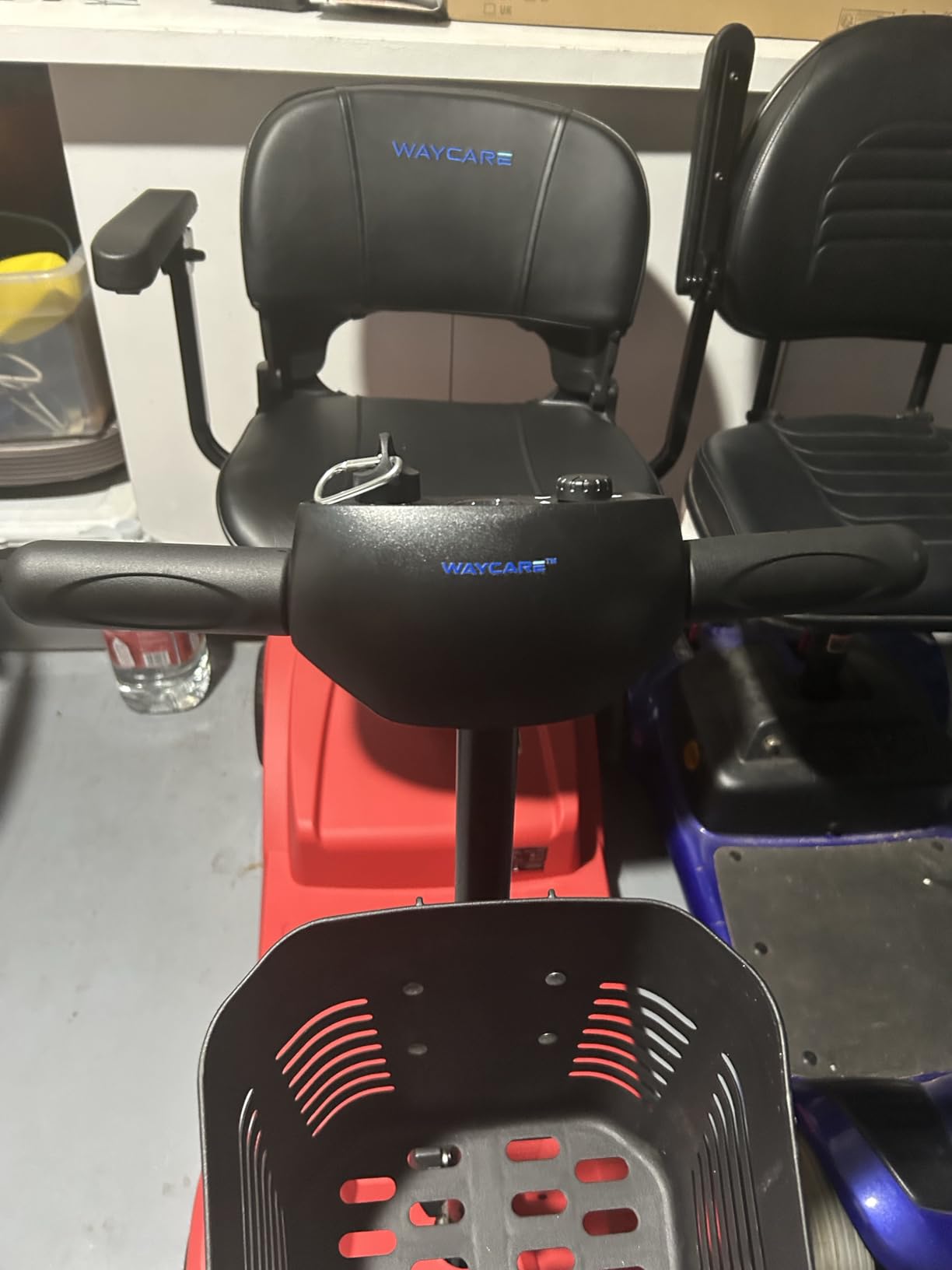
The 8 inch solid puncture-proof wheels need no attention, and the adjustable handles and control lever are designed to make entry and exit easier. ISO and CE certifications are listed, which is more documentation than most machines at this level carry.
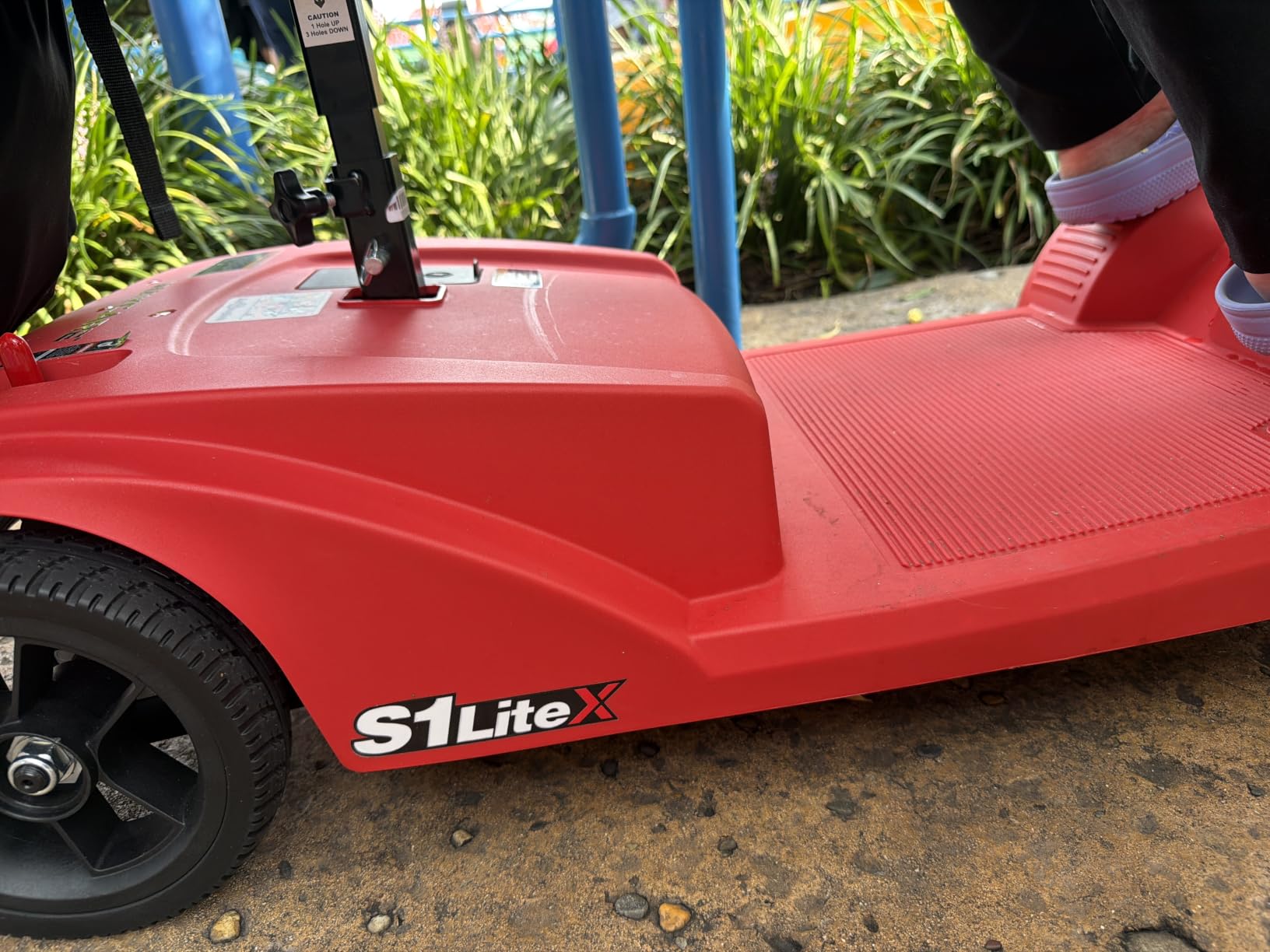
The recurring drawback is weight, at 80.3 lbs assembled, so the owner usually cannot load it alone. The solid wheel design transmits more vibration than air-filled tires on rough surfaces. Feature-wise it is bare: no listed taillight and no USB port. The wide four-wheel turning circle is awkward in small indoor spaces, and the rating distribution shows more one-star responses than any other four-wheeler here.
Who the WAYCARE suits
It suits a rider around 300 lbs who wants more capacity than a standard 265 to 300 lb scooter gives, on flat pavements and indoor floors. The hill-holding feature makes sloped driveways safer. Buyers who want a comfortable seat without paying for a premium frame will find it here.
Where the WAYCARE falls short
It falls short on lightness and on refinement. At 80 lbs it is one of the harder machines here to load, and it lacks the lighting, USB port, and suspension the higher models carry. If the scooter will spend its life outdoors on uneven ground, save up for air-filled tires instead.
10. Ecomobi M3: Best for Small Spaces and Tight Hallways
Light Weight Mobility Scooter for Adults, 3 Wheel Mobility Scooter
- 30 lb frame is among the lightest designs here
- 33 inch turning radius allows near in-place turns
- One-lift tool-free fold to an 11.8 inch profile for closets
- Two battery options of 20 or 32 miles with removable modules
- 2 inch thick padded seat and 8 inch wheels ride better than typical ultralights
- Three-wheel layout needs more balance judgement on curbs and slopes
- Rear anti-tip wheels add width behind the seat
- 30 lb figure is frame only and the seat and batteries add weight
- Around 5 mph is slower than the all-terrain models here
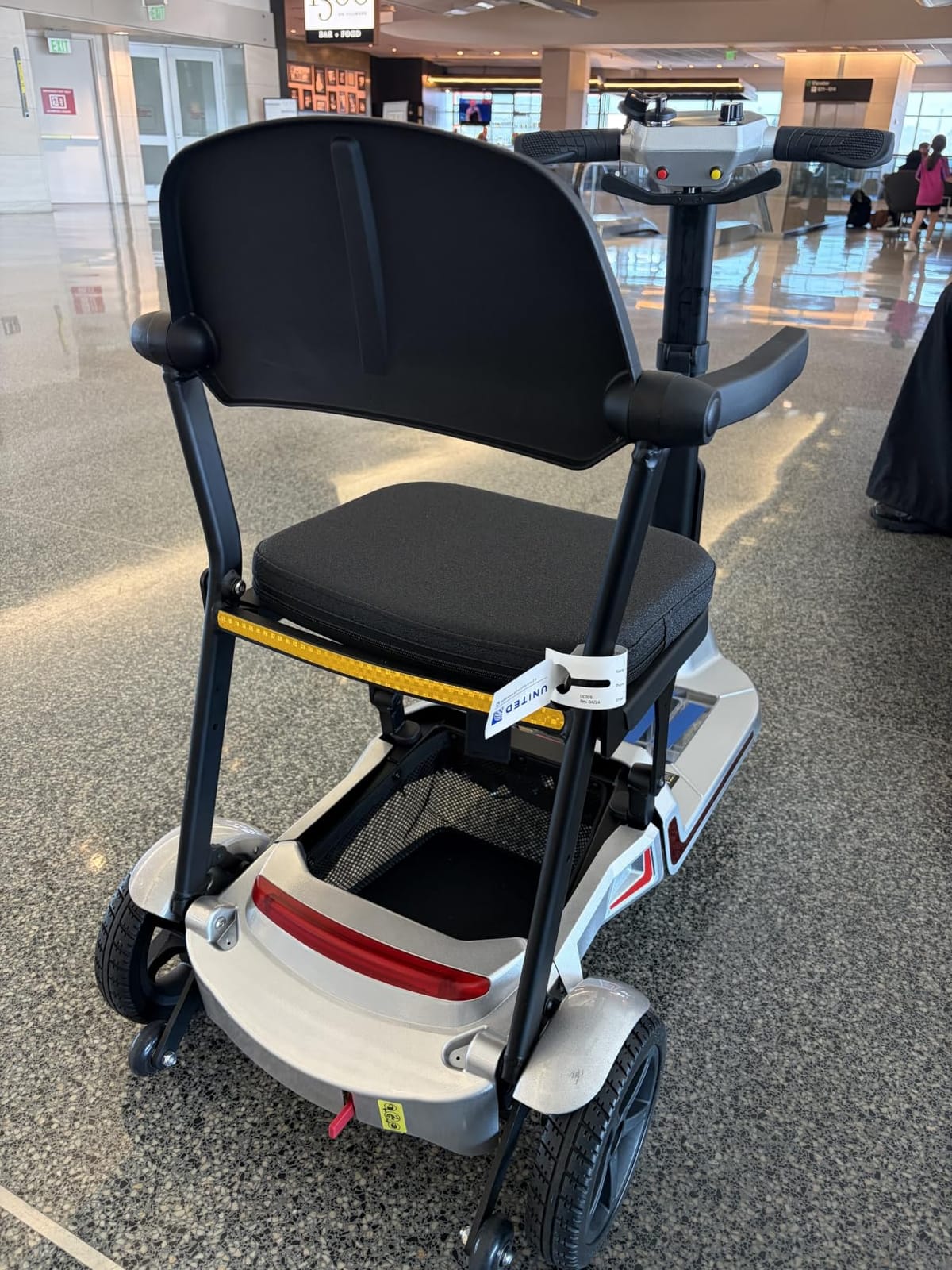
The Ecomobi M3 exists for one reason: the 33 inch turning radius. It turns essentially in place, which no four-wheeler here can do, and that single figure decides whether a scooter works in a small flat, a narrow hallway, or an elevator. Owners say exactly that in reviews, and the one-lift tool-free fold takes it down to 11.8 by 19.7 by 33.8 inches for a closet or a car boot.
It holds a 4.6 star average with an 86% five-star share across 221 reviews, the strongest five-star share in our set. The frame is 30 lbs without the seat and batteries, dual 8Ah batteries give up to 20 miles, and dual 12Ah batteries give up to 32 miles, with removable airline-friendly modules.
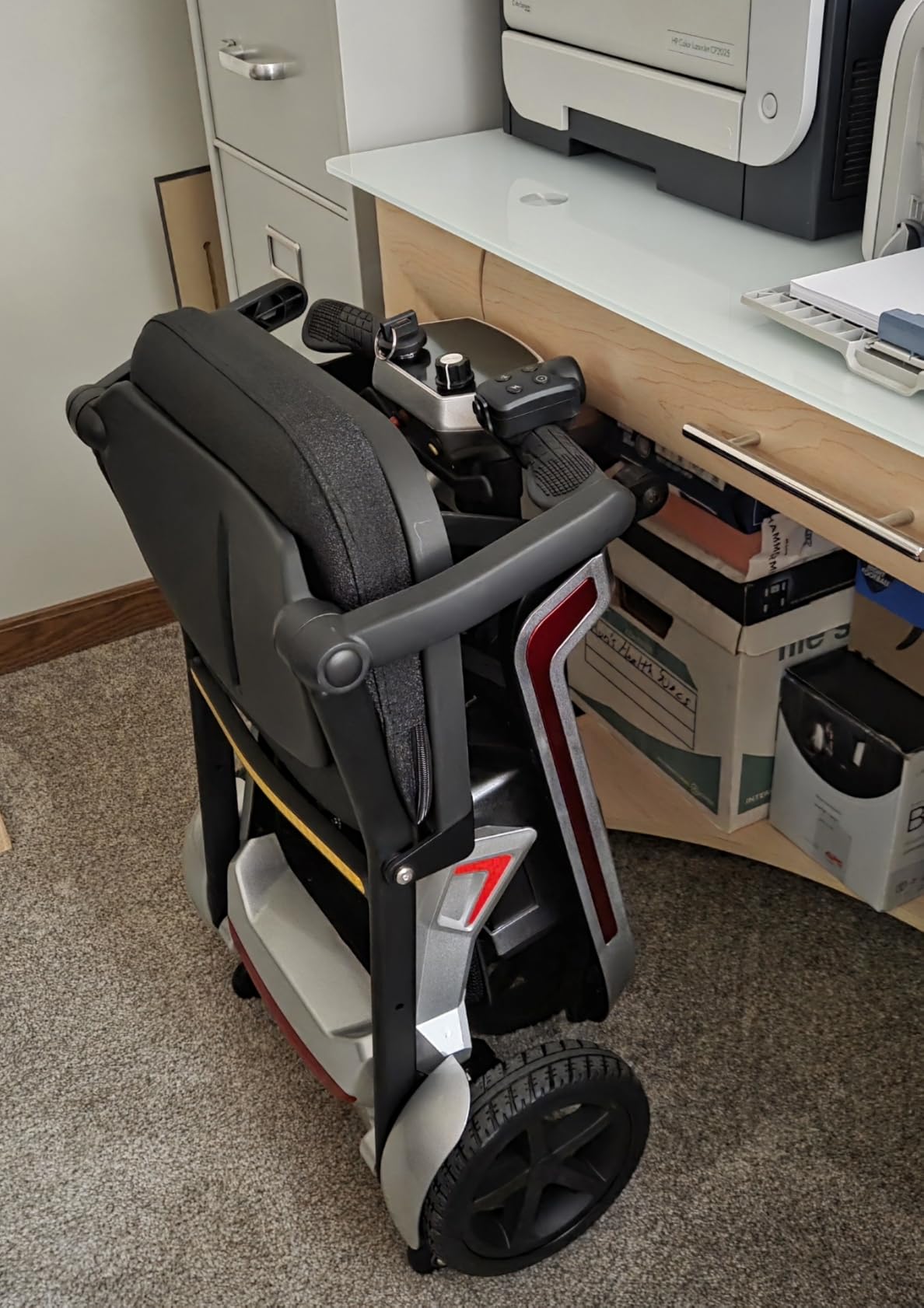
Ride quality is better than the ultralight category usually manages. The 8 inch wheels and 2 inch thick padded seat are larger and softer than most competitors, and there is an under-seat storage basket, a digital battery display, and an external GPS locator accessory. Rear anti-tip wheels, electromagnetic braking, and a rear tail light round out the safety hardware.
Be clear about what the 30 lb figure means. It is the frame only, and the seat and batteries add meaningful weight on top. The three-wheel layout needs more balance judgement on curbs and slopes than a four-wheeler, the rear anti-tip wheels add width behind the seat, and at about 5 mph this is slower than the all-terrain machines in the list.
Who the Ecomobi M3 suits
It suits a rider in a small apartment, a narrow hallway, or a home with a lift. It suits caregivers who can manage roughly 30 lbs plus the battery modules, which is a far more realistic load than an 80 lb four-wheeler. Riders who travel by air get removable lithium modules and a compact folded profile.
Where the Ecomobi M3 falls short
It falls short on terrain and on speed. Grass, gravel, and steep slopes are outside what a three-wheel frame with 8 inch solid wheels handles well. At around 5 mph, long open routes take time. Riders with significant balance concerns should treat the three-wheel layout as a real consideration rather than a small detail.
How to Choose a Seated Electric Scooter: 8 Criteria That Matter
1. Weight capacity against real body weight. Add the rider’s weight plus winter clothing and shoes, then buy the next capacity step up. Never ride at the published maximum. Several machines here are rated 300 lbs, and the AXADA’s standard rating is 262 lbs with 300 lbs as the tested maximum, which is a meaningful gap.
2. Heaviest single piece, not total weight. Ask the seller how many pieces the scooter breaks into and what the heaviest one weighs. The Rascal Venture is 125 lbs assembled but its heaviest piece is 34.5 lbs. The SuperHandy Passport is 35 lbs assembled with a 27 lb frame. That difference decides whether one person can load a car.
3. Turning radius for the smallest space you use. Measure the narrowest doorway, the hallway between rooms, and the lift. The Ecomobi’s 33 inch circle works in spaces where the Rascal’s 46.75 inch circle will not.
4. Range against the longest realistic day. Manufacturer range figures are laboratory conditions. Owners on Reddit ask specifically for honest range rather than brand claims, and our experience reading review blocks suggests treating the published number as a ceiling. Pick a battery that covers the longest day with margin, and check whether the battery detaches for off-board charging.
5. Tire type matched to ground. Solid tires need no maintenance and suit smooth indoor and pavement surfaces. Air-filled tires ride better on grass, gravel, and cobbles but need pressure checks. The PAISEEC’s 10 inch air tires are the most comfortable ride here for that reason.
6. Seat height, swivel, and armrests. A seat you cannot rotate makes getting on and off harder. So does a seat too low to push up from. Adjustable armrests give leverage for a transfer and support the forearms on longer rides.
7. Battery chemistry and travel. Lithium batteries are lighter and typically airline-permitted within watt-hour limits. Lead-acid packs are heavier and generally not permitted on aircraft, which is exactly why the AXADA cannot fly.
8. Safety and visibility hardware. Look for a working LED headlight, a rear brake light, reflectors, anti-tip wheels, and electromagnetic braking that engages when the control lever is released. Turn signals and mirrors appear only on the LAGTOM here, and they matter if the scooter is used near traffic.
Where you live also matters more than most buyers expect. Our wider guides to mobility scooters for seniors cover the DME buying route in more detail, including how suppliers document a purchase.
Getting On and Off the Seat Safely
This is the part that decides whether a seated scooter works at all, and it is where most spec sheets go quiet. The mechanics are simple: park level, switch off, set the brake, turn back to the side and look behind you, swing the seat or rotate it to face you, push down on the armrest to lower yourself, and swing back before moving. Practising that sequence ten times in an empty parking lot is worth more than any feature list.
Three design details change how hard the transfer is. Seat height is the biggest one: the Rascal’s 15 inch seat height is a workable transfer height for riders who cannot rise from a low chair. A swivel seat lets a rider approach from the side rather than backing into the seat, which is what the SKRT, AXADA, and Mbxcooter all offer. Armrests that flip up or adjust in width give you something to push against.
Two models here will not swivel at all. The PAISEEC S3 has a fixed, non-adjustable seat, which one buyer with limited knee mobility found unsuitable. The SuperHandy Passport swivels but its seat-to-handle distance does not adjust, so shorter riders lean forward. Fit is not a comfort preference in this category. It is the difference between independent transfers and needing help every time.
Who Should Skip a Two-Wheeled Moped-Style Seated Scooter
We did not include any two-wheeled seated scooter in this roundup, and that was deliberate. Riders on Reddit describe moped-style seated machines as fun and fast, and then immediately acknowledge the catch: they require core balance even at very slow speeds. That is a demand a three- or four-wheel scooter does not impose. The AI summaries that pull from those discussions land on the same conclusion.
Skip a two-wheeled seated scooter if the rider has balance concerns, arthritis that affects the hands or wrists, osteoporosis, Parkinson’s disease, or any condition where a wobble turns into a fall. Skip it if the rider cannot comfortably hold a throttle and brake lever for the length of a trip. Also skip it if the intended route includes kerbs, gravel, wet grass, or ramps, because a seated two-wheeler has no anti-tip wheels and no wide base to catch a mistake.
If a recreational seated scooter is genuinely wanted alongside a mobility scooter, treat it as a separate leisure purchase rather than a mobility aid, and check what licence or registration the local authority expects for that speed class. Speeds above the walking-pace band can cross into a different legal category entirely, which is why we would steer a senior toward the LAGTOM’s 1 to 4 mph range rather than its full 15 mph.
Paying for a Seated Scooter: Medicare, Medicaid and VA
Medicare Part B can cover a power-operated scooter, but only when it is prescribed as durable medical equipment and bought from a Medicare-approved supplier. Medicare covers 80% of the amount after the Part B deductible, and the beneficiary pays the remaining 20% coinsurance. Recreational seated e-scooters sold for general riding are not covered, because they are not prescribed as a mobility device.
The process runs in five steps. First, a doctor who is Medicare-enrolled evaluates the need and documents that the rider cannot walk safely without a device. Second, that doctor issues a written order specifying the scooter. Third, the order goes to a Medicare-approved DME supplier. Fourth, the supplier submits the claim, and prior authorization may be required. Fifth, the supplier delivers and sets up the scooter, and the beneficiary pays the 20% coinsurance.
Medicaid coverage varies by state and usually requires prior authorization plus a face-to-face appointment. Medicare Advantage plans follow their own rules inside Part B, and a Medigap policy can cover part of the 20% coinsurance. Veterans may qualify for mobility aids through the VA health system. For anyone comparing these routes, our guide to mobility scooters for seniors walks through the documentation a supplier typically asks for.
Frequently Asked Questions
Does Medicare pay for electric scooters for seniors?
Medicare Part B can pay for a power-operated scooter when a Medicare-enrolled doctor documents that the rider cannot walk safely, issues a written order, and the scooter is supplied by a Medicare-approved durable medical equipment supplier. Medicare covers 80% after the Part B deductible and the beneficiary pays the remaining 20% coinsurance. Recreational seated e-scooters bought for general riding are not covered.
What is the best-rated seated electric scooter?
The Rascal Venture 4-Wheel holds the highest rating in our roundup at 4.7 stars, and it is listed as an FDA Class II medical device with a three-year frame warranty. The best-rated choice for most families is the SuperHandy Passport at 4.2 stars across more than 1400 reviews, because 35 lbs assembled is light enough for one caregiver to load into a car.
Should I get a 3 or 4 wheel mobility scooter?
Choose four wheels if the route includes slopes, gravel, ramps, or uneven pavement, because the wider base stays stable on inclines and while you shift weight onto the seat. Choose three wheels if indoor space is the constraint: a 33 inch turning radius lets the scooter turn nearly in place, which four-wheel models cannot match. Riders on disability forums name three or four wheels as a safety requirement for mounting and dismounting.
How do I get on and off a mobility scooter safely?
Park on level ground, switch off, set the brake, turn back and check over your shoulder, then swing or rotate the seat to face you. Push down on the armrest as you lower yourself, and swing the seat back before moving. Practise the sequence in an empty area first. Seat height, a swivel mechanism, and adjustable armrests all make the transfer easier.
Can I take a mobility scooter on a plane?
It depends on the battery. Scooters with removable lithium-ion batteries that stay within airline watt-hour limits are generally accepted, and the batteries must be carried in the cabin rather than checked. Lead-acid batteries are not permitted on aircraft, which rules out some models entirely. Confirm with the airline before booking, and note the folded size of the scooter itself.
Conclusion
The best seated electric scooters for seniors come down to one honest question: who is doing the lifting. If a caregiver can handle about 30 lbs per piece, the SuperHandy Passport is the strongest all-round choice, because a 27 lb frame and two lightweight removable lithium batteries mean one person can load it and a 13 mile range covers a real day out. If nobody can lift that much, the honest answer is a scooter that is already where it is needed rather than one that has to be moved.
For riders above 300 lbs, the WAYCARE at 330 lbs or the LAGTOM at 500 lbs opens the field. For long days on rough ground, the Mbxcooter’s 45 mile option and the PAISEEC’s air tires are worth the extra weight. Whatever you choose, test the mounting and dismounting sequence before the money is spent, and check the heaviest single piece rather than the total weight. Measure the narrowest doorway in the house, buy one capacity step above the rider’s actual weight, and skip any two-wheeled seated scooter unless the rider has genuinely solid balance.