
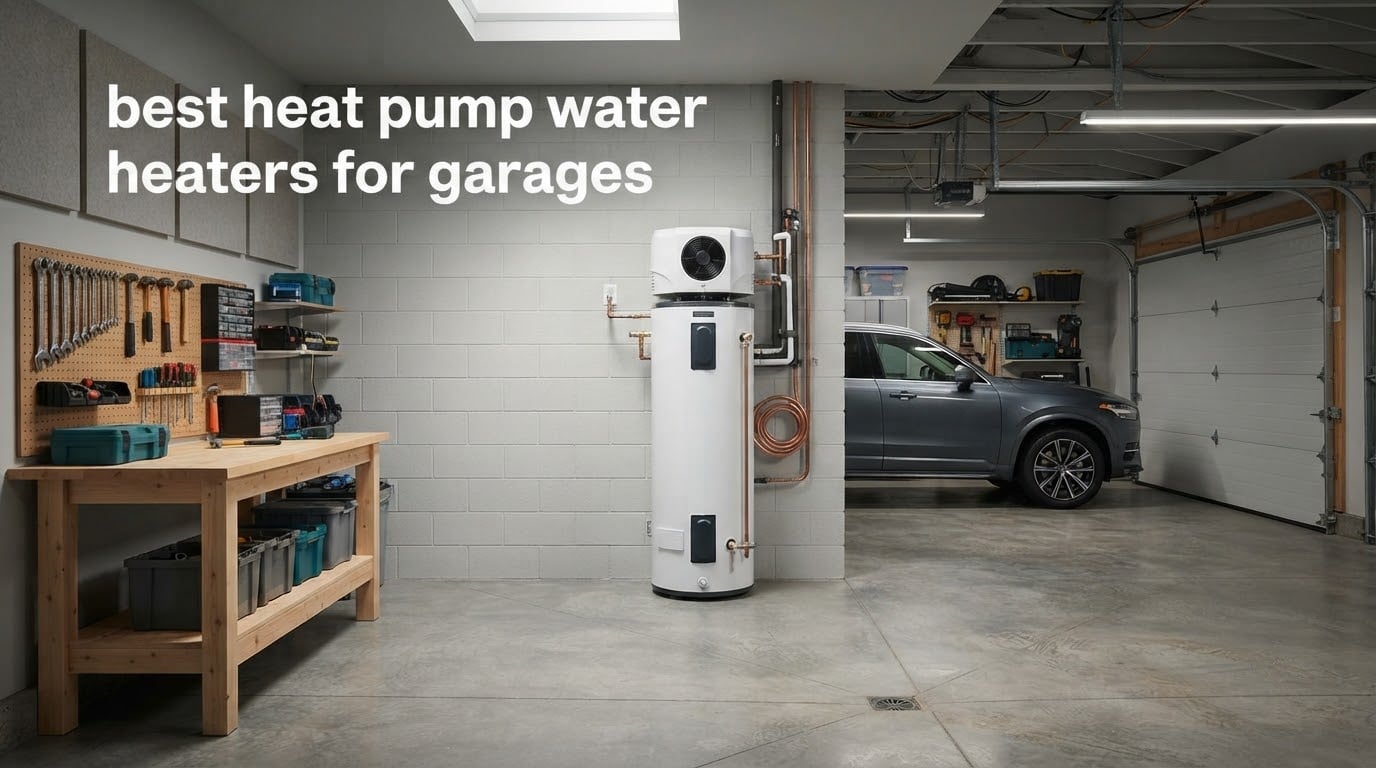
A heat pump water heater is the rare appliance that actually gets better the further you move it from the living space. A basement closet kills one with stale air and no room to breathe; a two-car garage gives it 700 to 1,000 cubic feet of ambient air to borrow heat from and a room where nobody will complain when the compressor kicks on at 6 a.m. That is the whole argument for the best heat pump water heaters for garages, and it is stronger than most people expect.
We spent weeks sorting through the current hybrid lineup, comparing published UEF ratings, first hour ratings, sound numbers, electrical demands, warranty terms and physical footprints, then matched each unit against the reality of a real garage: the winter temperature, the panel capacity, the floor drain or lack of one, and how much hot water a workshop sink actually consumes. Six units earned a place below. Nothing else in this category clears the bar honestly, and we would rather show you six real machines than pad the list with accessories.
The catch is that a garage is also where a heat pump water heater can fail most visibly. A compressor that sips 600 watts in July can fall back to 4,500 watts of resistance heat in January, and the difference between a great purchase and a disappointment is whether your garage stays above the manufacturer’s minimum temperature and whether the condensate has somewhere legal to go. We cover that honestly below, including which of these units we would skip.
If you are still deciding whether water heating is even the right problem to solve in your garage, our radiant heater guide for garages covers space heating separately, and our tankless water heater roundup covers the alternative you will be comparing against at checkout.
Can You Use a Heat Pump Water Heater in a Garage?
Yes, a heat pump water heater belongs in a garage more than almost any other room, provided four conditions are met. The garage must hold roughly 40°F or warmer through the coldest weeks, offer 700 to 1,000 cubic feet of free air around the unit, have a route for condensate to an approved drain, and have panel capacity for a dedicated 240-volt circuit. Miss the temperature floor and the unit drops to resistance heat all winter, and you bought an expensive electric tank.
That is why garages, basements and laundry rooms are the three locations manufacturers actually print on the spec sheet. Compared with a closet or a utility cabinet, a garage already satisfies the two hardest requirements: plenty of air volume and no conditioned living space to chill with the exhaust.
Garage Requirements at a Glance
These are the numbers that decide the purchase. Check all four before you start shopping, because each one can end the conversation or change which model you buy.
- Ambient temperature: 40°F to roughly 90°F year-round. Below 40°F the compressor cannot pull enough heat out of the air, and the unit drops into resistance mode. One model here explicitly states it must not go below 37°F.
- Air volume: 700 to 1,000 cubic feet of free air. A single-car garage is about the floor. Do not box the unit into an unvented cabinet.
- Electrical: a dedicated 240-volt circuit at 30 amps for most of these models, or 15 amps for the one listed below that draws far less.
- Noise: published ratings run 45 to 55 dBA, which reads like a quiet refrigerator in a hard-walled room rather than background silence.
- Condensate: a gravity drain to a floor drain or standpipe, or a small condensate pump if no gravity route exists.
- Code: 18 inches of clearance above the floor, a drain pan, a T&P relief valve, a dedicated shut-off, and a permit in most jurisdictions.
One more practical item: measure the ceiling. Several models in this roundup stand between 66 and 75 inches tall, and a finished garage with a low soffit or a parked vehicle can remove the headroom you assumed you had.
Top 3 Picks for Garage Hot Water in 2026
Three of the six stood out once we accounted for garage temperature, air volume and electrical reality rather than just spec sheet numbers.

Best Heat Pump Water Heaters for Garages in 2026
All six units below are true hybrid heat pump water heaters rated for indoor installation. We sorted them by how well the published specs match a garage rather than by price alone.
| Product | Specifications | Action |
|---|---|---|
| Senville 50 Gallon Hybrid |
|
Check Latest Price |
 ACiQ 50 Gallon Hybrid ACiQ 50 Gallon Hybrid |
|
Check Latest Price |
 Rinnai REHP50 50 Gallon Rinnai REHP50 50 Gallon |
|
Check Latest Price |
 Rinnai REHP65 65 Gallon Rinnai REHP65 65 Gallon |
|
Check Latest Price |
 Rinnai REHP80 80 Gallon Rinnai REHP80 80 Gallon |
|
Check Latest Price |
 Stiebel Eltron Accelera 220 E Stiebel Eltron Accelera 220 E |
|
Check Latest Price |
1. Senville 50 Gallon Hybrid Heat Pump Water Heater — The Best All-Rounder
Senville Hybrid Heat Pump Electric Water Heater, Energy Star, 50 Gallon
- Hybrid mode cuts power use by up to 70 percent
- Micro-channel coil wraps the full tank
- Quiet enough to compare to a refrigerator
- 7 yr parts and 10 yr compressor warranty
- 69 gallon first hour rating covers a 3-5 person home
- Weighs 218 lb and needs two installers
- Panel controls need clearer documentation
- Only 3 customer reviews so far
This is the unit we would put in our own garage. The spec sheet is unremarkable in the way a good spec sheet should be: a 50-gallon tank, 3.75 UEF, a 69-gallon first hour rating, and a micro-channel coil wrapped around the entire tank rather than a small cold spot at the bottom. Full-tank coil coverage is the detail that shows up three years in, when a cheaper evaporator has left the bottom of that tank doing all the work.
The published efficiency claim is a 70 percent reduction in electricity versus a standard electric water heater. In a garage that stays above 40°F, that number is realistic rather than a brochure claim, because the compressor has real ambient air to work with instead of a dead closet. The 4.5 kW rating also means the backup resistance elements are sized sensibly for high-demand moments.
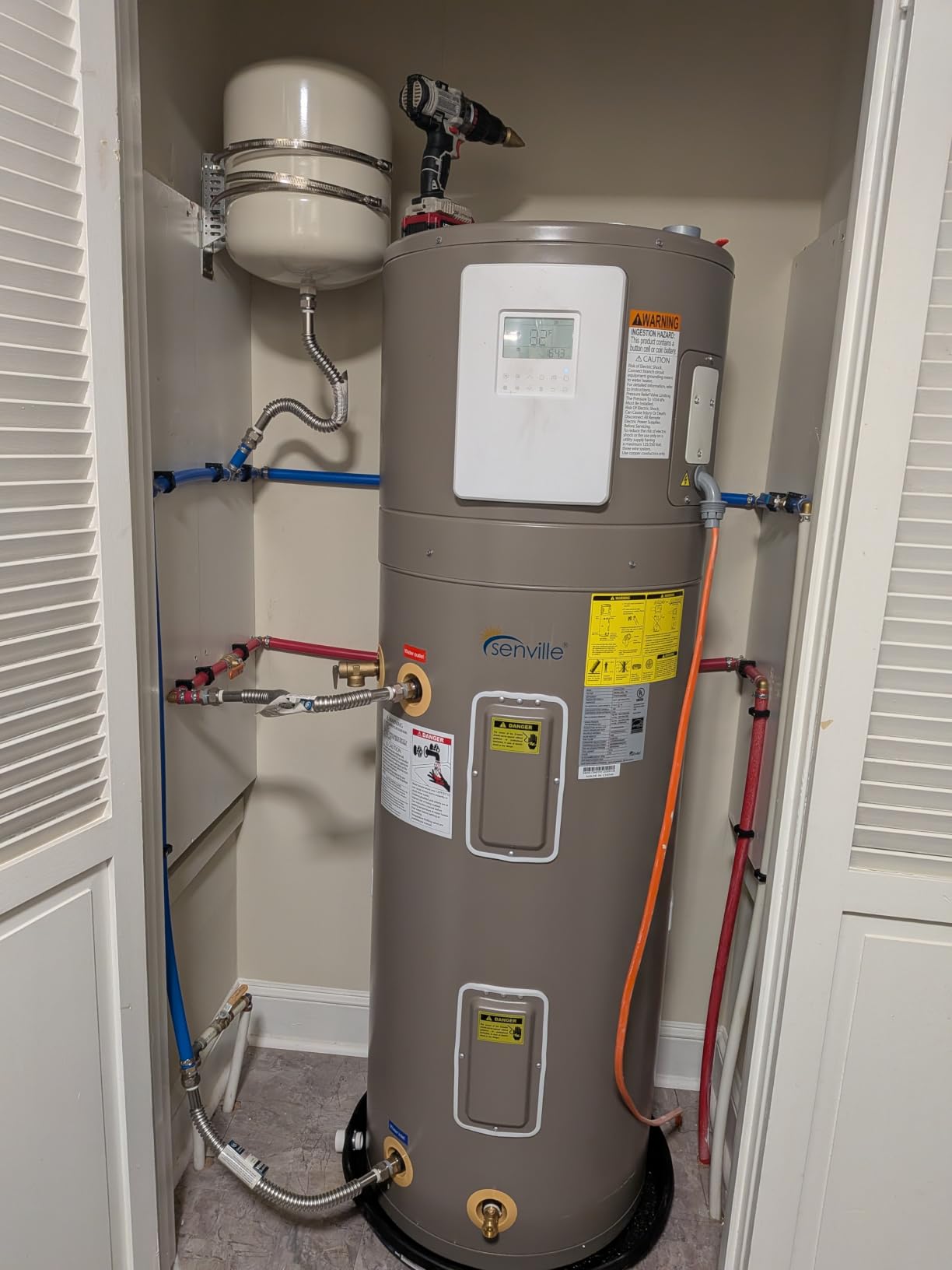
All three customer reviews rate it five stars, which is a small sample and we treat it as such. What those owners agree on is build quality: one professional installer noted superior heat pump and tank construction compared with the units they had been installing for years. That single data point is worth more to me than a hundred reviews saying the box arrived on time.
Two things give me pause. At 218 pounds it is not a two-person lift with one hand on each handle on a short move, and the panel controls needed explanation that reviewers did not feel the manual provided. Neither is a dealbreaker, but both belong in your planning.
Where the Senville Fits in a Garage
This is the pick for a typical attached or detached one-car garage in a moderate climate, feeding a utility sink, a wash bay, or a small ADU. The 50-gallon tank with a 69-gallon first hour rating covers three to five people without hitting the backup elements for anything shorter than a handful of consecutive long showers.
Its single micro-channel coil wrapped around the whole tank also means faster and more even recovery than units with a small bottom-mounted evaporator, which matters in a garage where you may be running a hose, a floor sweeper and a sink at once.
Where the Senville Falls Short
If your garage regularly sits below 40°F with no heat, the efficiency advantage largely evaporates and this becomes an expensive electric tank. Log your coldest-week temperature before ordering, because that single number decides whether this purchase makes sense.
The warranty split is also worth reading closely: seven years on parts and ten on the compressor. That is respectable, but it is not the twelve-year tank coverage the ACiQ offers with registration, so it is not the pick for someone buying purely on warranty length.
2. ACiQ 50 Gallon Hybrid Heat Pump Water Heater — Best for a Working Garage
- 1-ton compressor beats quarter-ton rivals on recovery
- Heat pump only mode runs 600-800 watts
- 49.5 dB(A) suits a workbench wall
- WiFi plus utility demand response built in
- 12 yr tank and parts warranty with registration
- Extremely heavy with only two handholds
- Plumbing connections sit in non-standard positions
- Needs a new condensate line at install
- Tech support reported as unresponsive
The reason this one earned its spot is simple: the compressor is a full ton, not a quarter ton. In a hybrid water heater the compressor size directly sets recovery speed, and owners reviewing this unit specifically note faster recovery than units using smaller compressors. In a garage workshop, where hot water demand is bursty and unpredictable, recovery speed matters more than it does in a whole-home basement.
It is also the only unit here with a published noise figure that suits a workspace: 49.5 dB(A), described by reviewers as ultra-quiet. If your bench sits against the same wall as the heater, that number is the one to buy on. The unit also carries WiFi and utility demand response, so you can shift the compressor off peak hours from a phone.
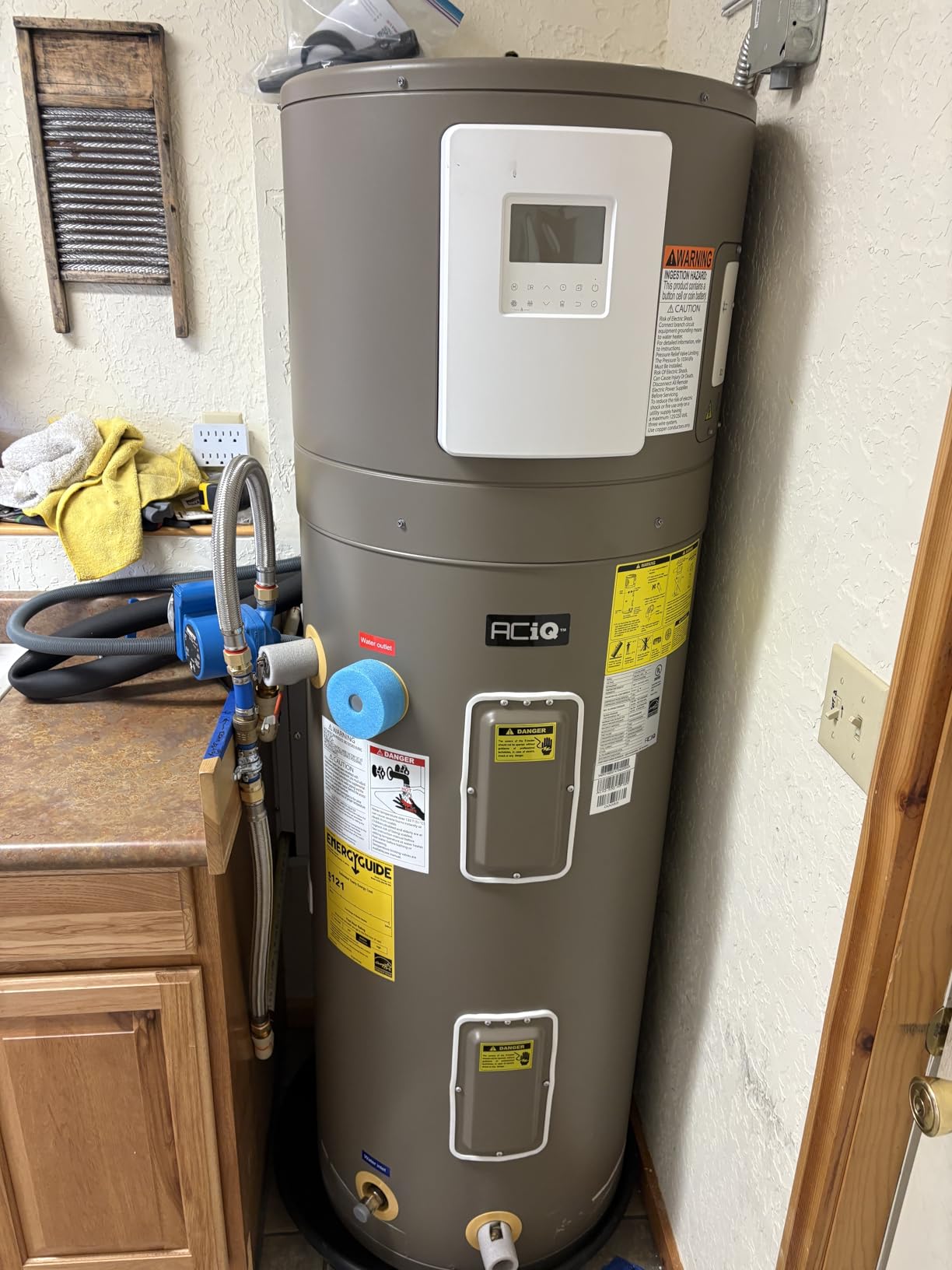
The manufacturer states the air volume requirement directly at 700 to 1,000 cubic feet and names garages and basements as ideal locations. That is the most honest spec sheet in this roundup, including the warning against unheated spaces below 37°F. It also caps tank temperature at 149°F.
Now the part that gives me hesitation. The six reviews average 3.9 stars, and the critical ones are specific and serious: extreme weight with only two handholds provided, plumbing connections in different locations than a conventional heater expects, and tech support described as effectively absent. One reviewer also flagged that the demand response feature can cause unexpected shutdowns during peak grid events, which in a workshop means a cold hose with no warning.
Why the ACiQ Works in a Busy Garage
The 600 to 800 watt draw in heat pump only mode versus roughly 4,000 watts for a conventional electric element is the number that pays the bills. If your garage stays warm, that mode can carry most of your hot water load for a fraction of the energy.
For a working garage with frequent short bursts rather than long household showers, the one-ton compressor is a genuine advantage. A large shop sink, a pressure washer and a utility sink rarely run at once for long, which plays to fast recovery rather than high total volume.
Why You Might Pass on the ACiQ
The lifting design is the biggest red flag. Reviewers describe needing three strong people, and only two handholds on a tank that heavy is a real ergonomic problem on a stair or over a curb. Plan for a crew or a mechanical aid, not a two-person carry.
The non-standard plumbing connection locations will also stretch a simple replacement job into a rework, and the reported lack of support is a real risk on a brand with few installed units in the field. If you are comfortable calling a technician when something stops working, fine. If you would rather have a brand with deep service coverage, look at the Rinnai models below.
3. Rinnai REHP50 50 Gallon Heat Pump Water Heater — Best for Tight Spaces
Rinnai REHP50 Electric Heat Pump Water Heater 50 Gallon Energy Star
- 73 gallon first hour delivery
- Zero clearance on top
- back and sides
- 10 yr tank and parts warranty
- Demand response enabled
- Standard 3/4 inch MNPT connections
- Only one customer review available
- 240V 30A circuit may need panel work
- Zero clearance does not remove the 18 in floor standoff
The Rinnai REHP platform solves a garage problem that most spec sheets ignore: air. All three REHP models require zero clearance on top, back and sides, which means you can put the unit against three walls, in a corner, or beside a stud bay, and still feed it the ambient air it needs. In a garage with a sloped ceiling, an attic space above, or a wall shared with storage, that flexibility is worth more than any app feature.
The numbers are solid. A 3.75 UEF with a 73-gallon first hour rating is more first-hour output than the other 50-gallon units in this roundup, which is a genuine advantage for a garage supplying more than one fixture. The glass-lined steel tank, UL and NSF certification, and a ten-year residential warranty on tank and parts give you the strongest coverage of the Senville and ACiQ units at this size.
It also carries R134a refrigerant and standard 3/4 inch MNPT inlet and outlet connections, so a plumber who has worked on water heaters for twenty years will not be guessing at the hookups. Demand response is enabled, so participating utilities can shift your compressor during peak pricing windows.
Why the REHP50 Suits a Garage
Zero clearance is the headline. In a finished garage with limited wall run or a low soffit, the REHP50 can go where a unit requiring 12 to 18 inches of service air on every side cannot. That single spec often decides the install.
The 73-gallon first hour rating also covers three to four people, which is the right band for a garage feeding a workshop sink plus a utility sink, or for an ADU conversion. The 22 by 66.81 inch footprint is compact for a 50-gallon hybrid.
Why the REHP50 Is Not the Winner
Only one customer review exists, and it is a single five-star report from a Florida owner who switched from gas and saw no meaningful rise in electricity use. That is encouraging for a warm-climate garage and tells you nothing about a cold one, or about a ten-year lifespan.
Operation is 240 volts at 30 amps, which is the same dedicated circuit requirement that trips up most DIY garage conversions. Verify your panel has a spare slot and two free breaker positions before this unit goes on the truck.
4. Rinnai REHP65 65 Gallon Heat Pump Water Heater — Best for High Demand
- 4.00 UEF is the highest efficiency here
- 80 gallon first hour delivery
- Same zero clearance platform as the 50 gallon model
- 10 yr tank and parts warranty
- Demand response enabled
- Only one customer review available
- Weighs 250 lb for a larger move
- Taller body needs more vertical clearance
- 240V 30A circuit may need panel work
When we looked across every published UEF in this roundup, the REHP65 came out on top at 4.00. That is not a rounding artifact. A higher UEF means fewer kilowatt-hours per hot gallon across the standardized test cycle, which translates directly into a lower bill in a garage that stays in the compressor’s comfort zone all year.
The 80-gallon first hour delivery is the number that matters for a garage supplying more than one demand point. Compare it to the 69-gallon figures on both 50-gallon units here: you get roughly eleven more gallons of hot water inside the first hour without triggering the resistance backup. For a shop that runs a hose, a sink and a pressure washer in the same hour, that margin removes the most common complaint about hybrid heaters.
Everything else carries over from the REHP50: zero clearance on top, back and sides, R134a refrigerant, 3/4 inch MNPT connections, demand response, and a ten-year residential warranty on tank and parts with one year on labor. The trade is size. At 250 pounds and 65 inches tall, this is a bigger move and a bigger footprint.
Why the REHP65 Earns Its Place
It is the efficiency leader and the first-hour leader at the same time, which is unusual. Most units trade one for the other, and in a garage where wasted standby heat goes straight into the room you are trying to keep cool, a high UEF is doubly valuable.
If your garage is being converted into an ADU or a studio with a shower, 65 gallons with an 80-gallon first hour rating is the correct starting point. The zero clearance design keeps it installable against a wall even in a converted space with no service air to spare.
Why You Might Step Down to the REHP50
The single review means the same caveat applies here as on the 50-gallon model: real-world long-term data is essentially absent. Judge the platform, not the review count.
If you are feeding one workshop sink and a hose bib, 65 gallons may be more water than you ever draw in an hour, and the extra 38 pounds and extra inches of height are real installation friction. Match the tank to demand rather than to maximum capacity; a bigger tank in a marginal-temperature garage just takes longer to recover.
5. Rinnai REHP80 80 Gallon Heat Pump Water Heater — Best for Full-House Backup Duty
Rinnai REHP80 Electric Heat Pump Water Heater 80 Gallon Energy Star
- Largest capacity in this roundup at 80 gallons
- 91 gallon first hour delivery
- 3.90 UEF ENERGY STAR certified
- 10 yr tank and parts warranty
- Zero clearance on top
- back and sides
- Only 2 reviews and they split sharply
- At 270 lb it takes a small crew to move
- Stands 74.56 in tall which many low ceilings cannot take
- First hour figure differs between listing text and spec sheet
The REHP80 is here for the garage that is really a whole mechanical room. At 80 gallons it is the largest tank we covered, and its first hour delivery is listed at 91 gallons, which puts it in whole-home territory rather than shop-sink territory. If your garage supplies a family of five plus a utility sink, this is the only unit in the roundup sized for that without dropping to resistance heat.
Efficiency holds up at 3.90 UEF, ENERGY STAR certified, on the same zero-clearance platform as the two smaller REHP models. It also carries demand response, so it can participate in utility load-shifting programs that reward running the compressor when electricity is cheap.
We want to be straight about the reviews here. Two reviews, and they are polarized: one five-star and one one-star, which is why the average sits at 3. You should treat that rating as an absence of information rather than as a verdict in either direction. There is not enough owner history on this listing to tell you how it performs over a decade.
Why the REHP80 Works
91 gallons in the first hour is the recovery figure that makes hybrid mode viable for a full household, because resistance elements do not have to carry the peak. In a garage that also dehumidifies the space through its exhaust air, a high-volume tank that recovers fast is the configuration that pays off.
Its 3.90 UEF keeps operating cost reasonable even at that volume, and the ten-year tank and parts warranty is the strongest coverage available at this capacity in this roundup.
Why This Is the One We Would Reconsider
Physical fit is the obstacle. At 74.56 inches tall it is the tallest unit here, and it weighs 270 pounds. A garage with a vehicle lift, a low beam, or a sloped ceiling simply cannot host it, no matter how well the numbers look on paper.
The first hour delivery is also listed inconsistently between 91 gallons in the description and 80 gallons in the spec sheet. That discrepancy is exactly the kind of thing to confirm with the manufacturer before you commit. And in most garages, 80 gallons is overbuilt: it is the right answer for a home-scale demand and the wrong answer for a workshop.
6. Stiebel Eltron Accelera 220 E — Best for a Weak Electrical Panel
- Runs on a 15 amp breaker instead of 30 amps
- 324 CFM airflow moves a lot of garage air
- Digital display with a 42 to 108F range
- Rolling piston compressor motor
- Aluminum condenser never contacts potable water
- One 1-star review reports a tank leak within two years
- That reviewer says warranty claims went unanswered
- 1700W heat output is well below the other units here
- UEF is not published in the available data
This is the only unit in the roundup that solves a genuine electrical blocker. Where every other machine asks for a 30-amp dedicated 240-volt circuit, the Accelera 220 E runs on a 15-amp breaker. For an older garage with a subpanel, a converted workshop, or a property where panel capacity is the deciding constraint, that single spec can be the whole decision.
The airflow figure is impressive on paper too. At 324 CFM it moves a substantial volume of air through the coil, which is what a heat pump water heater needs to harvest heat rather than recirculate warmed air back on itself. The unit carries a heavy-duty quiet fan and a rolling piston compressor motor, both aimed at the noise complaints that come with installing one of these in a work room.
The tank is glass-lined, the condenser is a large wrap-around aluminum unit with no direct contact with potable water, and the operating range is 42 to 108°F on a digital display. That 42°F floor is the highest minimum in the roundup, which makes it a poor fit for a genuinely cold garage.
Why the Accelera Is Still Worth a Look
The 15-amp circuit requirement is unmatched here. If your electrical service cannot absorb a 30-amp load without a panel or subpanel change, this is the unit that installs, and the other five become expensive paperweights until the electrician visits.
Its temperature floor of 42°F also makes it a reasonable match for a warm attached garage or an insulated shop rather than a cold detached one. Owners across builder forums frequently single out Stiebel Eltron for warranty quality and a lifetime powered anode, which is a meaningful contrast with the single review listed here.
Why We Are Not Recommending It Without a Caveat
The listing carries one review, and it is one star. That owner reports a slow leak on the underside of the tank within two years and says the company did not respond to the warranty claim. One review is a thin sample, but it is the only signal this listing offers, and it points the wrong way.
At 1700 watts of heat output, this unit also produces far less backup heat than the 4.5 kW and 5.5 kW resistance elements on the other machines here. In a garage that drops below 42°F, that is the wrong trade. Treat this as a targeted answer for a panel-capacity problem, not a general recommendation.
What Is the Downside of a Heat Pump Water Heater in a Garage?
The honest answer has five parts, and the first one matters more than the rest.
- Resistance mode erases the savings in a cold garage. Below the manufacturer’s minimum ambient temperature the compressor shuts down and the resistance elements run the whole job. Owners in unheated garages describe exactly this outcome: the efficiency promise disappears in the months it was supposed to matter most. Check your coldest-week temperature first.
- Condensate needs a drain you may not have. A heat pump water heater produces real water from the garage air. Most garages have a floor drain in the wrong place, which turns into a condensate pump line item and a freeze risk if the line runs through unheated space.
- Noise on hard walls. Published 45 to 55 dBA ratings sound quiet in a spec sheet and audible on drywall and concrete. A compressor cycle at startup is the loudest moment, and in a garage you may be standing three feet away.
- Panel capacity. A dedicated 240-volt, 30-amp circuit may mean a new breaker slot, a subpanel, or in a gas-to-electric conversion a service upgrade. That electrical work is frequently the largest single line in a garage installation.
- Exhaust air goes somewhere. The cool, dry discharge air is a genuine bonus in a garage, but if the unit sits near a doorway into conditioned living space it can pull that cool air indoors. Installers describe the effect as a mild draft near a wall thermostat.
None of these are dealbreakers. They are the questions to answer before the purchase, and the answers change which model belongs in your garage.
How Big a Tank Does a Garage Actually Need?
Most garages do not need a 65 or 80 gallon tank. A workshop sink, a hose bib and a utility sink running together draw far less water than a household showering routine, and matching capacity to real demand speeds recovery and lowers cost.
Use the first hour rating rather than the tank size. FHR is the number of gallons of hot water delivered in the first hour at the manufacturer’s set conditions, and it captures recovery speed as well as volume. The 50-gallon units in this roundup deliver 69 to 73 gallons in the first hour, which comfortably covers three to five people. The REHP65 delivers 80 and the REHP80 lists 91.
As a rough guide: one sink and a hose bib is a 50-gallon job. A shop with a pressure washer or floor sweeper alongside a sink moves you toward 65 gallons. A garage converted into an ADU or studio with a shower is a whole-home demand, and the 80-gallon unit is the only one here sized for it.
Bigger is not better in a marginal-temperature garage. A larger tank in a cold space takes longer to reheat, so it spends more time in resistance mode and costs more to run. If your garage is borderline on temperature, correct the temperature before you buy a bigger tank.
Noise, Airflow and Condensate in a Garage
Three physical realities decide whether an installation is pleasant or an argument with yourself.
Noise. The published figure that matters is the dBA rating, and only one unit in this roundup prints one: 49.5 dB(A) on the ACiQ. Most manufacturers describe their units as comparable to a refrigerator, which is the right mental model for a compressor cycle. Installers call the loudest moment the megaphone effect, where a startup in a bare drywall garage projects further than the rating suggests. Position the unit away from a workbench if you can.
Air volume. The stated requirement of 700 to 1,000 cubic feet is roughly a single-car garage with the door open to the rest of the space. That is why the zero-clearance REHP models are so useful: they can sit against a wall and still draw enough air. What they cannot do is sit inside a sealed, unvented cabinet, which starves the compressor of the very heat it was installed to collect.
Condensate. The drain water comes off the evaporator coil and needs a legal route. If you have a floor drain below the unit, gravity is the simple answer. If not, a standpipe or a small condensate pump handles it, and the line needs to be insulated if it passes through an unheated crawlspace or attic where it could freeze. Routed properly, the exhaust air leaves the room slightly cooler and drier, which is the free dehumidification bonus owners mention in summer.
For the wider efficiency picture, our heat pump water heater energy savings guide covers UEF in more depth than a garage roundup can.
Garage Water Heater Code Checklist
Water heaters in garages are permitted and common, but the code is specific about how they are installed. Walk this list before the installer arrives, because moving a unit after the fact means redoing pan, strapping and the standoff.
- 18-inch standoff. The ignition source of a garage water heater must sit at least 18 inches above the floor, which usually means a raised platform or a wall-mounted unit.
- Bottom board. Many jurisdictions require an approved bottom board under the tank on anything above a concrete slab.
- Drain pan. A pan with a visible drain termination catches a slow leak before it becomes water damage.
- T&P relief valve. The temperature and pressure relief valve must be installed on the hot outlet with a discharge pipe routed to a visible, safe location.
- Dedicated shut-off valve. A cold-water shut-off within reach of the unit, plus a discharge pipe where the code requires one.
- Dedicated circuit. 240 volts at 30 amps for most of these units, on 8-gauge copper, sized to 125 percent of the expected load.
- GFCI protection. A GFCI breaker in the panel or at the unit, which is the standard safeguard for any water-adjacent equipment in a garage.
- Disconnect switch. A means of disconnecting the unit without walking to the main panel.
- Seismic strapping. Required in a number of seismic regions, and worth adding elsewhere because an unstrapped tank is heavy enough to be dangerous.
- Permit and inspection. Most jurisdictions require one for a new appliance circuit, and the electrical and plumbing work are inspected separately.
Your local authority having jurisdiction writes the final word. Where this list and your local code differ, the local code governs.
Heat Pump Water Heater Installation Checklist for Garages
Before the unit ships, run through this sequence. Each step is cheap to do early and expensive to do late.
- Log your coldest-week garage temperature. Put a cheap thermometer in the garage through February. If it reads below 40°F, the compressor will not run when you need it most, and no amount of tank size fixes that.
- Measure the air volume. Length times width times height of the garage, and confirm it clears 700 to 1,000 cubic feet with the door open.
- Check headroom and footprint. Units here run from 60 to 75 inches tall. Measure the ceiling height where the tank will stand, and leave room above for service.
- Confirm the electrical plan. A dedicated 240-volt, 30-amp circuit, a spare breaker slot, and two free positions in the panel. If that fails, ask an electrician for a subpanel quote before you order.
- Plan the condensate route. Decide now between a gravity drain, a standpipe, and a pump, and insulate any line running through unheated space.
- Locate the T&P discharge and the drain pan outlet. Both need visible, safe termination points, not a hidden void.
- Confirm the permit path. Find out who pulls the permit and what the inspection covers in your jurisdiction.
- Arrange the move. These tanks weigh between 212 and 270 pounds. Get a crew or a mechanical aid rather than improvising on delivery day.
If you are weighing a heat pump water heater against a tankless unit for a garage, our tankless water heater roundup covers that comparison, and if the garage itself is too cold, our shop heater guide addresses space heating separately.
Frequently Asked Questions
Can I use a heat pump water heater in my garage?
Yes. A garage is one of the best locations for a hybrid heat pump water heater because it offers 700 to 1,000 cubic feet of ambient air and no conditioned living space to chill with the cool exhaust. The unit needs to stay above about 40F in winter, have a condensate route to an approved drain, sit on a dedicated 240V circuit, and meet local garage code including an 18-inch floor standoff and drain pan.
How cold can a garage be for a heat pump water heater?
Roughly 40F is the practical floor for most hybrid units. Below their minimum ambient temperature the compressor cannot extract enough heat from the air and the resistance elements take over, which removes the efficiency advantage entirely. The ACiQ in this roundup states it must not be installed in unheated spaces below 37F, and the Stiebel Eltron lists a 42F minimum operating temperature. Log your coldest-week garage temperature before buying.
Does a heat pump water heater need a 240 volt circuit?
Most of them do. The units in this roundup except one specify 240V at 30 amps on a dedicated circuit with 8-gauge copper, sized to 125 percent of the expected load, plus GFCI protection. The Stiebel Eltron Accelera 220 E runs on a 15-amp breaker at the same 240 volts, which makes it the option when your panel cannot absorb a 30-amp load without a subpanel or service change.
Where should the condensate from a heat pump water heater go?
To a floor drain, a standpipe, or a condensate pump discharge, depending on what your garage offers. Gravity drainage to a floor drain below the unit is the simplest route. Where no gravity path exists, a small pump handles the water, and any line running through a crawlspace or attic should be insulated so it cannot freeze. Reroute it before install rather than after.
What is the downside of a heat pump water heater in a garage?
The main drawback is resistance mode. In a garage that drops below about 40F, the compressor shuts down and the standard resistance elements heat the water, erasing the energy savings in exactly the months you expected them. Secondary issues are compressor noise on hard garage walls, condensate needing a drain route that most garages lack, and the panel work required for a dedicated 240V circuit.
Who makes the most reliable heat pump water heaters?
Reliability conversation in builder forums centers on Stiebel Eltron, Bradford White, A. O. Smith and Rheem, and owners frequently single out Stiebel Eltron’s warranty support and lifetime powered anode rod. In this roundup the published warranty terms favor the Rinnai REHP platform at ten years on tank and parts, and the ACiQ at twelve years with online registration. Ask your installer which brands have working service coverage in your area before choosing.
What size water heater do I need for a garage?
For a workshop sink plus a hose bib, a 50-gallon tank is enough, and the units here deliver 69 to 73 gallons in the first hour. A shop running a pressure washer or floor sweeper alongside a sink is better served by 65 gallons with an 80-gallon first hour rating. Only a garage converted into an ADU or studio with a shower needs the 80-gallon model. Judge capacity by the first hour rating, not by tank size.
Final Verdict
The Senville 50 Gallon Hybrid is our pick among the best heat pump water heaters for garages in 2026. A 3.75 UEF rating, a full-tank micro-channel coil, a seven-year parts warranty and a price point that leaves room in the installation budget make it the most complete package we found. The ACiQ takes the honors for a working shop where recovery speed and a published 49.5 dB(A) rating matter more than warranty length. The Rinnai REHP50 is the answer when wall space is tight, and the REHP65 is the one to buy if you want the highest UEF and first hour rating in the group.
Before any of them, check two things: your coldest-week garage temperature and your electrical panel. A garage below 40°F turns any of these into an expensive electric tank, and a panel without a spare 30-amp slot turns the purchase into an electrician’s project.